It has taken me a long time — years — to allow myself to feel feminine. This is not to imply that all women need to be feminine — far from it — but I’ve always been drawn to fashion, accessories, and ‘dressing up’. So the idea of the feminine has always appealed to me.
However. For most of my adult life I have worn somber colours — blacks, greys, browns. I have steered clear of anything bright, or patterned. I have steered clear of anything overtly feminine, except in small ways.
It almost goes without saying — now that you are here, and you know this blog is generally about Child Sexual Abuse — that I have been careful most of my adult life never to wear anything which might be considered ‘too feminine’ (read: ‘revealing’), either.
I have been afraid, all my life, of attracting unwanted attention from men. And because the ‘attention’ I got from my father didn’t make sense, and felt out of control — I thought ALL men were like this. Liable to put their hands on me. That I was liable to ‘make’ men ‘lose control’. Logically I knew this didn’t make sense — but it was what my experiences as a child, and then as a young adult survivor, told me: men only wanted one thing, and if I don’t ‘give’ it to them, I better be careful.
In my last post I mentioned that I’ve been fortunate enough to be working with other survivor/activists and with academics at the University of Bristol Dental School, developing ideas for increased access to and trauma-informed care in dentistry for CSA survivors. The experience has been eye-opening in lots of ways, and hugely empowering. It has been a gift to sit with others who get it, and who want to make a difference.
In the first workshop, we were asked to draw ourselves as a plant that had everything we needed. I am VERY far from an artist, but I instantly knew what plant I’d be: a pink clematis, climbing up the warm brick wall of my grandparents’ house, supported and loved and feeling beautiful. This is what I drew:
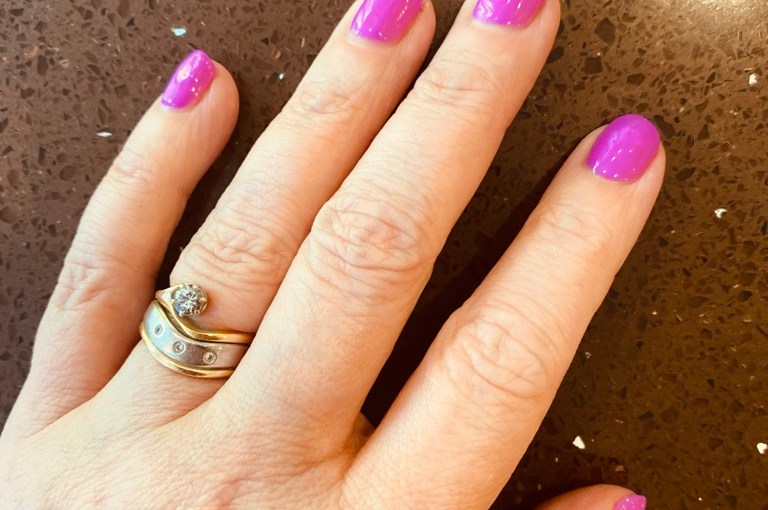
Notice that the flowers are PINK. I was surprised I drew this — pink? I don’t really do pink. And yet, I thought again: in the last year, I have purchased a mauve pink top, and just recently, a bright pink cardigan. And a few weeks ago — I went for the bright pink nails heading this post.
There’s another reason femininity — and specifically pink — have made me wary in the past. Because I associate pink with the body. With orifices, with genitals, and with danger.
But NOW! Something in me has been able to reclaim pink. Enjoy it. Revel in it. Pink is lovely. It’s not dangerous. It’s not attention-getting. It’s not about sex.
As for revealing clothing: this too seems to have turned a corner for me recently. I haven’t worn a real bikini except in front of my nuclear family in decades; revealing skin has up til now made me very, very nervous.
But NOW! For the first time I can remember I’ve got up the nerve to purchase a bikini for wearing when we go away in late August. I WANT to be like other women and not worry about it. Not be ashamed. With empowerment and understanding, I’m more settled in all aspects of my body and my femininity than I ever thought possible.
Next up: pink bikini?! Hmmm.
This extract from LEARNING TO SURVIVE captures some of what it’s like to feel disassociated from my body, constantly observed, and fantasised into a ‘relationship’. Which I hated.
***
just looking
The next summer, I end up in Blacksburg. I am keen to spend time with Alice and her new college friends, and have no trouble getting another restaurant job with evening shifts. I have the days to myself, and stay out of the house as much as I can; Alice and I go to a pool every day to swim, sunbathe, and drink margaritas. On my nights off, I go to the clubs, having several probably quite dangerous sexual encounters with strangers. There is also a woman I work with who appears desperate to sleep with me. I resist. And, as ever and at this point, none of this activity is important to me, despite various one night stands actually ringing my home phone in an effort to see me again. Sex means absolutely nothing to me, yet I seem to attract people, constantly. I wonder, in time, whether this happens to me because they know something about me, sense something, smell something almost. Sleeping with men – going straight to the sex, no enjoyment, seems required of me. I don’t know how to do anything else, or see myself, or them, otherwise. I don’t want to cuddle. I don’t want soft words. In fact: softness and fondness make me feel a bit sick. The sooner it’s over, the better. Let the hormones take care of business. Then leave as soon as you can.
At the time, I feel I am wise beyond my years, that I know something others my age don’t: this is all there is; get used to it.
That same summer, the household in Blacksburg acquires a set of weights and some gym mats. They are in the basement, in the half of the downstairs sitting room which has never been used for much. After a serious knee dislocation during a modern dance rehearsal at Oberlin, I am in rehab, building my leg muscles, generally getting back into shape, and use the weights every other day, doing core exercises etc as well. When he’s home, my father comes downstairs to watch me. He says he is learning about weights, and smiles, laughs a half-laugh. But I know he’s simply coming down here to look at me. When June comes home, he quickly gets to his feet, goes upstairs.
Encounters like this are common, I realise now. From age 16, when the abuse stops, right up until the last time I see him, at age 21, every time we are alone he behaves as if I am party to a secret, a secret between us. He behaves, I realise now, as if we are in a secret relationship. As if external forces have ‘broken us up’, but we still long for each other.
For me of course, nothing could be further from the truth. He repels me, disgusts me. His laugh, his hands rubbing together, fingers clasping. His physical awkwardness. I have a hard time being around him at all. I have no wish ever to see him again. Yet: here I am. Here is the family. Here is Blacksburg. Here is where I grew up.
What I struggle to accept now is my tolerance of the situation. How do I not storm out and never come back? How do I eat in the same room? How do I smile? How do I breeze in and out every day? Secrecy, I guess, is hard to break the surface of. It holds firm, membranous and tough, despite the liquid chaos underneath.
And I suppose, if I’m honest, a part of me still hopes. I hope that this will pass, and I know that some part of me is strong enough to last until it does. I continue to hope – for years – that he will change. That he will seek help in the ways that perpetrators I later witness are forced to seek help. I know – deeply and with real regret – that everything about his attitude to his relationship with me is wrong. What takes me so many years to do is give up on him. Give up on the family, give up on [my stepmother]. And it’s this giving up which brings lasting pain, to this day.



 PATRICIA DEBNEY