this time of year

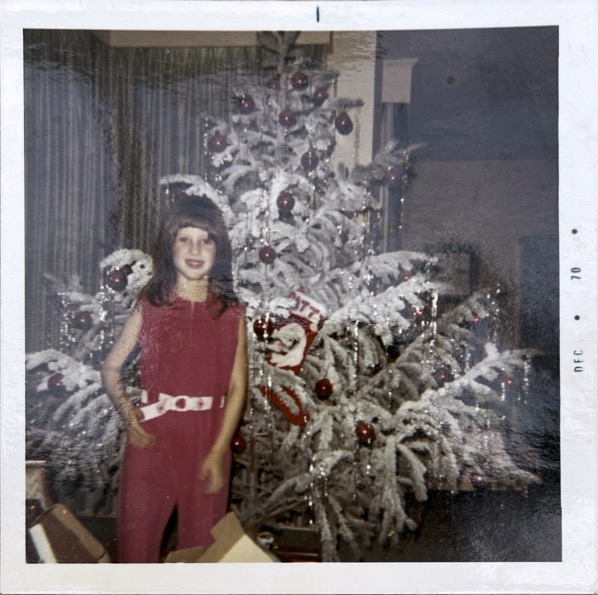
For as long as I can remember, the holiday season has too often brought with it a pervasive melancholy. When I was little — before going to live with my father at age six — Christmas could feel uncomfortable for me: as the only grandchild for a long time, all eyes were on me, wherever I celebrated. There are numerous photos of me in front of my grandparents’ white artificial tree, this last one when I am six years old, back in Texas for Christmas, two months after moving to Virginia.

Thereafter, Christmas becomes outright fraught. With my sister and brother and stepmother and father, the dynamics intensify. I am aware of being ‘the stranger’ in the celebrations, and I remember one particular photo of my stepmother cuddling my brother and sister on the sofa to one side, while I stand in front of the tree, my tightly clasped hands behind my back reflected in the mirror behind me. Just thinking about it breaks my grown-up heart.

I have been reading The Child Safeguarding Review Panel – I wanted them all to notice over the last couple of weeks. This UK report came out in November (2024), and focuses exclusively on Child Sexual Abuse within the family. It’s a depressing read in almost every way: what is missed, who isn’t believed and why, the devastating lack of resources for abused children and families, the over-reliance on ‘evidence’ and on the children themselves disclosing. However, a couple of aspects have struck me with force: first, that so often neglect is a hallmark of an abusive environment. If a child is not neglected, if a child is being cared for, watched out for — sexual abuse is much less likely to occur.

I was emotionally neglected throughout much of my childhood, and when I was living with my mother, physically neglected as well. Despite growing up in a firmly middle-class household, it’s clear that some basic needs weren’t met. This in turn contributed to making me vulnerable; I welcomed any attention I could get from my family, specifically my father. I now see that he groomed me by showing me attention, and then manipulated this into sexual abuse.

Pretence is another common denominator in abusive households. In my life, these layers of everything having to appear ‘fine’ and ‘happy’ seemed to triple at Christmas. We often went to family in Alabama, Florida, or Texas for a week over the holidays. The strain of having to appear ‘just fine’ cast a long shadow every year. The sheer irony of opening presents, having to ‘be a child’ amongst other children haunted me from the moment my father started abusing me. I wasn’t like other children — and I knew it. My childhood was irretrievable. I knew this too.

At Christmas, I often felt trapped. The family was forced into close proximity. I had no friends nearby, nowhere to go, nothing (except reading) to distract me. And I absolutely dreaded nighttimes. I was utterly terrified that my father would come into the room I was inevitably sharing with my siblings or with cousins — he’d done so before — and that then they would ‘find out’ what was happening.

The awful thing here is: I really felt it was my responsibility to keep up family appearances. It was my job to be careful, to make sure no one found out, because otherwise…..otherwise what? All these decades later the only answer I have is that if anyone found out they would simply hate me. Hate me for ruining their lives. Blame me for everything going ‘wrong’.

I am lucky now to have my own healthy family, my separate family traditions — which I created alongside my husband and children and extended family. I am lucky that I no longer feel in danger, or have to pretend for days at a time. I cannot and will not pretend about anything anymore.

So. Please remember that at this time of year there are children for whom Christmas is an ordeal. There are children who have to work extra hard to maintain the pretence, or who are afraid in their beds at night — doubly so, because there is nowhere else to go. Some children — like me — are happier at school, or at friends’ houses. For some children being with family is the last place they would choose to be.

Please remember too that as upsetting as it is to grasp: all of us — you, and you, and you — will know people who are perpetrating sexual abuse. At least 10% of the population is sexually abused before the age of 16. The vast majority of this abuse is perpetrated by family men. They do not appear to be ‘monsters’. They do not appear to be ‘sick’ or ‘unusual’. They make sure that they cultivate looking like a ‘normal’ family. Yet they commit abhorrent crimes. These are the facts.

Due to Gisele Pelicot’s courage, over 50 families (who no doubt consider themselves ‘normal’) must come face to face this Christmas with what lies beneath the surface of their ‘ordinary’ lives. It’s the tip of a huge iceberg, the excavation of which is long overdue. These families are not the exceptions — they are in fact now experiencing what is for large portions of society the hidden norm. Although the road ahead is long and distressing, I join with so many in hoping that this uncovering now has some momentum. Children — and victim survivor women and men — deserve a life free from shame and blame. Shame Must Change Sides.

familial betrayal

Pretty much everyone in the literary world — and most of the world in other areas I imagine — will now know about how Nobel Prize-winning writer Alice Munro did not protect her daughter Andrea Robin Skinner from the sexual assaults of her abuser husband, Gerald Fremlin, either during or after the events. Andrea’s story broke internationally last weekend, although it had clearly been known about for years and years — and kept quiet — in some circles.

Long and short: Andrea’s stepfather first assaulted her when she was nine years old. She told her stepbrother, who insisted she tell her bio father. The right reaction, but badly received: her father did nothing. Andrea returned to her mother’s house and to abuse for several years as a result. Andrea finally told her mother about the abuse. Munro briefly left her husband, but then returned. She stood by him even when he was accused of exposing himself to a neighbourhood 14 yr old girl. In 2005, Andrea took her stepfather to court — and won. Even then, Munro stayed with Fremlin.

Throughout it all, Alice Munro remained an icon, her reputation unsullied. We know now that even her biographer knew about the abuse, and chose not to write about it, as did a number of other literary people.

Here is the international Guardian article which appeared earlier this week. All of the major news and journal outlets have covered this story however, in varying degrees of depth and enquiry. I like Megan Nolan’s article in The New Statesman; she asks questions that need asking, and bares realities that need revealing.

There has been a fair amount of shock-horror and hand-wringing around the revelation of these ‘secrets’. But to anyone in the Child Sexual Abuse survivor world, Munro’s reaction, and the reaction of Andrea’s bio father — are the norm, not the exception. It is very, very common for the family to close ranks and eject the victim, whenever the disclosure occurs. It is very, very common for the victim to be implicated and blamed, and treated (in the case of a girl) like ‘the other woman’. Overall, it is very common for sexual abuse to be viewed as an infidelity by the non-abusing parent or partner. This allows the non-abusing parent/guardian to consider herself (as it is most often the wife/female partner) the injured party — thereby relieving her of any accountability when it comes to the abuse. She can say that she had ‘nothing to do with it’. Any family patterns or dysfunctions can be ignored. And often: the energy is then spent ‘repairing’ the marriage.

This is what happened in Andrea Robin Skinner’s/Alice Munro’s family, and happened in mine. It is what happened in a huge proportion of survivor families I know, and continues to happen in them today.

It is tempting to believe that women don’t leave their pedophile husbands because they are financially trapped, or lacking options. While this will no doubt be the case in some instances (even then: the child should be priority?! Some women DO leave their husbands or families when they discover sexual abuse, regardless), we cannot say the same about Alice Munro’s situation, which is why I bring this up: Alice Munro must not have wanted to leave her husband. She did not feel compelled to leave him.

If the non-abusing parent who has financial stability and status still does not leave the partnership or protect the child/victim/survivor, there are other elements at work here. What makes a person stay with a partner who is a proven or convicted pedophile?

All I can say to those who are shocked: welcome to my world, and the world of millions and millions of child victims and adult survivors. Andrea Robin Skinner’s courageous speaking out (alongside her now-supportive siblings) shows us once again that the incidence of Child Sexual Abuse does not discriminate. CSA is perpetrated at ALL levels of society, across ALL ethnicities, regardless of financial stability, education, or social status. These are facts. They are not supposition. They are real. CSA happens everywhere, every single day.

We have got to do better. We have to offer children safe ways out (which, too often unfortunately, are not about disclosing to parents), and we must continue to raise awareness not just of the existence of CSA, but of the lifelong damage done to victim survivors. Perhaps then non-abusing parents/carers will begin to understand the repercussions of their actions or inactions. Perhaps then there’s a hope that non-abusers will not so frequently side with abusers.

The truth I live with every day is this: I would have liked to stay in my family. I would have liked my father to leave. I would have liked to stay close to my siblings. But at root, because of my stepmother’s reactions/lack of action, none of this could happen. I had to save myself. I had to leave, and eventually become estranged. This is the painful reality. And it is the reality for millions of us.

***

Here is an older post which looks in detail at how I have wrestled with my stepmother’s role in my father’s abuse of me and the subsequent disclosure: forgiveness and complicity. All crashingly familiar, again.

in hope or in despair

The Flying Child’s recent blog post about arranging to see her abuser again — and what happened in that visit, in public — has stayed with me for several days.

Over and over in these days, I replay the scene in which I did something similar: I went to go stay with my father — my abuser — for one night when I was 20 years old. He was living alone in an apartment in Washington DC. The excerpt from LEARNING TO SURVIVE, below, recounts what happened.

That night marked the last time I saw my father. But it didn’t mark the end of me trying to ‘solve’ the family dynamics, of me trying to make him accountable, accept responsibility. Of trying to get an apology. These useless hopes, this belief that maybe just maybe I could ‘fix’ something — went on for another 10 years or so, through letters, therapy, and a few more conversations. To no avail: I do not believe he ever accepted that his actions, his arrogance, his delusions and pathology, were at the root of every single messed up relationship not in only his life, but in the lives of every member of his family. Delusion is indeed the word.

And so I return to why I — and Sophie of The Flying Child, and others, I’m sure — thought seeing our abusers again would be anything other than excruciating, or at worst, dangerous. For me, I can see now, I desperately wanted everything to be over, to be passed. I wanted him to be a father — as in fatherly, parental — and thought, somehow — because the warped world view of abuse also affected my self-perception — that I could lead him to that change of role simply by inhabiting a daughter role fully, and pretend nothing had happened. It’s important to note here that Child Sexual Abuse also skews how the victim views themselves: in my case, because my father seemed unable to ‘control himself’ in my presence, for years, I thought I had some influence over him. And I wanted to ‘use’ this ‘influence’ for good. Somehow. Looking back, knowing what I know now about abuse, I can see that this odd inflated ‘power’ dogged me for years. My perception of all relationships alternated between me having ‘no power’ and me having ‘all the power’. Just like how I registered the abuse.

So when I went to see my father, deep down I wonder if I figured that this was a time when I had all the power. That he would be able to see I needed to be free of him, and that the only way I wanted him in my life was as a father.

I was crushingly wrong about all of it. And yet only ten years later did I truly give up hope — and this giving up involved me cutting ties, me set adrift all on my own. As victims, we are forced into isolation, loneliness and confusion in exchange for escaping unresolved abuse and its attendant distortions. As a result our pain and despair can appear self-inflicted. Yet another way in which the abuser screws us. We strike the world and our families as self-destructive and stubborn. When all we are trying to do is save ourselves.

From Learning to Survive:

***

The summer between my junior and senior years of university, I see my father for what turns out to be the last time. I have worked all summer in a yet another restaurant in Roanoke, a country and western one this time. My father is doing some work in Washington DC, also looking for a permanent job there, never having made the progress he wanted in academia. He is living on his own in an apartment at the weekends. I am not certain what takes me to DC – perhaps I am seeing my friend Daniel, who lives close by, or perhaps I still have the particular blindness that comes with abuse, the compartmentalising that leads me to think that everything is manageable. In any case I am there on my father’s floor in a sleeping bag.

            It is an uncomfortable night. I become afraid that he will come in, that he will touch me. Eventually he does come in, but ‘only to talk’; he wants to ‘see how [I am]’. I am lying on the floor; he is crouched next to me. He wants to talk about the abuse somehow, to discuss ‘it’ – but I cannot imagine how this will happen. Ever, really, at this point, and never with him.

            I survive the conversation, virtually mute. He touches my hair. I am afraid I am going to throw up, although I have never thrown up in his presence before. Paralysis sets in. I know now that I want to hit him, to push him away, and that this is why my arms ache. For the first time then though, I know, I really, truly know it’s not safe: that I’m not safe. That I must go away for good, and not come back until things have changed, if ever. I leave after that night, and never see him again.

            Once the compartmentalising breaks down, it is impossible to put the cat, as it were, back in the bag. I know now that because I am by senior year mostly happy, settled, and with direction, I am for the first time grounded enough to open Pandora’s box. Apparently my body and mind now believe I can withstand whatever emerges, although I do not know this at the time, and although at many points over the next two and a half years, I do not feel I will ever make it through.