this time of year

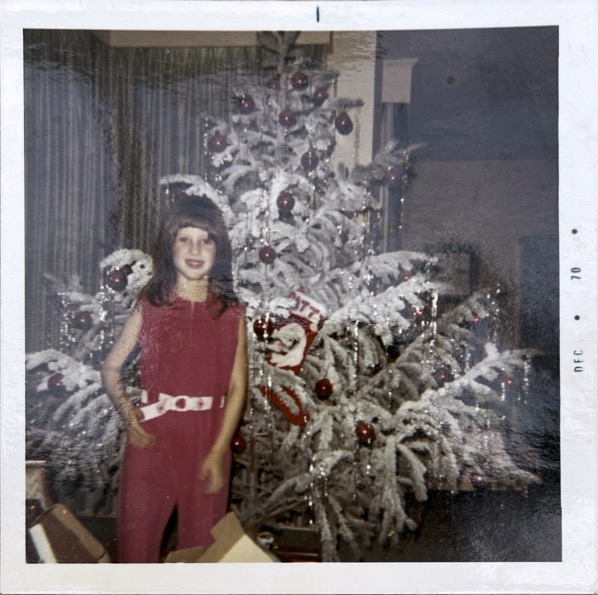
For as long as I can remember, the holiday season has too often brought with it a pervasive melancholy. When I was little — before going to live with my father at age six — Christmas could feel uncomfortable for me: as the only grandchild for a long time, all eyes were on me, wherever I celebrated. There are numerous photos of me in front of my grandparents’ white artificial tree, this last one when I am six years old, back in Texas for Christmas, two months after moving to Virginia.

Thereafter, Christmas becomes outright fraught. With my sister and brother and stepmother and father, the dynamics intensify. I am aware of being ‘the stranger’ in the celebrations, and I remember one particular photo of my stepmother cuddling my brother and sister on the sofa to one side, while I stand in front of the tree, my tightly clasped hands behind my back reflected in the mirror behind me. Just thinking about it breaks my grown-up heart.

I have been reading The Child Safeguarding Review Panel – I wanted them all to notice over the last couple of weeks. This UK report came out in November (2024), and focuses exclusively on Child Sexual Abuse within the family. It’s a depressing read in almost every way: what is missed, who isn’t believed and why, the devastating lack of resources for abused children and families, the over-reliance on ‘evidence’ and on the children themselves disclosing. However, a couple of aspects have struck me with force: first, that so often neglect is a hallmark of an abusive environment. If a child is not neglected, if a child is being cared for, watched out for — sexual abuse is much less likely to occur.

I was emotionally neglected throughout much of my childhood, and when I was living with my mother, physically neglected as well. Despite growing up in a firmly middle-class household, it’s clear that some basic needs weren’t met. This in turn contributed to making me vulnerable; I welcomed any attention I could get from my family, specifically my father. I now see that he groomed me by showing me attention, and then manipulated this into sexual abuse.

Pretence is another common denominator in abusive households. In my life, these layers of everything having to appear ‘fine’ and ‘happy’ seemed to triple at Christmas. We often went to family in Alabama, Florida, or Texas for a week over the holidays. The strain of having to appear ‘just fine’ cast a long shadow every year. The sheer irony of opening presents, having to ‘be a child’ amongst other children haunted me from the moment my father started abusing me. I wasn’t like other children — and I knew it. My childhood was irretrievable. I knew this too.

At Christmas, I often felt trapped. The family was forced into close proximity. I had no friends nearby, nowhere to go, nothing (except reading) to distract me. And I absolutely dreaded nighttimes. I was utterly terrified that my father would come into the room I was inevitably sharing with my siblings or with cousins — he’d done so before — and that then they would ‘find out’ what was happening.

The awful thing here is: I really felt it was my responsibility to keep up family appearances. It was my job to be careful, to make sure no one found out, because otherwise…..otherwise what? All these decades later the only answer I have is that if anyone found out they would simply hate me. Hate me for ruining their lives. Blame me for everything going ‘wrong’.

I am lucky now to have my own healthy family, my separate family traditions — which I created alongside my husband and children and extended family. I am lucky that I no longer feel in danger, or have to pretend for days at a time. I cannot and will not pretend about anything anymore.

So. Please remember that at this time of year there are children for whom Christmas is an ordeal. There are children who have to work extra hard to maintain the pretence, or who are afraid in their beds at night — doubly so, because there is nowhere else to go. Some children — like me — are happier at school, or at friends’ houses. For some children being with family is the last place they would choose to be.

Please remember too that as upsetting as it is to grasp: all of us — you, and you, and you — will know people who are perpetrating sexual abuse. At least 10% of the population is sexually abused before the age of 16. The vast majority of this abuse is perpetrated by family men. They do not appear to be ‘monsters’. They do not appear to be ‘sick’ or ‘unusual’. They make sure that they cultivate looking like a ‘normal’ family. Yet they commit abhorrent crimes. These are the facts.

Due to Gisele Pelicot’s courage, over 50 families (who no doubt consider themselves ‘normal’) must come face to face this Christmas with what lies beneath the surface of their ‘ordinary’ lives. It’s the tip of a huge iceberg, the excavation of which is long overdue. These families are not the exceptions — they are in fact now experiencing what is for large portions of society the hidden norm. Although the road ahead is long and distressing, I join with so many in hoping that this uncovering now has some momentum. Children — and victim survivor women and men — deserve a life free from shame and blame. Shame Must Change Sides.

familial betrayal

Pretty much everyone in the literary world — and most of the world in other areas I imagine — will now know about how Nobel Prize-winning writer Alice Munro did not protect her daughter Andrea Robin Skinner from the sexual assaults of her abuser husband, Gerald Fremlin, either during or after the events. Andrea’s story broke internationally last weekend, although it had clearly been known about for years and years — and kept quiet — in some circles.

Long and short: Andrea’s stepfather first assaulted her when she was nine years old. She told her stepbrother, who insisted she tell her bio father. The right reaction, but badly received: her father did nothing. Andrea returned to her mother’s house and to abuse for several years as a result. Andrea finally told her mother about the abuse. Munro briefly left her husband, but then returned. She stood by him even when he was accused of exposing himself to a neighbourhood 14 yr old girl. In 2005, Andrea took her stepfather to court — and won. Even then, Munro stayed with Fremlin.

Throughout it all, Alice Munro remained an icon, her reputation unsullied. We know now that even her biographer knew about the abuse, and chose not to write about it, as did a number of other literary people.

Here is the international Guardian article which appeared earlier this week. All of the major news and journal outlets have covered this story however, in varying degrees of depth and enquiry. I like Megan Nolan’s article in The New Statesman; she asks questions that need asking, and bares realities that need revealing.

There has been a fair amount of shock-horror and hand-wringing around the revelation of these ‘secrets’. But to anyone in the Child Sexual Abuse survivor world, Munro’s reaction, and the reaction of Andrea’s bio father — are the norm, not the exception. It is very, very common for the family to close ranks and eject the victim, whenever the disclosure occurs. It is very, very common for the victim to be implicated and blamed, and treated (in the case of a girl) like ‘the other woman’. Overall, it is very common for sexual abuse to be viewed as an infidelity by the non-abusing parent or partner. This allows the non-abusing parent/guardian to consider herself (as it is most often the wife/female partner) the injured party — thereby relieving her of any accountability when it comes to the abuse. She can say that she had ‘nothing to do with it’. Any family patterns or dysfunctions can be ignored. And often: the energy is then spent ‘repairing’ the marriage.

This is what happened in Andrea Robin Skinner’s/Alice Munro’s family, and happened in mine. It is what happened in a huge proportion of survivor families I know, and continues to happen in them today.

It is tempting to believe that women don’t leave their pedophile husbands because they are financially trapped, or lacking options. While this will no doubt be the case in some instances (even then: the child should be priority?! Some women DO leave their husbands or families when they discover sexual abuse, regardless), we cannot say the same about Alice Munro’s situation, which is why I bring this up: Alice Munro must not have wanted to leave her husband. She did not feel compelled to leave him.

If the non-abusing parent who has financial stability and status still does not leave the partnership or protect the child/victim/survivor, there are other elements at work here. What makes a person stay with a partner who is a proven or convicted pedophile?

All I can say to those who are shocked: welcome to my world, and the world of millions and millions of child victims and adult survivors. Andrea Robin Skinner’s courageous speaking out (alongside her now-supportive siblings) shows us once again that the incidence of Child Sexual Abuse does not discriminate. CSA is perpetrated at ALL levels of society, across ALL ethnicities, regardless of financial stability, education, or social status. These are facts. They are not supposition. They are real. CSA happens everywhere, every single day.

We have got to do better. We have to offer children safe ways out (which, too often unfortunately, are not about disclosing to parents), and we must continue to raise awareness not just of the existence of CSA, but of the lifelong damage done to victim survivors. Perhaps then non-abusing parents/carers will begin to understand the repercussions of their actions or inactions. Perhaps then there’s a hope that non-abusers will not so frequently side with abusers.

The truth I live with every day is this: I would have liked to stay in my family. I would have liked my father to leave. I would have liked to stay close to my siblings. But at root, because of my stepmother’s reactions/lack of action, none of this could happen. I had to save myself. I had to leave, and eventually become estranged. This is the painful reality. And it is the reality for millions of us.

***

Here is an older post which looks in detail at how I have wrestled with my stepmother’s role in my father’s abuse of me and the subsequent disclosure: forgiveness and complicity. All crashingly familiar, again.

generations

I’ve been thinking a lot about my mother over the last few weeks. Her illnesses. Her pathology. Her recurring cries for help.

She unfortunately married an abuser. Who, over ten years after they were divorced, began to abuse me. When I think back to telling her I was abused…I wonder if then, right then, she gave up almost completely.

My aunt and I believe that my grandmother was also abused by a family member. And we are sure there are more. How my father figures into this history of abuse is not something I will ever know. I am sorry if something happened to him, in the way that I am sorry when I hear of any abuse. But it is not a consideration when I face his abuse of me. After all: I am not an abuser. My aunt (whom he also abused) is not an abuser. My mother, abused by her own father, was not an abuser.

It is a myth that victims of abuse go on to abuse. It is a dangerous and wholly inaccurate assumption, one which partly absolves perpetrators of responsibility and accountability. The truth is, abused in childhood or not: the decision to abuse is down to the abuser. It is the abuser’s fault. No one else’s.

All of the abused women in my family have tried, and mostly succeeded, to break the intergenerational line of sexual abuse. My mother’s attempt to save me from her suicidal and infanticidal actions — her more or less throwing me from her sinking boat onto the boat which appeared to be floating, my father’s — was also an attempt no doubt to save me from her abusive past, and the fear of how she might harm me. She said to me many times that giving me up was the hardest thing she had ever done, and that she was wracked with grief for over a decade afterward, until I went to university. Later, when I told her about my father’s abuse of me — all of her sacrifice must have seemed for nothing. Must have destroyed whatever she had left, on all fronts.

Two and a half years after she died, I am finally going through her things. As I’ve known for a while, this is all — somehow — my next book. The photo above is I believe her graduation photo, from high school. She went on to the University of Texas at Austin and did a double major, in English Literature and Maths. She was smart. Very, very smart. The loss of herself over her lifetime is heartbreaking. So much promise, so much life. She was 79 when she died, destitute and completely alone in a high security nursing home, trailing a number of psychiatric diagnoses. In the pandemic. Despite our years of trauma with each other, it was the thought of her dying alone which really undid me, the night I received the email.

This short excerpt from my memoir — now titled Leaving Locust Avenue — recounts when I told my mother about my father abusing me.

***

paying the price

Over on Twitter (X now, yuck) I’ve been in conversation with writer and activist Elizabeth Shane about hypervigilance. I suspect that this kind of alertness to surroundings, to approaching/imagined danger is extremely common in survivors, if not universal.

I explore how hypervigilance affects so many areas of my life in another post, on expecting disaster.

In this same post, I mention that my elder son was diagnosed with Type 1 diabetes. This happened when he was 12. My hypervigilance meant that he was never in danger (unlike so many at diagnosis) — but this reality did not stop me from the crashing feeling that somehow I had not done enough: I had not kept him safe from harm.

When E was diagnosed, my world collapsed. I remember leaving him in hospital and coming home that first night, sobbing uncontrollably into his pillow. This remains the sharpest and most wrenching grief I have ever experienced. I remember what I was feeling: how can this happen when I have tried so hard? I have made it through everything life handed to me — why make my boy suffer too? I knew beyond doubt that he would suffer. That he was watching his life change on a dime, forever, and there was nothing any of us could do about it.

Type 1 diabetes is a life-threatening, completely life-changing, autoimmune condition. Developing it has nothing to do with diet or environment; the propensity is likely hard-wired, which means that it’s inevitable in some people. Type 1 is most often diagnosed in young people, and there are millions of families around the globe who face this particular grief — the grief of their child losing a carefree life, losing aspects of their childhood. From then on, every bit of food, every outing — and for several years, every night — is dominated by blood sugar readings, 24/7. From that moment, we could never just ‘jump in the car’ or ‘just go for a walk’. Everything had to be planned. Everything changed. This is the way it is for every family. It’s an intense, encompassing grief for the life we can never have again.

Four years later, also at age 12, our second son evidenced another chronic condition, hEDS (which, it turns out, I have too). He suffered an intractable knee dislocation which sent him miles in an ambulance to the hospital, having to bear excruciating pain. For eight years afterward, until we located a good surgeon, he lurched from crisis to crisis, emergency to emergency, pain to pain. As is common, he has numerous other chronic co-morbidities from hEDS. His life too had been turned upside down. Again: I had hoped to have one child with an ‘unencumbered’ life — but this was not to be. It took a long time for me to accept that I couldn’t ‘save’ him either, that I couldn’t make everything better. Let me at least make his life lighter.

I had wanted my own early suffering to be worth something. To matter. I wanted those difficult years to ‘count’ in the balancing out of Good and Bad. I had endured the Bad; surely now my children were due the Good?

The truth is: there are no scales of justice. Living through abuse does not mean that later life will be free of more bad luck. There is no such thing as ‘getting what you deserve’. Life doesn’t work like that, either for good or ill. We all know that finding our way through the lifelong damage of abuse is not counterbalanced by our abusers suffering in kind. The huge majority of abusers are never brought to account, either formally or informally. Whereas we, we all know, continue to pay the price they never pay.

When first one then the other of my two children had to face their life-long disabilities, I had to face that the neglect and sexual abuse of my early life did not somehow secure their wellbeing. I had to face that life never was and never has been fair. And that I had suffered for no apparent reason. For a long time, this realisation tore me apart. I had so wanted — so wanted — everything now, after my childhood and young life — to be just fine. To have borne what I did so I could accumulate Good Things for the future.

Over time I guess that I have learned — we have learned — to live with injustice, to navigate it. It’s been a necessary lesson. To value where we are now — rather than look for a time when we will be free of all this. None of us have had it ‘easy’, whatever that means. (I tend to think no one has it ‘easy’.) But somehow, through everything, we have cultivated genuine love. Genuine kindness. Genuine and fierce ties that bind us together, even when stretched over thousands of miles. I’m proud of us. The cost at times still feels immense — the grief bottomless, the suffering of no real use — but we got here, and for that I will be forever grateful.

fear & sacrifice

I’ve been thinking a lot about fear. When I look back over my life (59 years of it), fear figures heavily.

I begin my life being afraid for my mother. I fear for her wellbeing, I fear her not being there. I fear her attempting to end her life again. I also fear, I know now, her anger and lashing out. These fears last until she dies of natural causes, two years ago.

These early fears of course set up later fears. I fear being ‘sent away’ (as I was from my mother). I interpret this fear, over time, as fear of loss. Losing people. Losing what I have. Whatever that may be. Because fundamentally (I tell myself), something is always better than nothing. And ‘nothing’ is ‘the abyss’ — I have been too close to that too often. Anything is better than that.

This hard-wired fear means that living my life feels conditional. That somehow the security of the life I lead is entirely dependent on me preserving some version of the status quo. Depends on me ‘being good’. Eventually, I will do anything to keep from ‘making trouble’.

These fears are handy for my father, my abuser. He no doubt knows that I will not say a word. There is zero chance that I will ‘rock the boat’ in any way. Because I’m terrified of the abyss which lies beyond ‘raising a fuss’. As in my young childhood with my mother, I continue to believe there is literally no one to go to. No one. So it’s all down to me.

I find, in time, that I ensure my father is not discovered in my bedroom. I work hard to behave ‘normally’. I work hard to keep him away from my friends, my sister, or once, my cousin. I think I know how to play this game. I know I can play it. I know I can keep it secret. I know I can manage it without (I think) losing everything else. I believe that no one but me knows the scale of the loss that might happen if I crack. Throughout my childhood and adolescence, I deliberately and systematically decide to protect everyone else — in the family, in my circle of friends, at school or ballet — and endure whatever I have to. I need to protect everyone. In doing so, and unknowingly, I end up sacrificing myself in so many ways.

I still find it hard not sacrifice myself when the ‘going gets tough’. Sometimes it still feels like ‘one slip and everything will be lost’. And rather than lose everything, I choose to endure anything: I can bear anything, anything at all. Try me.

It’s been a relief in the last few years to accept that the world turns with me or without me. To relieve myself of the constant High Alert state I have lived in nearly my whole life.

We all find our messy ways along our paths, me included. But this doesn’t mean we are lost. It means, on the contrary, that we are in this together.

Father’s Day (UK)

My first father, and the father who never harmed me, was my grandfather. That’s us in the photo. I’m three years old, and we are in Luling, Texas. My parents were divorced when I was just a few months old. In this photo, I hadn’t met my father yet. I don’t know whether I’m leaving my grandparents’ care to go back and live with my mother, or whether I am joining my grandparents to live with them for a while, leaving my mother to her instabilities and mental illnesses. I traveled both ways, often, up until age six.

My grandfather is holding both of my hands here. My face has faded with time, but his remains strong, in focus. Out of shot here I am pointing my foot forward in my saddle shoes, as if I am foreshadowing the decades of dance I would start only a few years later.

In hard times, I still channel Granddaddy for comfort, hearing his voice in my head. He died over 20 years ago now, but I can still hear him — quietly spoken, always giving me strength and belief.

Why, you’re not going to let a little thing like that stop you, are you? he would say, no matter what;

and

We’re rooting for you! even over the telephone, often at the end of our conversations;

and

You can do anything you set your mind to.

Both of my grandparents were the solid centres of my whole life. I carry their words and actions with me, always, and miss them, honestly, daily.

Happy Father’s Day, Granddaddy. Love you always and forever.

***

What I’m saying here too is that I cannot consider my biological father my father. I cannot begin to put him in the place where Father’s Day happens. He was my abuser, and although that’s not all he was (any more than being a survivor is all I am), his abuse of me when I was a child — sexual, psychological, emotional — far overshadows any good which he may have done as a father in my life in other ways.

Child Sexual Abuse is not just the crimes themselves. CSA is insidious, pervading, and tarnishes every aspect of your relationship with your abuser (and too often, everyone). My father’s actions and decisions made him not-my-father. Forever. I never hear his voice anymore. Once I got rid of it, it was gone for good.

***

Here are two excerpts from Learning to Survive, my memoir about neglect, CSA, living through it all and with it. The first is about my life with Granddaddy, the second about my father.

***

1.

I go everywhere with them. Granddaddy takes me out in the pick-up truck, sometimes even in the back if I promise not to move around too much. He drives around the block so I can feel the wind in my hair. For longer journeys, though, I sit next to him in the cab. Together we go to the hardware store, the gardening shop, the fishing tackle store. I inspect tiny drawers full of screws and nuts and bolts, and once, lots of extravagant fishing flies lined up on the counter. It’s not my world, but with Granddaddy in his overalls, his hand around mine, or often, his hands resting on my shoulders, I get a peek at it.

It is Granddaddy who sets up the swing and slide in the backyard, and who builds a sandbox around the bottom of a tree for me. Outside, it is always hot and wet, but with Granddaddy working next to me, I play. The chameleons on the house fascinate me; I stand completely still, just waiting for one to run from the green grass to the red wall so I can watch it change colour. In the front, together we see the squirrels fussing in the tall trees, running through the thick spiky grass. I sit on the front step and watch him mow, watch our neighbours mow their front yards, the hands they raise to one another. And always, should anyone stop to talk, my grandfather waves me over, rests a hand on me: ‘This is our granddaughter,’ he says, ‘come to stay with us for a while.’ And whoever it is, sensing something, or maybe just liking what he sees, says, ‘Well isn’t that nice. Isn’t that nice for you?’ And my grandfather, with a little squeeze, says, ‘It sure is.’

2.

After the age of 11, I cannot remember a single decent time with my father. That is, one that isn’t inflected with fear, or repulsion, wondering what his next move will be. Wondering how he will exploit any moment to bring me closer to him, to be with him, later. As I look back, I think I may experience some moments of joy, in theory – like listening to music with him, peering through a telescope, arriving at the correct answer to a maths problem together – but none of them exist separately for long. I cannot tease them apart from everything else; I cannot make them stand up against the steadily rising tide of distress and fear. They become meaningless.            

So I forget them all. I forget any possibility of good in him, and it never comes back. That room, like so many, is entirely empty.

going back (4)

This is a photo of my grandparents’ old house in Beaumont, Texas. I took it nine days ago.

The house looks small to my eyes now, though of course as a child it felt palatial: so many big rooms, sofas cool to the touch, cool floors too, even those winding further back into the house, deep soft carpet. The garden full of chameleons I watched turn red on the brick walls, a sandbox my grandfather made for me, and swings.

When I was very little — younger than six — this house meant safety, security, and peace. It meant good food, praise, friendship, and love. It feels impossible to overstate this central truth: my grandparents made me who I am today. They rescued me from the unstable — neglectful — life with my mother and her boyfriends, over and over.

Nine days ago in Texas my aunt Lois and I filled every moment we had together with conversation. We have always been close, almost like sisters, despite our nearly 20 years’ age difference. This post makes clear how and why we always had such a connection — but the truth is too that we ‘never meet a stranger’ (in her father’s, my grandfather’s, words), and we are able to talk for hour upon hour. No exaggeration, the first day we saw each other this time, we managed to talk for eight hours straight. Yep!

I’ve always known — I remember, indeed — that I stayed with my grandparents in times of particular crisis. I was happy with them, and always longed to be there, so I have always taken comfort in my memories of all this. My conversations with Lois two weeks ago revealed a bit more, a couple of surprises: that at one point I stayed with them for at least a year, and that Lois assumed they were going to adopt me.

Lois was at university during this time, so knows few details. But it’s clear that they all considered my mother a danger to me. I don’t know why they didn’t adopt me, but I suspect that my grandparents deferred to my father (their son) — which, as we know, sent me from the frying pan into the fire. But they weren’t to know that. In any case, I was taken aback last week by the realisation that everyone knew I wasn’t safe. I am struck afresh by this refrain of my life: it wasn’t my fault; it wasn’t me; it was his/her doing all along.

I hadn’t been back to Beaumont in 20 years. My parents’ hold on me — my father’s wedge-driving, my. mother’s toxicity — effectively kept me away from a place and people I now know I truly love — and who truly love me.

Lois took me to the house, to the school where my grandmother taught; I saw my beloved cousin again, and I met his three beautiful children for the first time. Lois also ordered an autumn bouquet, which we placed on Ommie’s and Granddaddy’s graves, which I’d never seen. Being with them there was joyful really; in my mind I thanked them, told them about their great grandchildren, and let them know how happy I am now in my life, so much due to them.

My own parents are both gone. My father doesn’t have a burial place, and I scattered my mother’s ashes last week in San Antonio (more on this soon). With this trip to Virginia and then to Texas, I feel set free, an orphan released into love. I embrace the times with my grandparents, and all of my Texas relatives, with a full heart. It’s impossible to know what goes on behind the closed door of any house, but I do know that this house always felt like home.

going back (1)

[NB: probably part of a series]

After several years away, in two weeks I am going to the US. My main purpose in going is to settle my mother’s things, collect her ashes, and take her back to Texas from Virginia. I’m so grateful for all the support I will have over the two weeks I am there: Max, Brett, Anthony, Anna, Lois, Jamie and Patricia. I’m not sure any of this would be doable without you.

My mother died in May 2021. She was 79, and had been in a nursing home for a few months, following a few months in hospital. She had huge mental health challenges, and I now recognise that she had Narcissistic Personality Disorder. In her younger years, she could present a kind exterior when she wanted to. She believed she was kind, indeed. And more clever than anyone else, more sympathetic, wiser etc. She once told me, almost pleading with me to believe her, that she was ‘good with children.’ My understanding is that narcissists have no idea that they are ill. Because the problem always lies with someone else, not them.

I am her only child, and her only relative (bar Jamie in Texas) who ever spoke to her. She had also alienated all of her friends, one by one, as her selfishness became her single prominent characteristic.

I know she was lonely. And yet I called my mother only twice in the last year of her life. The penultimate time, I could hear that she was slipping. And, exactly like the old days when this happened, she called me names, accused me of conspiring against her, and said that I should stop trying to help.

It’s so hard to tell the difference between mental illness and actual personality traits. I came downstairs after that phone call, and as usual, completely fell apart. I was 56 year old, and my mother’s sharp, disparaging tongue could hurt me every bit as much as it used to.

I went into therapy again. I knew I needed to free myself from her, but I had no idea how to do it, having tried and failed numerous times.

It took a long while to unravel some things, in particular to unpick the deeply imbedded guilt: she’s had such a hard life, and everything about our relationship is just making it worse; why can’t I love her? Etc.

One day, as I was struggling to express this rock of guilt, my therapist said: ‘you do realise that in this day and age you would have been taken out of your mother’s care?’

My mouth literally fell open. ‘What?’

‘Yes,’ she went on. ‘She was abusive. She took drugs in front of you, she did sexual things in front of you, she allowed you to get into dangerous situations. She was neglectful. Nowadays social services would have been called in.’

After the shock, relief washed over me: there is a social consensus about caring for children, and she did not satisfy it.

No she did not. She did not know how to take care of me, and therefore didn’t.

The last time I spoke to my mother was shortly after this realisation. She was still in hospital, and her meds had clearly been balanced. She was pretty lucid, softly spoken, and nicer than she’d been in years. I had called to talk about plans for her apartment, and her belongings. And she said two things, bittersweet: Patty, you don’t owe me anything, you really don’t. And Patty, I trust you completely. You’ll make the right decisions. This was the closest she ever came to acknowledging her part in our disastrous relationship, and the only time she ever entrusted me with anything.

As her only child then I am going to Virginia in two weeks to go through what remains of her things. I am collecting her ashes, and then getting on a plane to San Antonio, where Jamie and I will scatter them. She was always but always trying to get back to Texas. I am as certain of this as I am of anything in my life: she wanted her ashes in Texas.

Finally: it’s important to register that my mother’s negligence and inabilities set me up for the sexual abuse I would later undergo. We never spoke directly about this, but I know it’s true. By six years old, when I went to Virginia, the pattern around love and attention being conditional was already well established. My grandparents planted unconditional love in those first six years and afterward, enough to see me through the very worst times of my life, but no one — not even them — could fix my mother’s conditionality. Or my father’s, for that matter.

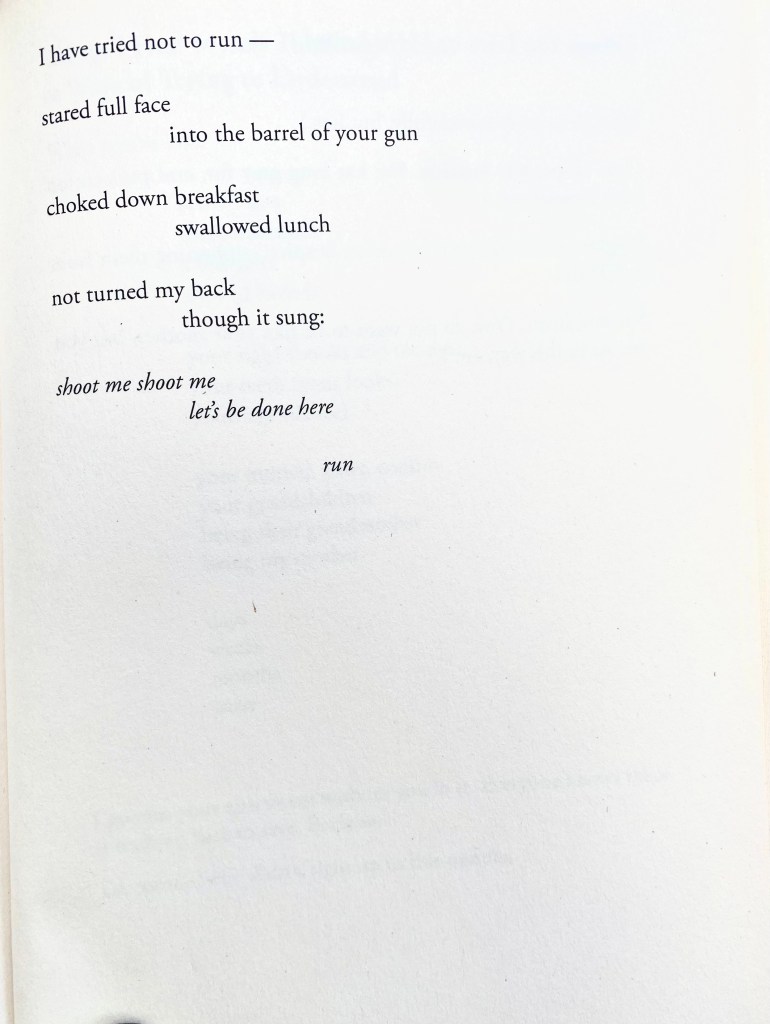
In a change from Learning to Survive, here are three poems from my last poetry collection, Baby (Liquorice Fish Books, 2016), with apologies for having to work with wonky images. Formatting is not fun on WordPress!

The ‘you’ in these poems is my mother.

***