I was sorry to miss the Shameless WoW Festival yesterday at Battersea Arts Centre (life too hectic right now). There looked to be some discussion there around #CSA (Child Sexual Abuse) as well as much-needed activism and lived experience around gender based violence. Insofar as CSA goes: might this be a corner turning?
I hope so. Bringing CSA to the public consciousness — really LOOKING at it — has been like turning around a huge ship in limited space: it will go, it will happen, but it will take lots and lots of small movements. A 1000 point turn, in other words, for British readers.
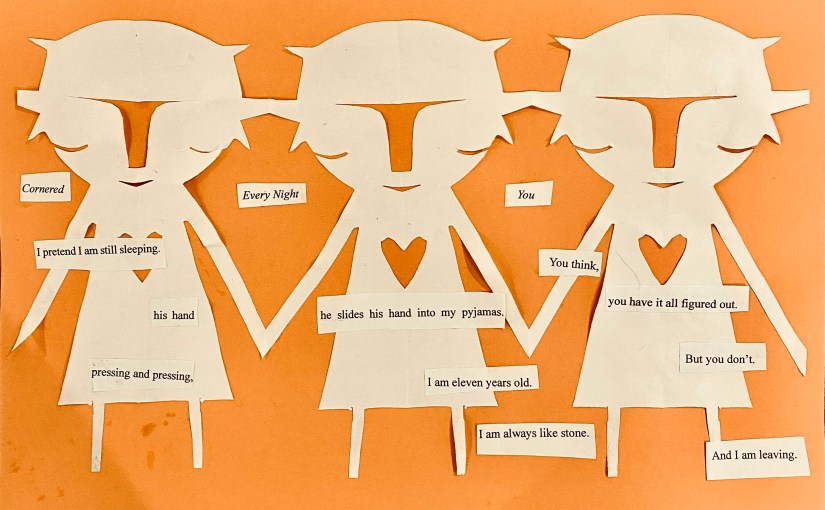
But the incremental and mighty ‘turns’ are there, now in abundance. Witness the part #CSA plays this year in #16Days (16 Days of Activism Against Gender-Based Violence); in particular, look at the work Viv Gordon and her colleagues are undertaking in Cutting Out — we ALL would benefit from doing this, mindful moments to place our concerns, anger, grief, hopes for the future into creative and ritualised action. The paper dolls go into the world to speak for us, hold us, and touch others, hand to hand.
Witness too the writers’ loud voices speaking directly to sexual abuse, sexual assault, and trauma: writers like alice hiller, Day Mattar, Chaucer Cameron, Tessa Foley, Clare Best — and myself. Witness how at last they are being heard: in Poetry and Trauma at Poetry in Aldeburgh, in shortlisting for national prizes, in national forums and readings.
Witness at last the enormous amount of grassroots work now being done by individuals and organisations raising awareness of CSA, developing policies for schools and medical professionals, and offering training for the same. I can’t help but imagine what life might have been like if someone had recognised and noticed my behaviour, or my father’s, during the abuse. If I had known that I was not the only girl going through this, that I was not on my own.
But I didn’t know that. Not for years and years. And any hint from anyone — teachers, friends, a therapist — that they knew something might be wrong, was unspoken. Nothing like this had words then, not words said in public or to each other. Looking back, I think some people in my life had suspicions. Yet they watched me have to leave my family home at 17 as a direct result of the abuse, and could say nothing. Silence damages everyone. In my memoir Learning to Survive, I write this about that time:
***
Us
[My friend] Valerie is perhaps the most upset. I remember she starts crying, right in the classroom. She wants to know why. And I have my answer, the one I use over and over ‘I just want to live with my mother before going away to college.’
I do not realise that Valerie still cares about me. I do not realise, if I’m honest, that anyone except [my close friend] Alice really cares. Yet my going disturbs the surface, and numerous people – students, teachers – seek me out to wish me well, and ask questions. The Principal of the school asks me in to see if he can do anything to make me stay, and if everything is okay. To which I say No, and Yes.
Of course it is [my English teacher] Mrs Amos I dread leaving the most. But again, to her credit, she doesn’t try to convince me otherwise. She wishes me all the best. She knows I will succeed in everything I do. She believes in me.
I encounter a curious mix of sorrow and knowingness when I announce I’m leaving. Looking back, I think that the sorrow mainly comes from those who cannot imagine how this has happened. Whereas the knowingness, the unspoken, rises through the eyes of those who may know something or suspect.
From here, I see our joint powerlessness. I see how mistreatment, how abuse, is too often communicated in silence, implied. How it is up to the women to get away, how other women must urge them silently. How they are brave, deserting everything. Leaving everything – their children, their lives, their homes – behind. Forced to cut and run.
Whereas really it’s my father who needed to leave. Really he should have been arrested. And I should have been able to stay put, and never lost [my half-siblings], the heartbreak of my life. And they in turn would never have had to carry their own complex and heart-breaking confusions – with no help from anyone — around for so many years.
***
So. Are we turning corners? I really, really hope so. So many are working so hard to ensure that safeguarding is now more nuanced, and that Child Sexual Abuse is part of the conversation. Up until now, too many abuse disclosures result in what happened to me: scapegoating, and the girl/woman/boy/man leaving/running/escaping. Isolation follows, and the attempt to remake a life. Please help us in working toward a time when this is not the only option.


 PATRICIA DEBNEY