One in 6 children is sexually abused, 90% by someone they know and trust, within the family fold. I was one of those children. An author of five books, I now turn myself to raising awareness, breaking the silences, and sharing lived experiences of CSA (Child Sexual Abuse). We must speak and stop this. The time is now.
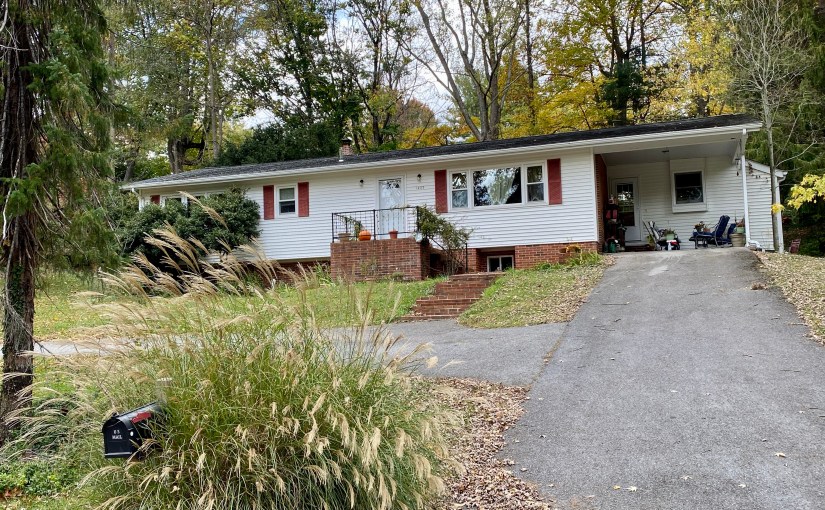
I took this photo three days ago. This is the house where everything started, and everything ended.
I was six years old when I came to live with my father, my step mother, and my two half siblings. Even at six, I wanted a family life, and deep down I was hopeful. My mother had been unpredictable, frequently immobile, and I had only seen my father once in my life before moving in with them. And yet: I was hopeful.
When I was 11, my father started grooming me in this house. Soon after, he began sexually abusing me. In this house. The abuse increased in frequency and severity until I was 15, although I don’t remember how it stopped. I locked the door? He stopped because I was too old? I don’t know.
But the abuse stopped, and within a year things fell apart to the point that I left this house at 17, back to my unpredictable and neglectful mother.
The hardest decision I ever made in my life was leaving my siblings. All in this house. I left them here, and I felt like pieces of me had been torn out. No one ever knew any of this.
This looks like a pretty normal house, right? It looks like a lot of houses in a lot of neighbourhoods.
Make no assumptions folks. Do not rely on appearances. Listen to something deeper. I’m sorry to say that everyone who reads this will have lived on a street or in an apartment block – possibly next door – to a family where child sexual abuse is happening. We need to do better. Starting now.
After several years away, in two weeks I am going to the US. My main purpose in going is to settle my mother’s things, collect her ashes, and take her back to Texas from Virginia. I’m so grateful for all the support I will have over the two weeks I am there: Max, Brett, Anthony, Anna, Lois, Jamie and Patricia. I’m not sure any of this would be doable without you.
My mother died in May 2021. She was 79, and had been in a nursing home for a few months, following a few months in hospital. She had huge mental health challenges, and I now recognise that she had Narcissistic Personality Disorder. In her younger years, she could present a kind exterior when she wanted to. She believed she was kind, indeed. And more clever than anyone else, more sympathetic, wiser etc. She once told me, almost pleading with me to believe her, that she was ‘good with children.’ My understanding is that narcissists have no idea that they are ill. Because the problem always lies with someone else, not them.
I am her only child, and her only relative (bar Jamie in Texas) who ever spoke to her. She had also alienated all of her friends, one by one, as her selfishness became her single prominent characteristic.
I know she was lonely. And yet I called my mother only twice in the last year of her life. The penultimate time, I could hear that she was slipping. And, exactly like the old days when this happened, she called me names, accused me of conspiring against her, and said that I should stop trying to help.
It’s so hard to tell the difference between mental illness and actual personality traits. I came downstairs after that phone call, and as usual, completely fell apart. I was 56 year old, and my mother’s sharp, disparaging tongue could hurt me every bit as much as it used to.
I went into therapy again. I knew I needed to free myself from her, but I had no idea how to do it, having tried and failed numerous times.
It took a long while to unravel some things, in particular to unpick the deeply imbedded guilt: she’s had such a hard life, and everything about our relationship is just making it worse; why can’t I love her? Etc.
One day, as I was struggling to express this rock of guilt, my therapist said: ‘you do realise that in this day and age you would have been taken out of your mother’s care?’
My mouth literally fell open. ‘What?’
‘Yes,’ she went on. ‘She was abusive. She took drugs in front of you, she did sexual things in front of you, she allowed you to get into dangerous situations. She was neglectful. Nowadays social services would have been called in.’
After the shock, relief washed over me: there is a social consensus about caring for children, and she did not satisfy it.
No she did not. She did not know how to take care of me, and therefore didn’t.
The last time I spoke to my mother was shortly after this realisation. She was still in hospital, and her meds had clearly been balanced. She was pretty lucid, softly spoken, and nicer than she’d been in years. I had called to talk about plans for her apartment, and her belongings. And she said two things, bittersweet: Patty, you don’t owe me anything, you really don’t. And Patty, I trust you completely. You’ll make the right decisions. This was the closest she ever came to acknowledging her part in our disastrous relationship, and the only time she ever entrusted me with anything.
As her only child then I am going to Virginia in two weeks to go through what remains of her things. I am collecting her ashes, and then getting on a plane to San Antonio, where Jamie and I will scatter them. She was always but always trying to get back to Texas. I am as certain of this as I am of anything in my life: she wanted her ashes in Texas.
Finally: it’s important to register that my mother’s negligence and inabilities set me up for the sexual abuse I would later undergo. We never spoke directly about this, but I know it’s true. By six years old, when I went to Virginia, the pattern around love and attention being conditional was already well established. My grandparents planted unconditional love in those first six years and afterward, enough to see me through the very worst times of my life, but no one — not even them — could fix my mother’s conditionality. Or my father’s, for that matter.
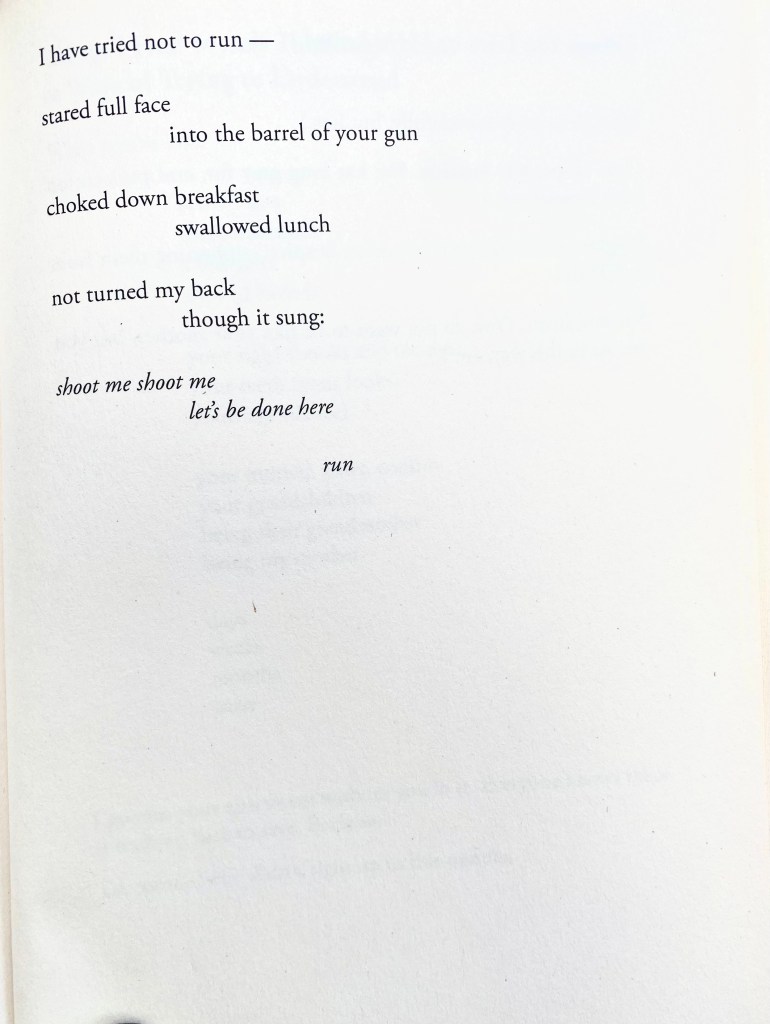
In a change from Learning to Survive, here are three poems from my last poetry collection, Baby (Liquorice Fish Books, 2016), with apologies for having to work with wonky images. Formatting is not fun on WordPress!
Over and over in these days, I replay the scene in which I did something similar: I went to go stay with my father — my abuser — for one night when I was 20 years old. He was living alone in an apartment in Washington DC. The excerpt from LEARNING TO SURVIVE, below, recounts what happened.
That night marked the last time I saw my father. But it didn’t mark the end of me trying to ‘solve’ the family dynamics, of me trying to make him accountable, accept responsibility. Of trying to get an apology. These useless hopes, this belief that maybe just maybe I could ‘fix’ something — went on for another 10 years or so, through letters, therapy, and a few more conversations. To no avail: I do not believe he ever accepted that his actions, his arrogance, his delusions and pathology, were at the root of every single messed up relationship not in only his life, but in the lives of every member of his family. Delusion is indeed the word.
And so I return to why I — and Sophie of The Flying Child, and others, I’m sure — thought seeing our abusers again would be anything other than excruciating, or at worst, dangerous. For me, I can see now, I desperately wanted everything to be over, to be passed. I wanted him to be a father — as in fatherly, parental — and thought, somehow — because the warped world view of abuse also affected my self-perception — that I could lead him to that change of role simply by inhabiting a daughter role fully, and pretend nothing had happened. It’s important to note here that Child Sexual Abuse also skews how the victim views themselves: in my case, because my father seemed unable to ‘control himself’ in my presence, for years, I thought I had some influence over him. And I wanted to ‘use’ this ‘influence’ for good. Somehow. Looking back, knowing what I know now about abuse, I can see that this odd inflated ‘power’ dogged me for years. My perception of all relationships alternated between me having ‘no power’ and me having ‘all the power’. Just like how I registered the abuse.
So when I went to see my father, deep down I wonder if I figured that this was a time when I had all the power. That he would be able to see I needed to be free of him, and that the only way I wanted him in my life was as a father.
I was crushingly wrong about all of it. And yet only ten years later did I truly give up hope — and this giving up involved me cutting ties, me set adrift all on my own. As victims, we are forced into isolation, loneliness and confusion in exchange for escaping unresolved abuse and its attendant distortions. As a result our pain and despair can appear self-inflicted. Yet another way in which the abuser screws us. We strike the world and our families as self-destructive and stubborn. When all we are trying to do is save ourselves.
From Learning to Survive:
***
The summer between my junior and senior years of university, I see my father for what turns out to be the last time. I have worked all summer in a yet another restaurant in Roanoke, a country and western one this time. My father is doing some work in Washington DC, also looking for a permanent job there, never having made the progress he wanted in academia. He is living on his own in an apartment at the weekends. I am not certain what takes me to DC – perhaps I am seeing my friend Daniel, who lives close by, or perhaps I still have the particular blindness that comes with abuse, the compartmentalising that leads me to think that everything is manageable. In any case I am there on my father’s floor in a sleeping bag.
It is an uncomfortable night. I become afraid that he will come in, that he will touch me. Eventually he does come in, but ‘only to talk’; he wants to ‘see how [I am]’. I am lying on the floor; he is crouched next to me. He wants to talk about the abuse somehow, to discuss ‘it’ – but I cannot imagine how this will happen. Ever, really, at this point, and never with him.
I survive the conversation, virtually mute. He touches my hair. I am afraid I am going to throw up, although I have never thrown up in his presence before. Paralysis sets in. I know now that I want to hit him, to push him away, and that this is why my arms ache. For the first time then though, I know, I really, truly know it’s not safe: that I’m not safe. That I must go away for good, and not come back until things have changed, if ever. I leave after that night, and never see him again.
Once the compartmentalising breaks down, it is impossible to put the cat, as it were, back in the bag. I know now that because I am by senior year mostly happy, settled, and with direction, I am for the first time grounded enough to open Pandora’s box. Apparently my body and mind now believe I can withstand whatever emerges, although I do not know this at the time, and although at many points over the next two and a half years, I do not feel I will ever make it through.
I now realise that a good portion of my psyche, my everyday psyche, is always ready for anything, waiting for the worst to happen. This hypervigilance is one of the key indicators of (C)PTSD (Complex Post Traumatic Syndrome Disorder), and it’s not at all unusual in survivors of Child Sexual Abuse or in fact of any shattering trauma.
Getting into therapy when I was 21 (which I wrote about here), speaking about my father’s abuse of me, released some of the intense pressure I hadn’t realised I was carrying inside me: like loosening a gasket or bleeding a radiator, some of the painful steam escaped over my three years with Diana, and subsequently with other life-affirming therapists. I suddenly found I had more energy for life, for learning, for loving and being. Holding back and down the facts and effects of the abuse — keeping those secrets — had ‘dumbed down’ my whole self. My energy for meeting the world, for being in the present, for enjoying anything, had up until that time been meted out, carefully titrated (as a method of self protection) so that I could survive, keep going. Good therapy released so much of that. I remember feeling uncontrollably overjoyed, bouncing, feeling so, so light with relief, with the sense that this, this happy person, was the Real Me.
With getting older and having more responsibilities however, the truth is: now this Real Me comes and goes, and I’m beginning to accept that she always will. I feel her more often now, and form my life around her as my proven reality — but the imposter who knows and says Bad Things Happen, who waits for the worst to happen, who insists on preparing for everything going wrong — that presence continues to occupy space in me. Indeed, I know that I am slipping into an actual unwell space when this sense of disaster takes over and descends full force. This doesn’t happen often anymore, but when it does I become paralysed, certain of catastrophe taking away all light in the world.
A clearcut example of this is something which has improved over the years: flying. I have written about my fear of flying elsewhere, and the roots of it, but one aspect of this was a kind of hypervigilance on steroids: I took every plane ride determinedly alert to something going wrong. I had a deep sense that if I was prepared for anything, if I held this preparedness in the forefront of my mind, then the plane and everyone on it would be fine. On long flights (UK to US and back again), this state of mind was completely exhausting; I couldn’t concentrate on anything, I felt sick with every bump, I could barely eat or drink, such was my focus on staying alert.
Thankfully, that feeling on plane rides for me is now very muted. I can read on them now, eat and drink, do puzzles. Only when turbulence strikes do I find the hypervigilance difficult to keep at bay.
There is a lot of ‘magical thinking’ tied up with extreme hypervigilance. For me, it’s always manifested in not only keeping myself safe, but keeping everyone I love safe too. This of course is directly related to my blog post the bargain, which looks at how I ‘sacrificed’ myself for my sister — or so I thought. In any case my concerns have always been generalised: it is up to me to keep things going okay. This pattern stems no doubt directly from not only keeping secrets around the abuse, but also the necessity I felt to be a ‘good girl’ through my mother’s significant neglect and psychological abuse of me.
It’s not a big leap I think to see how hypervigilance such as mine can be blown through the roof by the arrival of and care for children. And for certain dealing with hypervigilance has been one of the most significant challenges of parenthood for me. I know that my own anxieties have contributed to my children’s anxieties — and yet, my hypervigilance through the development of their own chronic conditions (Type 1 diabetes and Joint Hypermobility Syndrome [likely EDS]) has meant that I have been able to do a lot to keep them safe and locate the best care for them — identify too certain things before they became dangerous. But it’s difficult for me to draw ‘the line’. It’s hard for me to stop being vigilant. They are now in Boston and in Pittsburgh respectively, 1000’s of miles away and meeting their lives head on — yet often in the day, every day, I want to know that they are okay, sometimes hour by hour. They know this about me, and almost always respond with ‘I’m good!’ when I give in and send them a message at last, asking how they are. I have tried hard — and not succeeded — to control this vestige of my vigilance. It’s here to stay, I think.
My children understand all this because they know about my past, and because they both also have challenges of their own — because in both their cases, and despite all my vigilance and bargaining with the world, Bad Things Happened to them. In both their cases indeed, kinds of disaster struck, over which my hypervigilance had absolutely no sway whatsoever. More on this in another post, perhaps.
Over time, I’ve got a bit better and worked hard at believing ‘what will be will be’ and ‘we are where we are’, two phrases I railed against for years. In reality there’s a profound release in ‘taking my eyes off the road’, and if I allow myself to, I can almost always feel that surge of relief and happiness come back now: I survived, I love and am loved, and I’m truly happy.Everything really is okay.
I know now that I’m a hard-wired optimist, and I’m grateful that this love of life is able to fuel me most of the time. But I do continue to resent — at 58, so many years after my childhood, and with both parents dead — the old grey-faced imposter who rocks in the corner, always expecting disaster.
***
A poem from the chapbook-sized section of poetry toward the end of my prose memoir LEARNING TO SURVIVE, which was written over the few weeks when my father was unexpectedly ill, and then died. I wrote this right after his death, seeking solace in the silent crypt of Canterbury Cathedral.
[…]
in the cathedral
You are the smaller candle, placed right there. For once I’ve let you in, and you waver, your light pretty weak, your reach limited.
The rest of my life draws me nearer. The big glass candle, already lit, from which all else springs.
I have not worn my wedding and engagement rings in a couple of weeks. They need adjusting (fat fingers!) and the jeweller suggested leaving them off for a while so we could identify the ‘true’ sizing.
Fair enough.
For the first week, all I felt was weirdly bare. But everyone who has worn something on a finger for 35 years would feel this, I’m sure.
In the second week, there was a wedding to go to. Through a series of unfortunate events (as it were), I ended up needing to go without my husband. It was the wedding of a very close friend of Son 1 (who was Best Man too), and I very much didn’t want to miss it, regardless of circumstances.
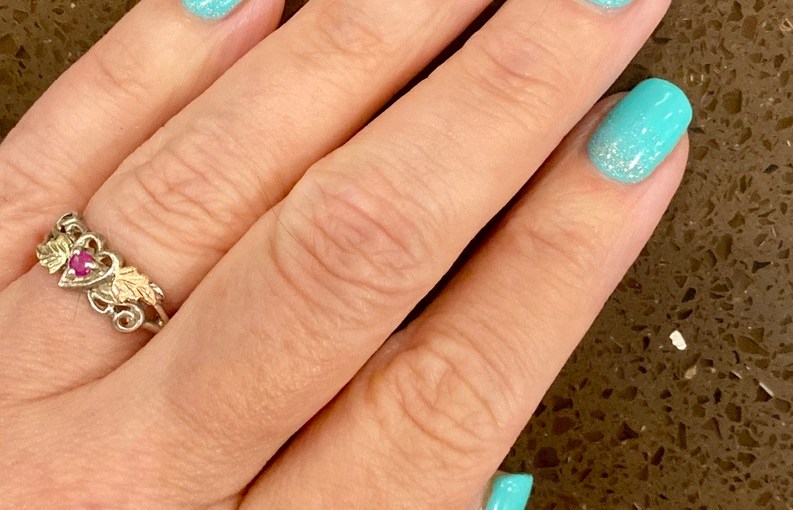
As I packed for the weekend away, my bare finger felt almost dangerous. My agitated mind sent one message: put something on that finger. I upended my jewellery box, searching for a ring — any ring — that would fit. I found the one in the photo. It was my mother’s, and I’ve never worn it. But it fits.
I assumed that this mild panic was about familiarity. That I didn’t want to go someplace new without feeling ‘secure’. I didn’t at first question what ‘security’ might mean for me. And how or why I didn’t feel secure without my rings.
At the wedding itself though, other things became clear. The replacement ring didn’t dispel my discomfort. Something had been triggered, and I couldn’t stop it. I felt exposed, like all my old dreams of being in a nightgown, naked.
Just to be clear: I am 58. I have been married/with the same person very happily for nearly 37 years. The sexual abuse perpetrated by my father stopped when I was around 15 years old, 43 years ago. For the last 30 years or so I never feel anything but safe in social situations.
And yet. It took hardly anything for the feeling of being ‘dirty’, ‘defiled’, to rush to the surface. Here I was again, face to face with the same old fears, all because I wasn’t wearing my wedding rings. At the wedding, I found myself watching where I walked and who I spoke to. I couldn’t help it. At times like these, times I remember so well happening again and again, I feel transparent, my shame, my dirtiness, my ‘sin’, on show for all to see. At times like these I think men can smell me, follow my scent, knowing that they can use me and throw me away. That I don’t matter, am not important.
In the event however, I was fine. The young men in this group — about a dozen of them — are warm, caring and protective. Somebody may have briefed them (my son?), but I was looked after all night, and included in everything. I felt very safe with them, never uncomfortable, despite a couple of panicky flutters I recognised from the past, directed at the older men in attendance: he’s looking at me LIKE THAT. I must avoid him. Etc.
Again, for clarity: I am 58. I am a feminist. In my everyday life, I am afraid of very little, and I am comfortable in my own skin. I enjoy being a woman, and I even enjoy at times feeling attractive. In my everyday life I want to be attractive in some way, I want to be authentic, sunny, real. Myself.
But it doesn’t take much for all of this to evaporate. You would think that my holiday nails in evidence in the photo would serve the purpose of making me feel invincible and attractive in some way. But they don’t. I am already in that place which feeds into the old narrative that the Abused Me is indeed my Real Self, and that abusers can see this, always.
Fortunately, I could think and feel my way through all this crap. I had a great time at the wedding, and am thankful for the love and care which surrounded me at all times. But the weekend was a reminder too that the fear always remains. As does the damage. As victim/survivors, we scrabble our way to health, to being loved and loving. If we are lucky we are able to stand straight at the top of this awful rock face, knowing our Real Selves. At times though it doesn’t take much more than a moderate breeze to send us over the edge again, climbing back to the top by our fingertips.
An excerpt from LEARNING TO SURVIVE. The fear is so deep, so constant, especially at first.
***
I learn to look for opportunities to be away. These must not be too often with friends; he gets jealous, and interrogates me late at night in my room. He looks for a chink, a white lie, that says I am meeting or involved with a boy, though he never finds one, because I never am.
Babysitting is heavenly. By age 14 I have four or five families on the go, and I end up out most Friday and Saturday night for years, New Year’s Eve as well. He waits up for me when I get home – but it’s late, 11.30 or midnight, and although he may block my path with questions, ‘saying goodnight’ is not plausible…. So the freedom of the evening continues as I rush down the stairs, change, fall into bed, and sleep, knowing he will not, will not, be down here tonight.
Very occasionally I sleep over at a friend’s house. But I am on edge. If they have a father at home, I feel exposed. He will see something, he will know. He will sense it, like a dog, and come asking too. He will know that something is wrong with me.
And once the father of very young kids I babysit in the neighbourhood offers to walk me home. It is late, and he is worried. I refuse, but he and his wife press: I cannot walk alone. So we set out. My familiar distraction technique works, and I talk, not letting him get a word in edgeways, keeping him away. I let him take me to within sight of my house, and then I run the rest of the way. Every man will take advantage of you if you let them.
So. My post shame (part 1) tackled (somewhat) the pervasive and wholesale shame that Child Sexual Abuse survivors often battle. The kind of shame that constantly threatens to undermine you (me): I should have stopped it; I’m dirty and will always be dirty; everything I attempt will fail; I will never be happy because I’m not worth it.
There is, however, another kind of shame. A very specific kind, which is very, very hard to talk about. I want to tackle this aspect now, because I feel like we don’t address this often enough — and for me, it was a huge thing both during the abuse and afterward. Off and on, I still struggle with it.
The shame I’m talking about is the shame that comes with having a body which can react physically, no matter how hard you try NOT to react, to preserve your shell.
Those of us who have been abused in childhood learn too fast and too early that the mind and body are at once connected and disconnected. It’s important here to remember that in the case of being groomed (like I was, and many if not most CSA survivors were), there is little violence. Instead, there is coercion, manipulation, softness, (false) declarations of love, etc. Therefore often — not always, but often — the body responds in the way that bodies respond naturally to touching without violence. The way that adults understand their bodies to be preparing for a sexual encounter, whatever that may entail.
When this happens — when a girl ‘gets wet’, or a boy has an erection etc — the shame is so overwhelming, so horrifying, that, for me anyway, I hated myself. Because as children we don’t want this to happen — but we have no control over our bodies, no control at all. And yet this is happening anyway.
I tried — desperately — to get some control over my body. When that didn’t work, I opted for secondary control: I became determined not to move, or speak, or respond in ANY way that I could control. I deliberately became stone, separate from my body.
I suspect this reaction is common. It preserves something, it makes us feel like we still have a little bit of ourselves.
However. Imagine carrying this ‘I must stay separate from my body’ message into adulthood, into relationships with people you care about, with people you want to be responsive and sexual with. The profound shame around sexual intimacy — for me anyway — springs from a hard-wired message I sent to myself during the abuse: this is disgusting; I hate my body; I hate myself.
Most survivors swing wildly between being terrified of sex on one hand and not valuing sex on the other, once they reach teenage years and beyond. I was at first terrified, and then — sex didn’t matter. At all. The root of this behaviour was shame, which easily morphed into self-disgust and self destruction.
All survivors I know have had to work hard at one time or another to figure out how to be intimate and have sex at the same time. How to hang on to everything about it, and not ‘check out’, dissociate, from the situation. That’s the easier option, and most survivors can do it instantly and with very little effort: boom, I’m not here. Do what you want. I’ll come back later.
I don’t know exactly how I’ve reconciled the physical responses of a child with the physical responses of an adult. It’s taken a long, long time not to back away, and to feel that this is right, not shameful. Not embarrassing. And that I’m not oversexed or weird for reacting at all.
I’m assuming that TRUST is the lynchpin. I’ve been with the same man, very happily, for nearly 37 years. But there were things I (and he) had to learn and accept along the way: I had to learn to say No sometimes, and we both had to learn that this did not mean the end of our relationship. I had to learn to acknowledge fear and embarrassment in the moment, and then we had to find a way through together.
None of it has been easy. And there were times when I wish I could just ‘go away’ in my head, like I used to. Because dealing with shame, and deep damage to the self and relationships — all this is painful. And not my fault. The blame lies elsewhere — with my father, though he never accepted it — yet my body and mind, they carry ALL the shame. And it is hell to defuse. So infuriating. Another thing we have to ‘fix’, though we had NOTHING to do with the breaking.
An excerpt from LEARNING TO SURVIVE, directly about this.
***
In my memory, he touches me every night, and some mornings. All the time. But this cannot be true. Can it?
The episodes – the days, places, ages – blur into each other. Forgetting the actions forgets time, chronology. Only fragments can be dragged to the surface.
At first, there are no words. Before the room in the basement is built, there can’t be, because I am sharing with [my half brother]. For similar reasons – I’m guessing – these times don’t seem to last long either.
I always lie on my stomach at first, because he reaches the very least of me that way. I try to be as small as possible, as asleep. As silent, as still. As like stone.
I am eleven years old.
Even in this upstairs room he slides his hand into my pyjamas. I have stopped wearing nightgowns, deliberately, and try to wear underwear when I can. He slides his hand under both and slowly creeps it down, rubbing my back the whole time. He feels there, rubbing. He keeps rubbing. And it becomes wet. He sighs. He rubs more.
I am angry. I am so angry at myself. Later, in the downstairs room, he will ask if it feels good. How about this, and this?
There are fleeting moments now and forever when I am in control, when I find something within my power to withhold. This is one of them: I am always like stone.
Obviously, mine centred around my memoir LEARNING TO SURVIVE, and my connected work to do with Child Sexual Abuse.
It was such a very good thing to do. Lucinda was wonderful, the audience was palpably attentive — and I felt like some of what fires me in this world for the last couple of years took flight.
The interview is necessarily general in some ways, but does bear witness to some of my own experiences, my own lived experience, the nature of it, and touches on the beginnings of how this all has impacted my life, and lives of so many others.
I want to thank everyone who came, and everyone who shared their own experiences then and subsequently. We are in this together. We are making progress and raising awareness. Together.
The link to the interview on the Goldster page is here. It is free to access. Scroll down to the ‘most recent’ programme.
I’ve been thinking a lot about what holds survivors of Child Sexual Abuse back — from telling someone, from seeking help — and pushes them toward desperation and too often, self destruction. What directs us at all costs away from feeling like victims.
Because a victim must be helpless. And powerlessness feels like weakness, close even to complicity.
Victims of Child Sexual Abuse are NOT weak. No way. They are, indeed, some of the most resilient and tenacious people you will ever know in your life. They — we — have to be. We had to find ways to survive. To preserve, somehow, parts of ourselves.
One of the ways we protect parts of ourselves is to excise — to extract, remove, rip out — or ignore, brush over, push down — toxic feelings which the abuse forces upon us, the most pervasive of which is probably SHAME.
Guilt is a feeling you get when you did something wrong, or perceived you did something wrong.
Shame is a feeling that your whole self is wrong, and it may not be related to a specific behavior or event
SHAME is the feeling that the whole self is wrong. Yes. I cannot emphasise this enough: and if the whole self is wrong, then anything the self does is… wrong. Life, and living, can become One Big Wrong Thing. Shame can become something that feels impossible to row back from, to know where even to start.
And because it’s so comprehensive, so all encompassing, most of us disconnect at some point. Something in us insists on being preserved, remember. Our instincts are always first for survival. We are hanging onto every last bit we have — which usually doesn’t feel like, or isn’t, much.
In order to do this, we don’t tell, we often don’t admit the abuse even to ourselves. We bury the fact of the abuse, we mummify it. When I first faced the terror of having been abused, the damage and shame, I used to think of my life as being on parallel train tracks. And I thought I had ‘jumped tracks’, I hoped permanently. That train track over there is the ‘bad’ part of me. I’m NOT on that track. I’m on this track here, a long way from shame.
However. The train tracks of shame run parallel to our lived reality whether we like it or not, whether we know it or not, no matter how hard we try. And sometimes, often, the tracks converge at an unexpected junction. Sometimes there’s a wreck. Sometimes the choking feeling of shame just emerges, triggered. And then if we’re lucky, the trains part ways and we are okay for a while.
This all-consuming shame is not a coping mechanism. It is the opposite. It is engendered by our abusers. It is planted there, inside us, and grows, completely out of our control. In fact, drowning in shame prevents us from coping; it cripples us.
Shame feels dirty. We feel dirty. We don’t want anyone to know that we must be dirty. We do everything we can to stay off those tracks. But sometimes we get stuck on those tracks, those shame tracks, for a long long time.
We need to keep reminding ourselves that the shame we feel is NOT ours; like the abuse itself, it was FORCED and/or MANIPULATED onto/into us. This shame is not an authentic part of us. This shame tells us we have done something — EVERYTHING indeed — wrong, and that it is all our fault.
But NOTHING — ABSOLUTELY NOTHING — ABOUT THE SEXUAL ABUSE WE ENDURED AS CHILDREN IS OUR FAULT.
Despite us ending up carrying the shame, and despite so few convictions for CSA, so little awareness, and so much surrounding disgust and horror:
NONE OF THIS IS OUR FAULT.
So what do we do about this shame? What do I do about it? Well, I run from it for years. I keep it so firmly on those other tracks that I can’t even name it. I’m not a victim, I tell myself, I am not brimming with self-disgust, emptied of all else.
Yet the energy required to run on two tracks (at least) at the same time eventually defeats me. For me, and only for a short while, the tracks converge and crash, never to be separated again. I have to figure out what to do about this ‘other Patricia’ — the one for whom everything is wrong, everything is dirty, everything is impossible. The shamed one. The one ashamed of simply beingalive. Yet alive she is, and hurting.
As I have said so many times: I was lucky. I am lucky. I had help. I had love. I had a few people to catch me when I was falling so, so fast.
It’s horrible to feel so worthless. So useless. So used. So left on the tracks to die.
I don’t know how to dispel pervasive shame. I do know that words alone don’t do it. Words alone don’t do much, when it comes to emotions beyond and before words, and emotions that flourish in a place where there are no words.
In my own life, DOING has helped me overcome shame (most of the time). I have walked the walk until somehow I am really walking it, with my whole heart. I speak out. I don’t hide. I vent. I rail. I don’t Give. A. Shit. I put that shame over there, scream at it, beat it with my fists — and show it that once and for all, I have survived.
I raise my children to know these stories exist, my story exists. I don’t speak to my father before he dies (after 35 years’ estrangement), nor my stepmother, still counting. This is me DOING. This is me BEING how I want to be, how I imagine my best self to be: passionate, strong, thoughtful, committed, loving. I take care of the Patricia he hurt; I look after her. I understand that he never knew the ‘real’ me. Never. And that he never will.
I do this until I believe in and am able to enact these things. Which is moment to moment, and always pretty much now.
***
An excerpt from LEARNING TO SURVIVE, when I realised I ‘just’ need to hang in there, that I have another ‘self’. That I will certainly escape.
***
Most years we drive further south at Christmas – to see either [my stepmother’s] parents in Florida, or Ommie and Granddaddy back in Texas. It takes about three days.
To save money we all stay in the same room in the motels along the way. For me, it is another welcome splash of rare freedom: he won’t dare, for sure.
One such night he is changing. [My siblings} and I are all piled into the other double bed. My father misjudges, and his penis flaps between his legs, which he then catches as he slams his legs back together. [My siblings] of course think this is completely hysterically funny, and it’s contagious, because then I’m laughing too. My father instantly loses his temper, and after dressing, comes over and throws back the covers, slapping me and one of them – whoever is in reach – hard on the bottom.
That shuts us up quick. It is the only time I ever remember being physically punished my whole childhood. Even then, as now, I am struck by the ludicrous hypocrisy of it all: does he really think it needs hiding? He has tried to get me to do things to it, with my mouth and hands.
In my last journey south with the family, I am nearly 17. The abuse has stopped. We are still all in the same motel room.
I have been involved with Suzanne for nearly a year.
In this final motel room, my father is irritated. He is irritated and unreasonable about everything. I know he is somehow angry at me – Suzanne, I reckon – and I don’t care. He can’t and won’t corner me tonight.
I leave the hotel room, taking T S Eliot’s Selected into the bleak and fluorescent lit corridor. Being in a secret love – which he cannot reach – I cherish my solitude. I lie down on the sofa bench there, and open the book.
The winter evening settles down
With smell of steaks in passageways.
Six o’clock.
The burnt-out ends of smoky days.
And now a gusty shower wraps
The grimy scraps
Of withered leaves about your feet
And newspapers from vacant lots;
The showers beat
On broken blinds and chimney-pots,
And at the corner of the street
A lonely cab-horse steams and stamps.
And then the lighting of the lamps.
It is a familiar section, and one I know then and now by heart. That night, as I’d done so often before – in a pattern I’d set up since the moon landing – I imagine a home I will make somewhere else. On Eliot’s streets, even. I invent the fronts of the houses, the shapes of the rooms, the soft blankets, hot chocolate, smell of wood on a cold night. In my head, this house is always very tiny, and I am almost like a doll, hiding there. But alive, living, and alone.
Suddenly – and it’s like a flash, like a fact blooming in me – I know that I will make a home somewhere else. That this is not a dream. It is real. And that the home will be for real people, not dolls: that I really can leave. That I really am leaving. In 20 months I will be leaving for university, leaving my father and his petty disgusting ways. And there is absolutely nothing he can do about it. I can leave! I really can. And will.
Two or three times in the last couple of months I’ve ended up in conversations about Child Sexual Abuse — with friends at hydrotherapy, and line dancing. Not soul mates, but folks I talk to and who talk to me. Whom I’m glad to see, and vice versa.
It has been a long time since I’ve disclosed to acquaintances. And I’ve come so far in such a short time when it comes to being open, not apologising, not rushing to make them feel somehow okay about my experiences — so far indeed, that I have been surprised all over again at the responses:
oh, it hardly bears thinking about, paired with a pursing of the lips. Horror.
this happened to YOU? (to someone middle class, educated, from a ‘good’ family)
it turns my stomach, said with a flat hand outward, keep it away. Disgust.
Sigh. There is SO MUCH work to be done, still, in order to have ‘normal’ conversations about CSA. So many misconceptions, factual and psychological.
We MUST think about child sexual abuse, as upsetting as we find it. Not acknowledging its existence perpetuates it. Silence creates secrecy. It perpetuates abuse. This is a simple equation.
Abuse doesn’t happen ‘over there’ somewhere. Abuse happens everywhere. But the stigma surrounding it — that it only happens in ‘bad’ households, in ‘deprived’ areas, to ‘uneducated’ people — ensures it’s kept at arm’s length. Refusing to acknowledge how widespread it is — you guessed it — perpetuates it. If people don’t believe it happens everywhere, they won’t believe it happens anywhere near them. So it will continue. Another simple equation.
Sexual abuse IS disgusting. But for 1 in 6 children, it’s a REALITY. These children don’t have the luxury of turning away in disgust. By not acknowledging this reality — again, as upsetting as it is — again, we perpetuate abuse. We abandon children to the perpetrators.
The shock of sexual abuse is real. Finding out that a friend or acquaintance was abused, or that a child you know is being abused, is pretty awful. There’s no getting around that. We all know abuse is BAD.
I’ll admit that it’s easy for me to forget how upsetting those who have not been abused or are not involved in intense dysfunction can find the whole idea of sexual abuse. I probably mention it several times a day in conversation, and have done now for a few years. It’s my ‘normal’.
However. Hear me out. NORMALISED doesn’t mean that CSA is RIGHT or OKAY. ‘Normalised’ means in the open, discussed — not ignored, skirted around, backed away from. ‘Normalised’ means part of a life. A sad part of life, an upsetting part of life, to be sure — but day to day reality for perhaps 15% – 30% of families in the UK right now (the victims and their families, and the perpetrators and their families).
When we ‘normalise’ CSA we aren’t saying it’s ‘fine’. We are saying this happens. Everywhere, and to every kind of person, across all ages and stages. We are also saying perpetrators are close by. We are also saying be alert, make space for children to disclose, be open to the possibility. We are saying: we see this, and we want to stop it.
The gap between survivors for whom CSA is an openly discussed reality, and those fortunate enough to claim they have ‘never known anyone’ who has been abused, those who are so horrified that they physically and mentally turn completely away — this gap is hard to bridge. We need to be able to acknowledge the awfulness of abuse, the horror of it indeed, alongside being able to take practical steps to help, to raise awareness, to see it as possible anywhere, and possibly perpetrated by someone in or well known to the family.
CSA is a terrible thing — destructive, damaging, a lifelong sentence for survivors and their loved ones. But not allowing ordinary conversation and awareness of CSA is another kind of terrible, the kind of terrible which guarantees more and more suffering for those who are drowning in silence, the 1 in 6 children, the 11 million adult survivors in the UK.
***
This poem is from Learning to Survive, written within days of my father (my abuser) dying. This is the openness, the awareness, the acknowledgment of complexity I know is possible. The place where we are not keeping secrets anymore, and friends and colleagues know and understand, without horror.
I didn’t feel I could post this on Father’s Day (UK), which was yesterday. I feel I’m stepping on others’ toes, raining on parades, being a party-pooper, for mentioning that yes, I had a father. But he wasn’t really a father. No one wants to hear this, and I don’t blame them, on that day at least.
So I’m posting today. About something which has been on my mind a lot recently.
I guess — actually, I know — that I am forever haunted by the idea that I let him touch me. Swiftly followed by why didn’t I stop him? These questions are in the same area where a lot of other questions surface for most survivors. Even if they don’t ask themselves, others ask them: why didn’t you tell someone? why did you let him/her do it?
Etc.
The answers to these questions are complex. Primarily, and for every survivor I have ever spoken to, not telling has to do with fear of consequences — either within the family (everything will fall apart, everyone will be furious and hate me) or at the hands of the abuser (the abuse will be so much worse, he will actually kill me). This fear is consuming, as strong as super glue; there seems no way to loosen its grip. And too there seems nowhere to go, no one to turn to. The isolation — the forced and manipulated isolation — of a victim is profound. Certainly I believed that my father stood between me and everyone and everything in the world. That I had to go through him to get anywhere, or lie. And because he read my diaries, and because he followed me sometimes when I went out — I couldn’t ever lie or get around him.
However. I knew the abuse was wrong. I knew I hated it. I knew it was all his perversion, and that for now I just had to BEAR it. Which I did. But as soon as my (half) sister began to approach 11 (the age when my abuse started), I felt sick with an additional fear. Was he going to start on her? How could I protect her?
When I first began seeing my now ad-hoc therapist, about six years ago, I went in because I was crazy worried about my own children’s safety. For no real reason. Her first question to me was: what bargain did you strike with your father? what did you exchange?
I knew the answer to that immediately, and told her. Apparently almost all survivors strike either a spoken or unspoken bargain with the abuser, so that the abuse seems somehow for the greater good. Because we have to be able to bear it somehow.
This is my bargain. From Learning to Survive:
***
I come back from Oxford with a bit more courage and sense of self.
As usual, and soon after my return, one night I hear my father come downstairs. He knocks once, lightly, then opens the door. My lights are off. I can feel him move across the room, his cigarette breath close on my face.
I wanted to see how you are, he says. We haven’t talked in a while.
‘Fine,’ I say, ‘I’m fine.’
He rubs my arm. Are you? he says, then sighs. I recognise it as the sound of him building up to do something.
I don’t say anything; I’m so tired. I just want him to go away.
But no matter what I do or say tonight, it will happen.
He is beginning: prying my arms apart, unbuttoning my pyjama top. He asks questions as he goes this time: Is this okay? Okay? Okay?
‘Daddy.’ He’s so surprised that he stops in the middle of what he’s doing.
Yes?
‘As long as you promise not to do this to [my sister].’
What?
‘I said okay, as long as you promise not to do this to [my sister].’
He sits back on his heels. Of course not.
‘Good.’ I cross my arms again.
You’re special, he says, I thought you knew that. He sits forward again and strokes my face. No one can take your place.
[My sister] believes that he did not abuse her, at all. At the time, she must be 11, and my fear for her is all-consuming. I am afraid that when I go to college in three years, he will ‘turn’ to her. Once he doesn’t have me, I am afraid he must have someone else. So I desperately want to believe him when he says he won’t do anything to [my sister]. But I know now that this can just as easily have been another lie. And that the real reason he does not abuse [my sister] is that he cannot – practically, in the house – get away with it. Or that she is not as vulnerable, fundamentally, as me.
Or, most basely, perhaps by the time I leave, she is too old for his tastes. This is a thought which – among only a few, now, years later – always turns my stomach. But the reason might be that plain.
It is a surprise to me now, and also not a surprise somehow, that I really do believe his promise at the time to stay away from [my sister]. That I do not – again, somehow – find a way to warn her. I love her and [my brother] more than anyone in the world, and I know what my father is doing is wrong. Why do I not break my silence and protect them?
I think I know some answers to this, all these years later. Answers I could not even think, much less write, then. The first is shame: that is, I allowed him to do this. I feel, in my eyes, and, I am sure, in anybody’s – disgustingly and irretrievably complicit. After all, I let him do it. I should have stopped him.
The second is fear. I never stop being terrified, deep down, of what might happen to the family, of how much everyone – including [my siblings] – will hate me for making everything (because I am sure this will happen) fall apart, if I tell. That they will or can react in any other way does not occur to me – that anyone ever can or will react with anything but disgust, pity, and hate does not occur to me, in fact, for years.







 PATRICIA DEBNEY