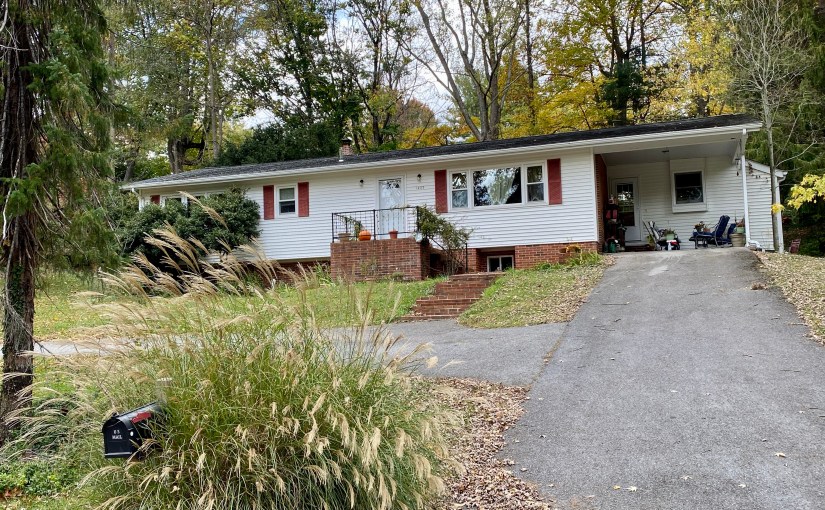
I thought I would take a minute here to acknowledge the shifting of my memoir title from Learning to Survive to Leaving Locust Avenue. First things first: a big THANK YOU to Caroline Litman, gifted writer and fellow Highly Commended author in the Bridport Memoir Awards. She read my book, and floated this title with me. I immediately knew it was right. So grateful to her for this stroke of insight.
Second: the title makes clear that this house is at the centre of the abuse. On this avenue. In Southwestern Virginia suburbia. It feels right and important to flag here that Child Sexual Abuse occurs everywhere and anywhere. Including within the four walls of my childhood home. My sexual abuse did not happen in some ‘deprived’ area, by parents who were ‘addicts’ or ‘on benefits’ etc etc… I make these points because, believe it or not, over the last couple of years I have had people say exactly these things: ‘oh I knew it happened in some parts of town’, and ‘oh but you are doing so well, how?’ etc. All judgments of not only me now, but the circumstances I and others grew up in. And a ridiculous, shaming attitude toward those who grew up differently. This attitude conveniently keeps CSA at arm’s length — over there, not in my backyard.
Once and for all, here it is: Child Sexual Abuse happens to at least 1 in 6 children across all socioeconomic levels. I am happy to provide the resources I and others, including dozens of charities and organisations, use to arrive at this — but I would also encourage you to look it up yourself if you have questions, as along the way you will find out a great deal about Child Sexual Abuse.
My father was a professor, as were many wage earners living along this particular avenue. And his crimes were completely hidden in this house. How many more houses along this street hid Child Sexual Abuse? Statistically speaking: several. Yes, almost certainly: several.
Third and finally, I come to my leaving Locust Avenue. It was the last thing I wanted to do, in so many ways. But I felt forced out, scapegoated (as I now know is typical in family cases of abuse) — and I had to do something to save myself. As followers of this blog will know, I had to leave behind my [half] brother and [half] sister after 11 years of living with them, and was forbidden from telling them anything. It was a terrible secret to keep. Feeling forced to leave my childhood home destroyed it for me, forever, regardless of any good times there.
So yes. Leaving Locust Avenue is right. It captures so much at the heart of this book.
Here is an excerpt from the memoir which recalls when I first arrived at Locust Avenue.
***
Ommie and Granddaddy take me to Blacksburg the first time [when I am six years old]. Ever the intermediary figures, with them I feel entirely at ease. I remember no feelings of apprehension or even distress saying goodbye to my mother. I don’t remember saying anything to her, or her words to me. I believe we drive up, taking the two days along the Natchez Trace, through Alabama and a corner of Mississippi, then up through Tennessee, South Carolina and North Carolina, arriving at last in deep Southwestern Virginia, in the Blue Ridge Mountains. The only clue I have to the nature of the experience is that later my grandfather tells me he catches me sleep-walking on the journey. He wakes up in the middle of the night in the Best Western, and I am standing there, with my hand on the door handle of the room, about to open it. We are two floors up, and outside there is a metal railing around the rectangle of the pool in the middle. Needless to say, he leads me back to bed.
The house on Locust Avenue, in Blacksburg Virginia, where I mostly live for the next 11 years, is medium sized. Set in a hilly suburban area, it is a single storey olive green clapboard with a steep drive up to the carport. With three bedrooms, a living room, a lounge, dining room/kitchen and two small children, until I arrive it must seem relatively spacious. There is a large flat space out back, the only flat place in the neighbourhood in fact; in later years we brave my father’s warning of killing the grass every evening in order to play kickball, softball, and ‘ghost’. It is a real neighbourhood, with at least a dozen kids of all ages in the streets, especially in summer.
Of course, I know nothing about anything at first. I am impressed by the swings under the big tree, and remember swinging in them with a kind of aimlessness, while Ommie and Granddaddy stand close by watching.
I am impressed too by my half-brother and half-sister, six months old and two and a half, respectively. Already I have missed having siblings, and this ready-made family thrills me. I remember picking [my sister] up, and half-carrying, half-dragging her down the hallway to her room, delighted I can do it. I remember [my stepmother’s] anxiety about this action, afraid I will drop her.
[My sister] is a beautiful child, with enormous blue eyes like Granddaddy’s, and long ash blonde hair. The photograph from close to this time shows her sitting serenely with her legs tucked out to one side, in a blue velvet dress with her hands folded neatly in front of her. Her hair is pulled back just at the crown, her widow’s peak emphasising her high forehead and her gentle, serious face. In the picture she looks vulnerable, like life has caught her unawares, and it is true that from the instant I walk into that house I feel protective of her.
I am ashamed to admit that in all of our years together I never really consider the effect my entrance must have on her. It is only with my own two children, with the exact same age difference, that I can see how I – this vocal, eager to please, attention seeking child – might have overrun and quieted an already naturally introverted little girl. Suddenly [my sister] is the middle one, and despite the several visits to Texas I take in the first years, she remains so until I just as suddenly leave the house eleven years later.
Both [my sister] and I, in a sense, and differently, become stranded. It is due to her quiet determination to keep in touch that we manage to communicate at all in the years after I leave the house, given what will happen.
I imagine that for [my brother], being so young, my entrance is more seamless. My earliest memory of him is noticing his bottle propped up on the cushion of the sofa while [my stepmother] prepares dinner. I remember going over to it and holding it for him; I want someone to feed him. Is it my imagination, or does he look me in the eye then? I wonder now if my deep affection for babies begins with him, with the desire to connect.
Physically, [my brother] too has the long face, the blue eyes of our family. He is always [my stepmother’s] baby though, and I have clear memories of him sitting on her lap, her going through his hair, looking in his ears, grooming him like a chimp grooms her little one. For many years, until recently, he and I fall entirely out of contact, which I regret. As with so much else, I feel I failed him. It was not my job to catch him when so many things seemed to fall apart, first for me, then for him; nevertheless, I wish I had been able to.
And what of my father and stepmother? They inspire in me no emotions, and I suppose at first I look at them as just the next set of grown-ups to take care of me. I am used to living elsewhere, so at first my father’s house is just another in a long line. I remember that he has black glasses and dark hair. I remember [my stepmother’s] long hair and long legs, her quiet, slow-moving ways. Her distance. My father teaches mathematical physics at Virginia Tech, and is at work most of the time. I remember a few arguments, raised voices, and going into school afraid that they will get divorced. But in the main, I remember no display of emotions either from my side or theirs, only the unspoken sense that I have to be good – I have to behave – in order to stay. And that staying is imperative. Underneath it all, beneath the daily smooth running of life, things are desperate somewhere, and I know it. And as is the way with children, I end up feeling like everything, all the ways in which this will or won’t work — everything ultimately depends on me.


