One in 6 children is sexually abused, 90% by someone they know and trust, within the family fold. I was one of those children. An author of five books, I now turn myself to raising awareness, breaking the silences, and sharing lived experiences of CSA (Child Sexual Abuse). We must speak and stop this. The time is now.
Today is Mothering Sunday here in the UK, so I dedicate this post to my mother, another survivor of sexual abuse perpetrated by her father.
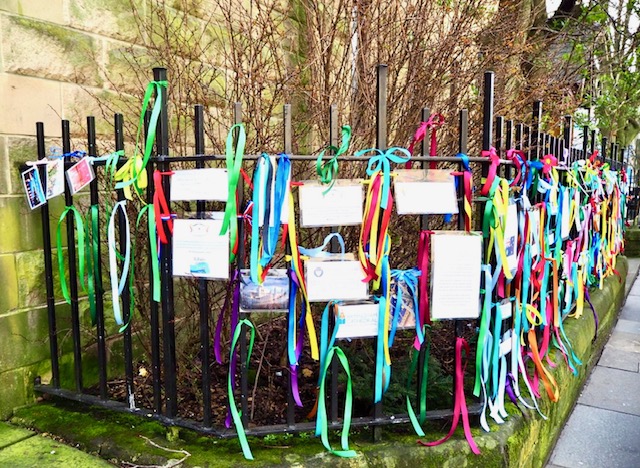
Last week I was in Newcastle (UK), where I helped do a LOUDfence on the railings of St Mary’s Cathedral. As ever, the act of tying ribbons — colourful, fluttering — releases something purposeful in me and I think in others. The tags which are attached by the ribbons recount grief, and loss, and sorrow, and in some — betrayal. They also speak of support, validation, and the determination to make a difference in every walk of life. To say loudly: we hear you, we believe you, we are so sorry. And we want this never to happen again.
A new and powerful symbol in LOUDfence is the introduction of empty shoes: children’s, priests’, religious sisters’, laity’s. They all represent people who aren’t there, who can’t be, and people whose shoes we need to walk in, to be with, and hold close. Abuse is a destructive force. It rips us from those we might love, and from the roads we might have walked.
LOUDfence is making a difference. It’s reaching beyond countries, and beyond regions. Beyond silence and silencing. Victim survivors from every walk of life can see themselves — can feel themselves held. Know that they are seen too, in some cases by the very people who did them harm.
Change comes through a gathering which reaches critical mass, a tipping over into the clear sense that we MUST enact cultural change. On all fronts.
I’m so proud to be part of this movement. Next stop: West Virginia USA in April.
***
Antonia Sobocki (founder of LOUDfence UK) asked me to write a poem for the Newcastle LOUDfence. Here it is. I am not usually one for writing to commission – I tend to freeze up! – but this time I had the gift of a pair of baby shoes I had found in my mother’s belongings after her death. Here are the shoes, and here is the poem.
(apologies for the poor quality reproduction here — the clumsiness of WordPress!)
A couple of weekends ago, I went to Cardiff for my first LOUDfence. Founder and Director of LOUDfence UK Antonia Sobocki had invited me to help launch Wales’ LOUDfence movement.
As victim-survivors, we have come to expect emotional turmoil around Child Sexual Abuse: being misunderstood, not being heard, not being ‘seen’, not being believed. We have come to expect physical turmoil too: not feeling able to go someplace (church, for instance), or revisit any childhood location without fear, or even wear certain clothes, smell certain smells, hear certain sounds — without triggers which drive us far away from our lives.
In Cardiff, I was prepared to feel a lot of this turmoil. I was prepared to feel on the outside looking in. To feel at arm’s length from the huge ‘authority’ figure called the Church. I did not expect to be moved.
I am generally not a church-goer. However, my husband’s family are Catholic, we were married in a Catholic church, etc — and I feel comfortable with a Catholic mass insofar as hymns and actions and words go. At the last minute in Cardiff I was drafted in to do the first reading, from Ezekiel. This too was absolutely fine; I am used to finding a calm place in myself from which to read, in any environment really.
Archbishop Mark O’Toole took the mass. Antonia and I were in the front pew. And as he spoke, something started to let go in me. He was soft-spoken, sad — and offered a profound apology. He took responsibility for the failings in his beloved Church. He directly addressed survivors, many of whom (it turns out) were in the congregation. He made room for their – my – suffering. For their – my – trauma. He spoke about the betrayal all of us — whether abused in association with the Church or not — had undergone, perpetrated by the very people meant to take care of us. He acknowledged his own guilt too, by proxy, in perhaps not responding as he should have, not taking note of everything he needed to, and of not making it his responsibility to understand and enact change. He showed his own pain in the face of all of this.
I began to feel he was speaking to me. Directly to me. He was saying he was sorry. He was saying that he ‘saw’ me, saw all of us survivors. And I found myself crying almost uncontrollably. It was the first time in my life — my whole 45 years of living with the debris and breakages from five years of sexual abuse when I was a child — that anyone with any authority, part of any institution AT ALL, had apologised. Sorry. Had opened their hands palms upward in a gesture of responsibility, of grief, and reparation. We are sorry.
Through his humility and gentleness, Archbishop Mark brought the part of me which feels undeserving — the broken part, the abused part — back into the centre of the Church’s responsibilities and concerns. How many times have I felt I was writing/shouting/crying into a wind which blew it all right back into my face? How many times have I felt ignored? Hundreds of times, as have all survivors. The trauma of sexual abuse haunts us, and for some of us, it haunts us most particularly in the place where witnessing faith might help: the Church. And yet: this time our words and feelings were held there. Believed. Grieved for.
It is not in my nature to be loud about my experiences of abuse. Although I consider myself an activist, I am a fairly quiet one. My activism is through my writing, through the research and arts projects I participate in, and through being open and frank about my own experiences. Over time, my transparency in every aspect of my life has encouraged numerous people to disclose their own experiences of abuse to me. Part of what I hope to do is make room for conversations in contexts which have nothing to do with abuse. What matters is that people who confide in me know that they are safe. That I won’t shout about their abuse. That they can trust me. That we are in this together.
And for the first time in my life, two weeks ago I was welcomed into the centre of someone else’s openness and transparency. For the first time, I felt that our experiences as survivors were at the centre of things, not around the edges fighting hard to be heard. I felt respected and believed.
At the end of the mass, Archbishop Mark invited Antonia and I to process out of the church ahead of him and the rest of the clergy. I reached for Antonia’s hand. We walked out together.
It was one service, yes. One priest. One church. There is still so much to do in challenging and changing our cultures both from inside and outside our faith institutions. But for me — Cardiff was an enormously powerful beam of hope. Maybe change right through to our oldest and most revered institutions is actually possible. Some of us move more quietly than others — but we are all, each of us, centring survivors, sharing our stories, trying to protect children, and, step by step, one foot after the other, shifting cultures. We are all loud now.
Archbishop Mark’s homily begins at about 26 minutes in.


 PATRICIA DEBNEY