One in 6 children is sexually abused, 90% by someone they know and trust, within the family fold. I was one of those children. An author of five books, I now turn myself to raising awareness, breaking the silences, and sharing lived experiences of CSA (Child Sexual Abuse). We must speak and stop this. The time is now.
The liminal space of airports can take me one of two ways: either I feel elated by the possibilities that travel may hold, or I feel lost, rudderless, unmoored.
It’s not surprising I guess that what with everything happening in the world right now — the latter pulled me in deep last night, as I traveled back from Germany after seeing our (beautiful, precious, smiling and laughing, curious) grandson. Thank goodness for new life, right now especially, truly.
In the airport I found myself surrounded by businessmen while waiting for my flight. All men. All working. All seemingly contained, professional.
And for the first time in years and years, I was furious at all of them — so furious that I struggled not to cry. I wanted them to be up in arms. I wanted them to show that they noticed what was happening in the world. That they knew they were privileged. That they understood their positions of power — and that they rejected this power, wholesale. Then I wondered how many of them were abusers. I wondered about the women and girls and boys in their lives: were these men good people?
Who knows. All I could see, all I could read in their faces, was that they were unperturbed. Contrary to the triggering and beyond I was going through: they felt safe. They had no reason not to feel safe.
Let’s say that again: they had no reason not to feel safe.
Then I actually did cry as the plane taxied and took flight over Cologne. I saw the lights of the city below, and knew there were thousands of abused people there — the vast majority abused at the hands of men.
We have every reason not to feel safe. I have every reason not to feel safe. I want to scream: look, why don’t you — just open your eyes! You have done this. You run the world so you always win, so you are safe, happy, prosperous — and so you can bask however you choose in the entitlement bestowed upon you by being born male, into a patriarchy.
But they are not looking. Not those men. Not then, and possibly not ever. They don’t have to.
Which is why I cried: I must look. My eyes are stuck open. Every day, and especially right now. Millions of us have to look. We have no choice but to know about all of this, from the inside — and none of us, not a single one, wants to.
We are flayed raw. We are so tired. We are so heartsore.
***
This morning the words that circled my mind in the airport at last found their poem: one of Twenty-One Love Poems, a sequence by Adrienne Rich, the great activist feminist writer, one of only two or three writers whose work has echoed through my life. I first read her poems in 1980.
I’ve added emphasis to the lines I’ve been hearing over and over….
IV.
I come home from you through the early light of spring flashing off ordinary walls, the Pez Dorado, the Discount Wares, the shoe-store… I’m lugging my sack of groceries, I dash for the elevator where a man, taut, elderly, carefully composed lets the door almost close on me.—For god’s sake hold it! I croak at him.—Hysterical, he breathes my way. I let myself into the kitchen, unload my bundles, make coffee, open the window, put on Nina Simone singing Here comes the sun… I open the mail, drinking delicious coffee, delicious music, my body still both light and heavy with you. The mail lets fall a Xerox of something written by a man aged 27, a hostage, tortured in prison: My genitals have been the object of such a sadistic display they keep me constantly awake with the pain… Do whatever you can to survive. You know, I think that men love wars… And my incurable anger, my unmendable wounds break open further with tears, I am crying helplessly, and they still control the world, and you are not in my arms.
So many are asking this question right now: survivors of Child Sexual Abuse, allies of survivors, and the general public.
Who will be charged? Who will be prosecuted? And importantly: will this global explosion around sexual abuse and sex trafficking change anything?
***
I was up at the University of York this week, diving into a set of materials gathered by relatives of a long-term survivor activist in the UK. She was clearly an incredible woman, and built her huge network brick by brick through paper, telephone, personal relationships (before connectivity of any sort). This work is a fundamental part of a larger project I am working on with some colleagues, and it’s very exciting — here’s the LinkedIn page. The project only officially started this month, but we have done work around it now for the last six months. I can go into details once the website is up, in about two weeks!
Meanwhile, the archive material around this amazing survivor activist blew me away:
she worked so hard. She ran support groups, distributed leaflets, lobbied politicians and attorneys. She involved much of London, and had strong connections throughout the UK. Against all odds, she kept going for decades. I am only now, after about five years of doing this myself, beginning to understand how much this will have cost her.
toward the end of her life, she wrote about how ‘nothing had changed’, in all her 40 years of campaigning. Her voice was as strong as ever, but she didn’t and couldn’t understand why what she and others were screaming about CSA wasn’t being acted upon. Sound familiar? I cried.
I cried too because she knew everything we know now — in the 70’s. She had statistics (which haven’t changed), questionnaires, testimonies. She wrote plainly and directly, no sugar-coating. She understood and distributed leaflets about how to keep safe. She understood manipulation, coercion, and taboo. She shouted about it all — but to what end? I am heartbroken by how painful this must have been for her.
I cried the hardest because: in the 70’s and 80’s I knew very little about sexual abuse. I had no words for what was happening/had happened to me. I thought I was the only one. I was terrified and ashamed. All I knew was that I hated it. Sitting in the archives with her vast materials, I just kept thinking if only I’d known, if only someone had said something to me, if only I’d seen a leaflet, if only I’d had someone to turn to.
And now I say: if only any of her work (and the work of many others) had been acted upon, think how many potential victims might have been saved.
***
Basically, the project above is about developing a way to archive survivor activist materials — to record past activisms, make connections, and to build upon it all going forward. So we know who has come before us, so we can consolidate their work, honour them, and effect change — rather than what we too often do now: seemingly invent the wheel era after era, and risk getting precisely nowhere therefore.
Do I think the global Epstein ‘scandal’ will lead to change? Will society begin to understand that the root of abuse is power? Will we stop blaming victims? Will we believe them? Will we change what constitutes ‘evidence’ in cases of CSA and SA? Will we acknowledge the sheer prevalence of CSA? Will we open our ears and eyes? Will we help the children — and succeed in imprisoning more than the current 2% of men and women who perpetrate abuse?
We have SUCH a very long way to go. The materials I poured through this week turned me inside out. She fought with all she had — and over 40 years later, devastatingly, almost nothing has changed.
We have to do better. We have to do better for not only the millions upon millions of survivors of CSA, but for the millions upon millions of potential victims of CSA.
So please don’t stop talking about CSA, now that the ball is truly rolling. Please be an ally. Please don’t turn away. Please accept that children are being abused all around you: that is, at least 1 in 6, 15% of the population. These are FACTS, as difficult as they are to accept.
Please raise your voices. Please commit to advocating for cultural and social change at the deepest levels. Otherwise — I’m pretty sure that everything will die down, and continue as it was. It’s the path of least resistance after all, and I have witnessed now how easily so much can be lost.
So please: let’s be the change. We need every one of you.
Safe to say it’s been a grim few days, on top of already grim days, on top of a hard year.
I was raised never to be angry. Never to disrupt. Never to raise a fuss. For abuse victim survivors of any sort, anger can bring with it a variety of outcomes, all bad: more abuse perhaps, to ‘put you in your place’; more attention, which may draw eyes to the abuse, which in turn will definitely destabilise your life — and make everything worse. This repression of anger is familial, environmentally necessary. It kept my father from flying off the handle, from making everyone suffer.
But it’s also often cultural: be reasonable. Somehow this has become the reigning metric of so many of our lives. And it has its roots in the primacy of logic. We are encouraged to stand back, to be ‘objective’.
Of course this whole ‘reasonable’ approach has the effect of removing us from our emotional selves. It downplays our emotions, our views, and ultimately is a form of gaslighting: you don’t really feel this, how could you think/feel this, and finally, you’ve got it all wrong.
Case in point: the last time I spoke to my father, in 1987, it was on the phone. I was shaking with fear and anger, struggling to hold the earpiece to my ear. I said that I wanted him to accept responsibility for what he had done to me, that it was sexual abuse. His response was to laugh, and say I’d been reading too many magazines. I then said that unless he did as I asked, he would never see any future children I might have. He laughed again.
***
In fact: he never did see my children. In that moment, that last conversation with him, I somehow managed to hold onto the importance of what I felt, of right and wrong. I somehow, and possibly for the first time, managed to speak to him, however terrifyingly hard it was — and it was — with my whole self.
This won’t be the only post I do about our whole selves, and what this means to me.
For now though I’ll say that I’ve got better at anger. I’ve got better at not always having logical reasons, at not having to explain every last thing — at just feeling something. Feeling something is not in itself threatening, not in itself dangerous.
So what do we do now with these equal measures of anger and despair? When it sometimes seems that any full-throated reaction is ‘too emotional’, ‘too political’, ‘too extreme’?
Sunday January 25th, the day after Alex Pretti’s death, I felt, like a lot of people, incandescent with rage. And grief. All day. And I couldn’t see how I was going to get out of it. Would I just have to get used to this hopelessness — would we all?
At the end of the day I had a text conversation with family. All of us are distressed. We all have loved ones in the US; we all care.
I said that I was so angry, didn’t know what to do with myself. Our younger son M wrote:
…you can have a day of being furious
…but the goal is not to trick yourself into thinking
you’re fighting BY getting angry.
In other words: anger is the justified by-product. Of grief, of horror, of despair.
But it’s not, in itself, The Fight. In itself, anger does not do any useful battle.
How do we ‘fight’ then? How do we make sure we are heard? How do we make a difference?
We are heard by being whatever loud means to us — through the written or spoken word, through image, through music — in our houses, on the streets, on the phone. By breaking barriers, pushing through the societal and familial boundaries we have been hesitant to question before now.
It is very much time to ask questions and demand answers, and to keep doing it, to press and press at it all. I think we know this. It’s time to stand together. To break all the silences which form the hierarchies which control our lives — the ‘families’ if you will, which declare how we should act and what we should say.
Nope. No more. It’s time.
I’m so grateful to son M for giving me some clarity through my overwhelming feelings. And yeah: I’m extremely proud to have played a part in raising him.
So. I spent the first nine months of 2025 feeling pretty freaked out: everything seemed worse, and likely to keep getting worse. Pillars of what most people in the world have taken to be truths and even basic human rights crumbled and continued to crumble. I for one felt that the ground I had stood on my whole life was shifting, inexorably. And I know I wasn’t the only one. I know so many felt this and continue to feel it. Unfortunately, this hasn’t changed yet in any real way.
As I mentioned in my last post, the overriding feeling for me through this became the one I dread possibly the most: we were being silenced. At every turn.
Then came the US government shutdown and the Epstein files saga. And I started to notice: wait, survivors are standing up together. With allies. At least some people are starting to build some momentum.
And then, Virginia Giuffre’s powerful memoir, Nobody’s Girl. It was being read — albeit with a kind of horror still — but it was being read. Not everyone was turning away. It was not ‘niche’ reading. It was not in a bubble. It was mainstream.
Guiffre’s experiences in her childhood home and beyond have the exact shape and tone — down to what is said, the manipulation, the physical responses of her abusers — of not only my own experiences as a victim survivor, but the experiences of every survivor I have spoken to about it.
But she then goes on. She places the abuses in the context of our cultures and our societies. She makes clear that she was not the exception. That child sexual abuse is endemic. And that it’s all about power. Many — across mainstream media, and certainly across socials — sat up and took notice in ways I’ve not seen before.
If you haven’t read the book — read it. It may be triggering for some of you, so take care. And some of you will find it very upsetting. What I would say to that is: welcome to our world. Survivors carry aspects of her story — as she did — every day, day in, day out. We don’t have the luxury of ‘not engaging’ with abuse. We have lived it, and it will never go away.
I’m just stating facts.
***
It’s tempting to turn away from activism — whether quiet or loud — because more often than not it meets with disbelief, horror, embarrassment, or dismissal.
And yet, somehow this latest series of events hasn’t skidded to a stop at a dead end. Somehow a ball is still rolling.
In 2017, the #metoo movement went viral. Begun by a survivor of child sexual abuse, Tarana Burke several years before, it gathered sexual violence as a whole under its umbrella. Various offshoots developed, including #metooinceste, which started in France.
However. From my and other CSA survivors’ I know points of view — we never really felt heard with #metoo. Like so many, I have been sexually assaulted as an adult, and I felt #metoo supported these disclosures. But despite the origins of the phrase, I never felt that it could hold Child Sexual Abuse, or CSA. The viral wave swept it elsewhere. Soon, any hint of #metoo in relation to CSA simply disappeared.
Something is happening now though. Does anyone else feel it? NOT just around Epstein and his cronies (including we know who). But around the whole space of CSA. In the last six weeks or so, my Threads and Bluesky and even Instagram feeds have been flooded with disclosures, with CSA survivors who have never before gone public about the abuse they suffered — now feeling safe to disclose, or that it’s necessary to disclose, or that they know it’s time to disclose, to connect some dots, to be here in solidarity. And the vast majority of these disclosures identify family and family friends as perpetrators. Unsurprisingly.
One way or another I’ve been working in this space for about six years. And almost the whole time, I have felt that my words, my experiences, my desire to connect and amplify — to make a change, somehow — have had almost no impact beyond the (beautiful!) survivor activism community. My greatest frustration — the thing which has done me in time and time again over the years — has been the sense that we are not being heard. That no one is really — really — listening.
I feel a shift now, though. A lasting shift, I hope. A solidarity across ‘types’ of sexual abuse is coming to the fore, a space for all survivor stories and testimonies. As are vocal allies, who are saying over and over, in public and on socials: ‘listen to survivors’, ‘believe the survivors’. I am sensing that there is a gathering together of activists, survivors, and allies into what we have long been working for: a survivor-led #metooCSA movement. We are gaining critical mass — for our voices, and for change.
Thank you always Tarana Burke, for your courage, and your words.
I have been writing and re-writing this post in my head for months.
What happened? I considered this for weeks.
What I did not want to admit (to myself, or anyone) was how completely shaken I was by the re-election of an abuser to the White House. His re-emergence, followed by lawless action after lawless action, rendered me almost paralysed.
What is the point of working away in my small corner of the fight against Violence Against Women and Girls, when the whole world order has turned justice on its head?
More pointedly: every survivor I know hears an abuser in his voice. An abuser, and a bully. We have all known this since at least 2015. We all recognise it. And for the last 10 years, we have not been heard. And as we all know: when we talk and no one hears, we are silenced, again.
It took me several months to realise that I was simultaneously triggered and silenced by happenings in the US. Again and again I felt that any voice I had ever had was useless. I see now that I have spent the last year being re-traumatised, over and over.
The reality is: the country where I grew up is being dismantled. The values I thought we all shared (more or less) have evaporated. Any ‘noise’ I might be able to make surely disappears into thin air.
I remain pessimistic when it comes to the US managing to take care of its people. This feels a very long way from achievable at the moment.
However. In the last few months, the plight of the Epstein survivors, and the involvement of men and women who occupy the most wealthy and powerful positions in the world in their trafficking — have crashed my worlds together.
Thing is: we are all the same. As survivors, we are all the same. Whatever our backgrounds, whomever our abusers. Whether ‘it’ happens once, or repeatedly over years and years or perpetrator after perpetrator: we must join forces. Our homes (or lack thereof) made us vulnerable to sexual abuse; in this, we are a community.
We must not allow the isolation that inevitably accompanies our abuse to silence us. We must not consider some peoples’ experiences of abuse more harmful or ‘worse’ than others. We must understand that we are in this together, all of us.
Only then will we be able build upon the voices and experiences of survivors toward real cultural and social change: toward accountability, restitution, prevention.
I come to this post today through partially gritted teeth. I’m not sure if any of this will do any ‘good’. But I can’t not try. The last year has shown this to me in technicolour: I have to keep trying. I have to. The one thing I know is that I would do anything to save a child from going through what one in six of us goes through, worldwide. To that end, I have managed to keep going with a couple of projects, quietly, which will soon come to a kind of fruition. But I know I need to use my voice too, publicly. It’s so important that we do this if we can. And I can.
Today is Mothering Sunday here in the UK, so I dedicate this post to my mother, another survivor of sexual abuse perpetrated by her father.
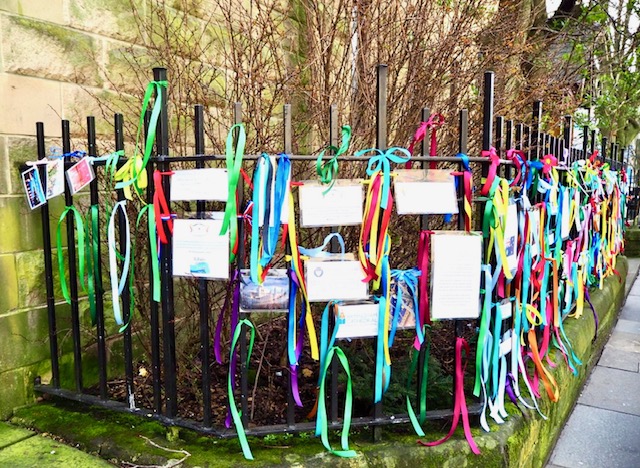
Last week I was in Newcastle (UK), where I helped do a LOUDfence on the railings of St Mary’s Cathedral. As ever, the act of tying ribbons — colourful, fluttering — releases something purposeful in me and I think in others. The tags which are attached by the ribbons recount grief, and loss, and sorrow, and in some — betrayal. They also speak of support, validation, and the determination to make a difference in every walk of life. To say loudly: we hear you, we believe you, we are so sorry. And we want this never to happen again.
A new and powerful symbol in LOUDfence is the introduction of empty shoes: children’s, priests’, religious sisters’, laity’s. They all represent people who aren’t there, who can’t be, and people whose shoes we need to walk in, to be with, and hold close. Abuse is a destructive force. It rips us from those we might love, and from the roads we might have walked.
LOUDfence is making a difference. It’s reaching beyond countries, and beyond regions. Beyond silence and silencing. Victim survivors from every walk of life can see themselves — can feel themselves held. Know that they are seen too, in some cases by the very people who did them harm.
Change comes through a gathering which reaches critical mass, a tipping over into the clear sense that we MUST enact cultural change. On all fronts.
I’m so proud to be part of this movement. Next stop: West Virginia USA in April.
***
Antonia Sobocki (founder of LOUDfence UK) asked me to write a poem for the Newcastle LOUDfence. Here it is. I am not usually one for writing to commission – I tend to freeze up! – but this time I had the gift of a pair of baby shoes I had found in my mother’s belongings after her death. Here are the shoes, and here is the poem.
(apologies for the poor quality reproduction here — the clumsiness of WordPress!)
A couple of weekends ago, I went to Cardiff for my first LOUDfence. Founder and Director of LOUDfence UK Antonia Sobocki had invited me to help launch Wales’ LOUDfence movement.
As victim-survivors, we have come to expect emotional turmoil around Child Sexual Abuse: being misunderstood, not being heard, not being ‘seen’, not being believed. We have come to expect physical turmoil too: not feeling able to go someplace (church, for instance), or revisit any childhood location without fear, or even wear certain clothes, smell certain smells, hear certain sounds — without triggers which drive us far away from our lives.
In Cardiff, I was prepared to feel a lot of this turmoil. I was prepared to feel on the outside looking in. To feel at arm’s length from the huge ‘authority’ figure called the Church. I did not expect to be moved.
I am generally not a church-goer. However, my husband’s family are Catholic, we were married in a Catholic church, etc — and I feel comfortable with a Catholic mass insofar as hymns and actions and words go. At the last minute in Cardiff I was drafted in to do the first reading, from Ezekiel. This too was absolutely fine; I am used to finding a calm place in myself from which to read, in any environment really.
Archbishop Mark O’Toole took the mass. Antonia and I were in the front pew. And as he spoke, something started to let go in me. He was soft-spoken, sad — and offered a profound apology. He took responsibility for the failings in his beloved Church. He directly addressed survivors, many of whom (it turns out) were in the congregation. He made room for their – my – suffering. For their – my – trauma. He spoke about the betrayal all of us — whether abused in association with the Church or not — had undergone, perpetrated by the very people meant to take care of us. He acknowledged his own guilt too, by proxy, in perhaps not responding as he should have, not taking note of everything he needed to, and of not making it his responsibility to understand and enact change. He showed his own pain in the face of all of this.
I began to feel he was speaking to me. Directly to me. He was saying he was sorry. He was saying that he ‘saw’ me, saw all of us survivors. And I found myself crying almost uncontrollably. It was the first time in my life — my whole 45 years of living with the debris and breakages from five years of sexual abuse when I was a child — that anyone with any authority, part of any institution AT ALL, had apologised. Sorry. Had opened their hands palms upward in a gesture of responsibility, of grief, and reparation. We are sorry.
Through his humility and gentleness, Archbishop Mark brought the part of me which feels undeserving — the broken part, the abused part — back into the centre of the Church’s responsibilities and concerns. How many times have I felt I was writing/shouting/crying into a wind which blew it all right back into my face? How many times have I felt ignored? Hundreds of times, as have all survivors. The trauma of sexual abuse haunts us, and for some of us, it haunts us most particularly in the place where witnessing faith might help: the Church. And yet: this time our words and feelings were held there. Believed. Grieved for.
It is not in my nature to be loud about my experiences of abuse. Although I consider myself an activist, I am a fairly quiet one. My activism is through my writing, through the research and arts projects I participate in, and through being open and frank about my own experiences. Over time, my transparency in every aspect of my life has encouraged numerous people to disclose their own experiences of abuse to me. Part of what I hope to do is make room for conversations in contexts which have nothing to do with abuse. What matters is that people who confide in me know that they are safe. That I won’t shout about their abuse. That they can trust me. That we are in this together.
And for the first time in my life, two weeks ago I was welcomed into the centre of someone else’s openness and transparency. For the first time, I felt that our experiences as survivors were at the centre of things, not around the edges fighting hard to be heard. I felt respected and believed.
At the end of the mass, Archbishop Mark invited Antonia and I to process out of the church ahead of him and the rest of the clergy. I reached for Antonia’s hand. We walked out together.
It was one service, yes. One priest. One church. There is still so much to do in challenging and changing our cultures both from inside and outside our faith institutions. But for me — Cardiff was an enormously powerful beam of hope. Maybe change right through to our oldest and most revered institutions is actually possible. Some of us move more quietly than others — but we are all, each of us, centring survivors, sharing our stories, trying to protect children, and, step by step, one foot after the other, shifting cultures. We are all loud now.
Archbishop Mark’s homily begins at about 26 minutes in.
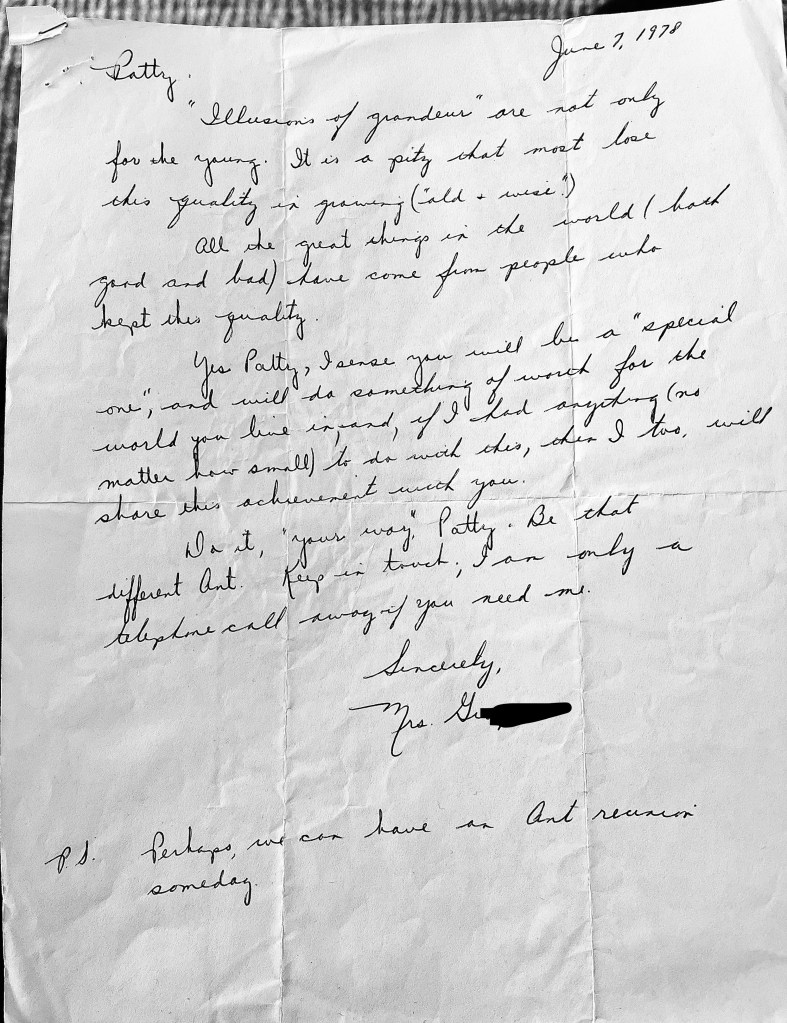
Over the weekend I discovered a note given to me by my Social Studies teacher when I was 14 (1978). I clearly remember the circumstances surrounding it: my father or my stepmother had told me that I had ‘illusions of grandeur’. I went to this teacher, Mrs G, upset. Ever since I could remember, I had harboured feelings of wanting to do something important, something meaningful. I don’t know why I apparently confided in my father or stepmother — but I do remember being very hurt by them. I felt belittled.
Mrs G however: as the note above shows, she believed in me. For my part, I adored her, absolutely adored her (as I did many teachers throughout my formal education, feeling handed between them like a baton in a relay race, for safe keeping). She was mischievous, an individualist, and taught me more about good essay writing than anyone else, before or since.
I must have kept this folded piece of paper because it helped. She believed that I could do something. And she would know. She would know, I thought, possibly more than my father or stepmother would. She was in the world in ways they weren’t — I sensed this, already.
Now though what strikes me about this note are the words at the end: ‘I am only a telephone call away if you need me.’
I have no memory of these words. No memory of that level of care at this age — the age at which I now know some of the most harrowing and damaging instances of sexual abuse occurred, seemingly relentlessly. I wonder what I thought about those words then? Would I have considered speaking with her? Would I have ever thought about phoning?
And why such a pointed offer of help? Did I show more than I think I did? Did she suspect anything?
I was a very high achiever throughout my formal education. I was not shy. I had friends. I was principled, political, and often revelled in being ‘a bit different’, particularly in terms of fashion. By age 15, in the days of mostly preppie wear, I wore patent leather heels, balloon black trousers, a thrifted double breasted red top, and put my hair in tiny braids so that it was all kinky the next day. Etc. Yet: I never misbehaved. I never actively rebelled.
I now know that I stuffed the sexual abuse I was experiencing into a box in my head — and slammed the lid down tight. I did this almost from the start, almost knowingly. I remember the gut response when my mind flitted to the abuse: pay attention to what you like: forget everything else, forget it. This separation of mind and body preserved my mental health for many years. Until it didn’t. I know this story is so familiar to so many.
Recently there’s been a bit of discussion on X (Twitter) about whether signs of abuse were missed in us survivors when we were being abused. And the more I think about it, the more I become confused. Maybe there was enough ‘unusual’ about me to make teachers think, or wonder? Certainly I was always hailed as ‘very mature’ for my age — not physically, but emotionally. I often felt out of step with peers. All the talk of boyfriends, crushes, and dates — I found excruciating and terrifying in equal measure. I wanted nothing to do with it. My overriding priorities were learning, writing, and ballet. Not much else mattered very often. This might have been interpreted as ‘mature’? Was it noticeable? Was this a ‘sign’?
The truth is, I never would have phoned Mrs G, although from here I fervently wish I had been able to. And there were other teachers, after her, who often seemed to be waiting for me to say something. But what? What?
What can children say about the dangers they live in? Precious little, I think, is the answer even now. So it’s up to teachers? But that can’t be right either, as even if something (what?) is ‘noticed’ — chances are high that a child will lie when asked directly. I am certain I would have.
There are so many variations of ‘signs’ of abuse — many that are in fact seen as ‘fine’ (good behaviour, quiet etc) — that there is no rulebook here. None of us can produce a definitive list. What’s clear however is that adults in the position to notice need to be given the training and the space to act; similarly, children need to hear and see that sexual abuse can enter conversation. If there had been a space to speak, or to write, about what was happening to me — one that wasn’t judgemental, that didn’t put me in a vulnerable place, that wouldn’t pity me or think less of me, one that I trusted to look after me — I might, might have found a way to send a clear message.
But there was no space for that then. Despite Mrs G, and despite all of the kind adults in my school life as the years progressed — the thought of mentioning anything to them about the abuse I experienced never, ever occurred to me. And indeed: no one made me feel safe enough so that I knew, if asked, I could answer honestly. So I never even got close.
I’m heartened by the work of the many survivor-centric organisations and charities now on the ground, going into schools, speaking with medical students, within the police, with churches of almost all denominations, scouts organisations, community leaders etc. This is the training and awareness which is so desperately needed. I pray that the enormous differences they are making hold fast. I pray for a future in which a teacher, nurse, doctor, pastor, priest, vicar, scout leader — neighbour, friend, anyone — feels empowered to ask, carefully and with respect, knowing there is support available: is something happening? And for a future too where another child like me (like so many of us) might go back to Mrs G and be able to say: something is happening.
This extract from Leaving Locust Avenue follows what happened when I decided to move schools at 17, at the beginning of my senior year of high school. No one asked much, but looking back — I wonder if at least a couple of them wished for the space and permission to do so.
All I really remember about the decision to go is getting in the car and driving. I cannot remember whether I have permission. But I get in the car and drive a few roads, some out by S’s house which I love, in the country, between mountains.
I find myself at the shopping area close to our house. The strip mall, which used to have that A & P, a department store, a hairdresser. And a phone booth.
I park the car next to the phone booth. I phone, incredibly it seems now, my therapist. I have a plan. When I tell her, I sense her relief. I sense – oh as I have in so many situations, so many times over these years – a woman urging another woman to go, to run, to escape. She approves. She agrees. And I allow myself – for a millisecond of a moment only, so caught up in my own moment of course – to think that she too has been trapped by [my father].
Even now I am astonished that I know this from the conversation. But I do. And it gives me the impetus to phone my mother.
I phone her right there and then. I ask her if I can come live with her. I say I am ready. That I must, must leave. And I must leave now. She, to her credit, rises to the occasion. She asks me, once, if I am sure; I only have one more year in Blacksburg after all – am I sure? I say I am sure. And then – perhaps like my father 11 years earlier – she agrees with no hesitation, no consultation. She will have me.
I know I am going. I am 17 years old, and am a month into my senior year of high school. I am placed second in my graduating class, the salutatorian, only a whisker away from valedictorian. And I am leaving.
*
My childhood friend Val is perhaps the most upset about me going. I remember she starts crying, right in the classroom. She wants to know why. And I have my answer, the one I use over and over ‘I just want to live with my mother before going away to university.’
I do not realise that Val still cares about me. I do not realise, if I’m honest, that anyone except Alice really cares. Yet my going disturbs the surface, and numerous people – students, teachers – seek me out to wish me well, and ask questions. The Principal of the school asks me into his office to see if he can do anything to make me stay, and if everything is okay. To which I say No, and Yes.
Of course it is Mrs A [my English teacher] I dread leaving the most. But again, to her credit, she doesn’t try to convince me otherwise. She wishes me all the best. She tells I will succeed in everything I do. She believes in me.
I encounter a curious mix of sorrow and knowingness when I announce I’m leaving. Looking back, I think that the sorrow mainly comes from those who cannot imagine how this has happened. Whereas the knowingness, the unspoken, rises through the eyes of those who may know something or suspect.
From here, I see our joint powerlessness. I see how mistreatment, how abuse, is too often communicated in silence, implied. How it is up to the women to get away, how other women must urge them silently. How they are brave, deserting everything. Leaving everything – their children, their lives, their homes – behind. Forced to cut and run.
Whereas really it’s my father who needed to leave. Really he should have been arrested. And I should have been able to stay put, and never lost [my sister] and [my brother], the heartbreak of my life. And they in turn would never have had to carry their own complex and heart-breaking confusions – with no help from anyone — around for so many years.
It has been SO LONG since I’ve been here. As with everything, then the guilt of NOT doing something accumulates, and then there’s so much water under the bridge that… the task becomes impossible. Or feels it.
However. It is not like me to stop something or give up. There are lots of reasons — some of which I’ll post about here — why I keep repeating this to myself. Never give up.
First: the really fab news that I hinted about last time. Way back in March of this year, 30,000 words from my memoir about Child Sexual Abuse (Learning to Survive) won Highly Commended in the Bridport Memoir Awards. Soon after, I discovered that there were about 1,000 entries. Top 5 out of 1,000 entries. It has been such a joy, a real lift, to have my work validated and valued in such a competition. One of the HUGE blocks to getting stories of CSA out is the resistance of the ‘mainstream’ (whatever form that takes — whether media, arts, medicine) to hearing about these stories. Those of you who circulate in this world of survivors know all too well: the ‘mainstream’ is hugely more likely to draw back than to bear witness, or listen, or support. The ‘mainstream’, generally, turns away.
My prize in the Bridport felt like the beginning of something — at last! I have been struggling for two years to get a bit of purchase for Learning to Survive. My frustration has always been: I have published five books, one of them prize winning, and my work has been collected in various high profile national anthologies, published in newspapers etc. So WHY — why?! — is this book, a book I know is worthwhile and sound and well-written — staggering through almost universal rejection from literally dozens of potential outlets? The Bridport win gave me hope that the book may now be championed — despite the lack of precedent in the publishing world for stories such as mine (as OURS) — hope that someone may be willing now to take a risk.
Second, and alas, it’s clear now that the Bridport accolade has made little difference to the book’s future, at least in the UK. As a result of the Bridport however I have met some wonderful people, people cheering me on, people who — alongside me — are shocked that I’ve not been able to place the book. I’ve also been in touch with some of the judges/readers of the Bridport for advice from within ‘the industry’: from each, the writing is lauded (more than my writing has ever been lauded before, just for comparison), the subject acknowledged as important and vital, my handling of it ‘just right’…. but these effusive compliments are mitigated with ‘the subject is too dark to sell’, ‘maybe child sexual abuse has been done to death’ — etc. In other words: great writing, but the material itself is unpalatable. It’s scary. It’s ‘too much’ for readers. Not worth the risk for publishers. I want to scream what about memoirs about the Holocaust? What about memoirs about domestic violence? Murder? Grief? They exist, and they are ‘dark subjects’; they are horrifying and difficult. Yet somewhere along the line, someone has considered them important enough to be in circulation. Important enough to learn about, to witness. Not so Child Sexual Abuse, clearly.
I have indulged in a couple of threads on Twitter around these responses. Here, in short:
1)CSA affects at least 15% of the population, of ALL adults and children. THERE’S your readership publishers, not to speak of the millions of people who love, support, and care for survivors. It’s a huge audience, ready-made, an audience in dire need of stories which speak to their experiences. Which break the awful silence and shame, which raise social awareness. Which comfort and support, which tell them they are not alone, that there is a future for them and all of us.
2)Child Sexual Abuse has absolutely NOT been ‘done to death’. What we do hear a lot about are ‘serial’ pedophiles such as Savile, Maxwell, Epstein. What we do hear about are ‘monster narratives’ about ‘evil people’. We read about abuse that happens ‘over there’, that is NOT in our lives. We do not read about intra-familial CSA, or CSA perpetrated by someone the child knows. Which makes up 90% of all CSA. We do not read about abusive fathers, uncles, grandfathers, brothers, babysitters, boyfriends, carers. We do not read about the most common form of CSA, that which happens in our lives, right under our noses.
3)There is a clear moral imperative to publicise these stories. Given that there are millions of survivors in the UK alone, and thousands of millions of survivors around the world. Given that these victims and survivors are — wholesale, forcibly — drowning in silence. Given that most survivors of ‘everyday’ CSA believe that they are pretty much the only victims of this in the world. That they are alone in their trauma and loss and shame. Given all this, survivors surely deserve better. There is only one literary memoir published in the UK about CSA (by Clare Best), and only a very few in Europe and Australia. We deserve more. We deserve to be seen. We deserve to be included in the long list of wrongs which need righting in our world.
4) Finally: it’s insulting to label anyone’s suffering as ‘too dark’ for general consumption. Particularly if that suffering is widespread, or ultimately turned toward doing good. My book and writings, and the work of so many other survivors, exist with the explicit aims of relieving suffering and of prevention. Of reaching out, empowering, and bringing strength and hope. All of the abuse in my book is finished by 30,000 words in. The rest of the book — 35,000 words — is about survival, hope, and living.
***
I could go on. Fortunately, as you can see, my anger has returned. Anger turned inward is sadness and depression, and I admit that I have been battling these consequences over the last couple of months. I am silenced AGAIN. We are silenced AGAIN. It’s painful, re-traumatising, and heartbreaking.
I am holding on to the belief that things may be shifting. Slowly, granted, but shifting. There are hundreds of us doing work around CSA in the UK alone, and much of it makes forays into the mainstream. Recently, Channel 4 aired a documentary which told Emily’s story: her father was her abuser. Recently too, Nicole Caroli featured in the Metro newspaper — telling her story and raising awareness. (Nicole also runs an excellent blog, here.) Sophie Olson’s (The Flying Child’s) ‘Last Taboo’ Radio 4 programme, aired nearly two years ago, continues to break down barriers, as does her work with schools, midwives, social workers, etc (Sophie’s blog is here). The glorious and indefatigable Viv Gordon continues her moving performances and showcasing of fellow survivors, championing the necessity of their work. Elizabeth Shane publishes poetry and devotes her time to supporting and speaking up for survivors. Jane Chevous at Survivors Voices and Antonia Sobocki of LOUDfence (also at Survivors Voices) are frankly astonishing in their breadth and dedication to raising awareness and holding others to account in the world of CSA.
There are many more. We are forces to be reckoned with, and there are lots of us.
Many activist/survivors are old hands at this. They know the battles and are not giving up. I’m very new here. And the stark nature of these battles has hit hard. The reality that CSA is drenched in stigma and silence, at every turn, regardless of external validation and the accompanying shocking statistics around CSA — still, in the 21st century! — has hit hard. The fact that my book seems not to stand a chance in this country due to social attitudes toward something that has nothing to do with me — that was not my fault, that I did not choose, that I wish more than anything had never happened — has hit hard. Once again, I’ve had to face that none of this is my fault. Yet I still suffer the consequences.
Saying all this: I cannot give up. I won’t give up. I am able to speak when so many cannot. It really is that simple. I’m back on the horse, with my sights now turned to the US market. I welcome any tips, advice, leads. Something has to give.







 PATRICIA DEBNEY