trying to stay in the saddle

[image: the Osmington White Horse]

It has been SO LONG since I’ve been here. As with everything, then the guilt of NOT doing something accumulates, and then there’s so much water under the bridge that… the task becomes impossible. Or feels it.

However. It is not like me to stop something or give up. There are lots of reasons — some of which I’ll post about here — why I keep repeating this to myself. Never give up.

First: the really fab news that I hinted about last time. Way back in March of this year, 30,000 words from my memoir about Child Sexual Abuse (Learning to Survive) won Highly Commended in the Bridport Memoir Awards. Soon after, I discovered that there were about 1,000 entries. Top 5 out of 1,000 entries. It has been such a joy, a real lift, to have my work validated and valued in such a competition. One of the HUGE blocks to getting stories of CSA out is the resistance of the ‘mainstream’ (whatever form that takes — whether media, arts, medicine) to hearing about these stories. Those of you who circulate in this world of survivors know all too well: the ‘mainstream’ is hugely more likely to draw back than to bear witness, or listen, or support. The ‘mainstream’, generally, turns away.

My prize in the Bridport felt like the beginning of something — at last! I have been struggling for two years to get a bit of purchase for Learning to Survive. My frustration has always been: I have published five books, one of them prize winning, and my work has been collected in various high profile national anthologies, published in newspapers etc. So WHY — why?! — is this book, a book I know is worthwhile and sound and well-written — staggering through almost universal rejection from literally dozens of potential outlets? The Bridport win gave me hope that the book may now be championed — despite the lack of precedent in the publishing world for stories such as mine (as OURS) — hope that someone may be willing now to take a risk.

Second, and alas, it’s clear now that the Bridport accolade has made little difference to the book’s future, at least in the UK. As a result of the Bridport however I have met some wonderful people, people cheering me on, people who — alongside me — are shocked that I’ve not been able to place the book. I’ve also been in touch with some of the judges/readers of the Bridport for advice from within ‘the industry’: from each, the writing is lauded (more than my writing has ever been lauded before, just for comparison), the subject acknowledged as important and vital, my handling of it ‘just right’…. but these effusive compliments are mitigated with ‘the subject is too dark to sell’, ‘maybe child sexual abuse has been done to death’ — etc. In other words: great writing, but the material itself is unpalatable. It’s scary. It’s ‘too much’ for readers. Not worth the risk for publishers. I want to scream what about memoirs about the Holocaust? What about memoirs about domestic violence? Murder? Grief? They exist, and they are ‘dark subjects’; they are horrifying and difficult. Yet somewhere along the line, someone has considered them important enough to be in circulation. Important enough to learn about, to witness. Not so Child Sexual Abuse, clearly.

I have indulged in a couple of threads on Twitter around these responses. Here, in short:

1) CSA affects at least 15% of the population, of ALL adults and children. THERE’S your readership publishers, not to speak of the millions of people who love, support, and care for survivors. It’s a huge audience, ready-made, an audience in dire need of stories which speak to their experiences. Which break the awful silence and shame, which raise social awareness. Which comfort and support, which tell them they are not alone, that there is a future for them and all of us.

2) Child Sexual Abuse has absolutely NOT been ‘done to death’. What we do hear a lot about are ‘serial’ pedophiles such as Savile, Maxwell, Epstein. What we do hear about are ‘monster narratives’ about ‘evil people’. We read about abuse that happens ‘over there’, that is NOT in our lives. We do not read about intra-familial CSA, or CSA perpetrated by someone the child knows. Which makes up 90% of all CSA. We do not read about abusive fathers, uncles, grandfathers, brothers, babysitters, boyfriends, carers. We do not read about the most common form of CSA, that which happens in our lives, right under our noses.

3) There is a clear moral imperative to publicise these stories. Given that there are millions of survivors in the UK alone, and thousands of millions of survivors around the world. Given that these victims and survivors are — wholesale, forcibly — drowning in silence. Given that most survivors of ‘everyday’ CSA believe that they are pretty much the only victims of this in the world. That they are alone in their trauma and loss and shame. Given all this, survivors surely deserve better. There is only one literary memoir published in the UK about CSA (by Clare Best), and only a very few in Europe and Australia. We deserve more. We deserve to be seen. We deserve to be included in the long list of wrongs which need righting in our world.

4) Finally: it’s insulting to label anyone’s suffering as ‘too dark’ for general consumption. Particularly if that suffering is widespread, or ultimately turned toward doing good. My book and writings, and the work of so many other survivors, exist with the explicit aims of relieving suffering and of prevention. Of reaching out, empowering, and bringing strength and hope. All of the abuse in my book is finished by 30,000 words in. The rest of the book — 35,000 words — is about survival, hope, and living.

***

I could go on. Fortunately, as you can see, my anger has returned. Anger turned inward is sadness and depression, and I admit that I have been battling these consequences over the last couple of months. I am silenced AGAIN. We are silenced AGAIN. It’s painful, re-traumatising, and heartbreaking.

I am holding on to the belief that things may be shifting. Slowly, granted, but shifting. There are hundreds of us doing work around CSA in the UK alone, and much of it makes forays into the mainstream. Recently, Channel 4 aired a documentary which told Emily’s story: her father was her abuser. Recently too, Nicole Caroli featured in the Metro newspaper — telling her story and raising awareness. (Nicole also runs an excellent blog, here.) Sophie Olson’s (The Flying Child’s) ‘Last Taboo’ Radio 4 programme, aired nearly two years ago, continues to break down barriers, as does her work with schools, midwives, social workers, etc (Sophie’s blog is here). The glorious and indefatigable Viv Gordon continues her moving performances and showcasing of fellow survivors, championing the necessity of their work. Elizabeth Shane publishes poetry and devotes her time to supporting and speaking up for survivors. Jane Chevous at Survivors Voices and Antonia Sobocki of LOUDfence (also at Survivors Voices) are frankly astonishing in their breadth and dedication to raising awareness and holding others to account in the world of CSA.

There are many more. We are forces to be reckoned with, and there are lots of us.

Many activist/survivors are old hands at this. They know the battles and are not giving up. I’m very new here. And the stark nature of these battles has hit hard. The reality that CSA is drenched in stigma and silence, at every turn, regardless of external validation and the accompanying shocking statistics around CSA — still, in the 21st century! — has hit hard. The fact that my book seems not to stand a chance in this country due to social attitudes toward something that has nothing to do with me — that was not my fault, that I did not choose, that I wish more than anything had never happened — has hit hard. Once again, I’ve had to face that none of this is my fault. Yet I still suffer the consequences.

Saying all this: I cannot give up. I won’t give up. I am able to speak when so many cannot. It really is that simple. I’m back on the horse, with my sights now turned to the US market. I welcome any tips, advice, leads. Something has to give.

the cost of immobility

On the advice of my consultant, I’ve been forced into ‘complete rest’ recently. Somehow my lower back started acting up, and six weeks later not only is it not recovered, but I keep ‘setting it off’. It’s a rollercoaster.

As a consequence of my indeterminate (thus far) back issue, I haven’t been to dance or do hydrotherapy in weeks. Complete rest for me is extremely difficult. I am used to just throwing myself into things, and my body coping. The advantage of being strong and bendy is that I’ve always been able to do virtually anything without any serious consequences. I always get injuries, yes, but they clear up more or less in a few weeks. Now I am finding that things simply aren’t healing; my chronic pain has escalated, and it seems that my early arthritis (common with hEDS) is impacting everything.

So. What of mobility?

I have mentioned before here my reliance on dance as a way of shifting trauma. Dance has always been the way that I manage to stay in touch with my body — not disassociate, be grounded, be meditative, etc.

Free movement in my environment has been crucial to my mental health for decades, and, probably more than anything else, preserves my wellbeing and my belief in the future.

I noticed when I had my hip replacement operations that within a couple of weeks I felt low. Everything seemed to stop. I felt paralysed, unable to help myself. Useless. But each time, I knew the end was in sight: slowly slowly I began to move again. I had goals. I did physio diligently. And in each case, I was walking well by six weeks post-op.

My current situation is different however. The end of my immobility is not in sight. The cause of this pain and reactivity is unknown. It’s not clear that I will dance again, though I will do everything in my power to get there. I have no exercises to do, no agency in this. Except to be patient.

Which is not my top personality trait, if I’m honest!

I suspect that immobility triggers many Child Sexual Abuse survivors. There are several aspects of this for me:

  • I froze while I was being abused .
  • I could not walk or run away from my father; I was stuck.
  • I could not push my father off of me. I could not move my arms. I was afraid he would do something ‘worse’.
  • I stayed still in order to ‘disappear’.
  • I felt in danger of imploding, the withheld fear and panic inside me almost overwhelming.

Helplessness — true helplessness, powerlessness — is extraordinarily grinding. Your body seizes up much like your mind does. You turn into a rock, and cannot reach out. You cannot do anything to help yourself. You simply cannot. You feel yourself slipping into invisibility, nearly losing yourself in the process.

Immobility, for me, equals being nothing. Not being able to dance, for me, risks dissociation. It can also bring the inner turmoil of CPTSD: bad dreams, flashbacks, the ramping up of despair.

I am completely aware of what immobility means for me. But my reactions are not something I can control. They are hard-wired.

I am much stronger now than I was when I was a child, of course. I have more to live for, a lot more hope. And I know that whatever happens, I can bear it. But lasting through, time and again, does come at a cost.

***

(Side note: I won’t be excerpting Learning to Survive for a little while. I’m all good though, and am so grateful for everyone’s companionship and belief.)

final going back (6)

This is really a kind of epilogue. There was another important thing that happened when I went to the US — specifically, to Texas.

Some of you may remember the little town between San Antonio and Beaumont, where my grandparents would meet my mother, and I — like the bundle of acceptance I was then — would be passed one way or the other, depending on my mother’s health: from my grandparents back to her; or, more often, from her to my grandparents. This town is called Luling.

When I was staying with my San Antonio relatives this time, my Beaumont Aunt Lois asked if we could meet just outside San Antonio, to avoid confusion and traffic. She was picking me up to take me to Houston airport, and from there I would fly home back to London.

She told me she was thinking about a little town, and I said ‘You’re not going to say Luling, are you?’. She was, and did. Chills ran up and down my spine, and she said along hers too.

Yes. Luling it was then. We were once again going to bring the two sides of family together, over 50 years later.

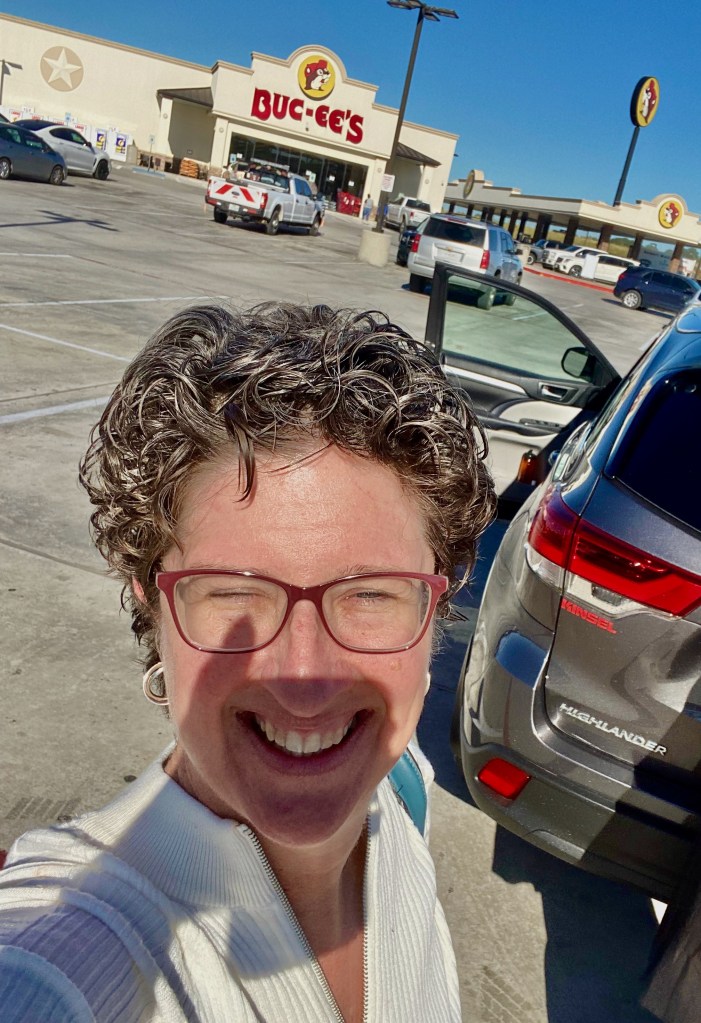
The image featured at the top of this post is the sprawling Bucee’s where we met. A long way from the tiny diner which appears in all of the background photos here on this site. And yet: it’s the place we where we met, once again, and where I passed, completely willingly, from one car to the other.

I couldn’t help myself. I was…ecstatic. Of the three relatives there with me, the San Antonio and the Beaumont sides — no one could remember if they’d ever met before. But they all shook hands, shared stories, under the blaring full Texas sun. We were all together. Something had healed for me, knitted as one. Finally.

And then I came home.

going back (5)

Three weeks ago today in San Antonio, Texas, my cousin Jamie (more about my love for him here), my cousin Linda, Jamie’s wife Patricia, and I scattered my mother’s ashes across the graves of her (and their) beloved grandparents’ graves.

I read the Hopkins’ poem God’s Grandeur , and anyone who wanted to say something, said something. There was no sugar coating of the difficult relationships we all had with her, but we all loved her.

It was wonderful to be with people who knew her, and who cared for her and for me, no matter what. My people.

The journey to Texas with my mother’s ashes was traumatic; I do not recommend it. I was completely unprepared for the separate examination and testing the box would need to undergo. On my own in an airport of rushing people, security folks handling ‘my mother’, I just stood there and sobbed and sobbed. The low point. But I had to get her to San Antonio. Which I did.

(After security, I found a place in the terminal to cry more, send a sad note to the family WhatsApp, and blow my nose. Within a couple of minutes I spoke with E in Boston, heard from M in Pittsburgh, and spoke with R in Cambridge. I am so grateful for my solid, loving family.)

I had not been to San Antonio in 34 years, since leaving for the UK. Yet there, especially after the scattering, sheer elation took me by surprise. I was so happy. I felt like having a party – dancing! Home at last. My home, which I had truly thought lost to me forever. It was so much more powerful and empowering than I could ever have imagined.

My mother would have been delighted, through and through. And would have utterly relished the cracking Tex Mex we had afterward for lunch. We toasted her with margaritas.

Goodbye Mom. Rest in peace now.

going back (4)

This is a photo of my grandparents’ old house in Beaumont, Texas. I took it nine days ago.

The house looks small to my eyes now, though of course as a child it felt palatial: so many big rooms, sofas cool to the touch, cool floors too, even those winding further back into the house, deep soft carpet. The garden full of chameleons I watched turn red on the brick walls, a sandbox my grandfather made for me, and swings.

When I was very little — younger than six — this house meant safety, security, and peace. It meant good food, praise, friendship, and love. It feels impossible to overstate this central truth: my grandparents made me who I am today. They rescued me from the unstable — neglectful — life with my mother and her boyfriends, over and over.

Nine days ago in Texas my aunt Lois and I filled every moment we had together with conversation. We have always been close, almost like sisters, despite our nearly 20 years’ age difference. This post makes clear how and why we always had such a connection — but the truth is too that we ‘never meet a stranger’ (in her father’s, my grandfather’s, words), and we are able to talk for hour upon hour. No exaggeration, the first day we saw each other this time, we managed to talk for eight hours straight. Yep!

I’ve always known — I remember, indeed — that I stayed with my grandparents in times of particular crisis. I was happy with them, and always longed to be there, so I have always taken comfort in my memories of all this. My conversations with Lois two weeks ago revealed a bit more, a couple of surprises: that at one point I stayed with them for at least a year, and that Lois assumed they were going to adopt me.

Lois was at university during this time, so knows few details. But it’s clear that they all considered my mother a danger to me. I don’t know why they didn’t adopt me, but I suspect that my grandparents deferred to my father (their son) — which, as we know, sent me from the frying pan into the fire. But they weren’t to know that. In any case, I was taken aback last week by the realisation that everyone knew I wasn’t safe. I am struck afresh by this refrain of my life: it wasn’t my fault; it wasn’t me; it was his/her doing all along.

I hadn’t been back to Beaumont in 20 years. My parents’ hold on me — my father’s wedge-driving, my. mother’s toxicity — effectively kept me away from a place and people I now know I truly love — and who truly love me.

Lois took me to the house, to the school where my grandmother taught; I saw my beloved cousin again, and I met his three beautiful children for the first time. Lois also ordered an autumn bouquet, which we placed on Ommie’s and Granddaddy’s graves, which I’d never seen. Being with them there was joyful really; in my mind I thanked them, told them about their great grandchildren, and let them know how happy I am now in my life, so much due to them.

My own parents are both gone. My father doesn’t have a burial place, and I scattered my mother’s ashes last week in San Antonio (more on this soon). With this trip to Virginia and then to Texas, I feel set free, an orphan released into love. I embrace the times with my grandparents, and all of my Texas relatives, with a full heart. It’s impossible to know what goes on behind the closed door of any house, but I do know that this house always felt like home.

interlude

[image: by Kat at https://krazykabbage.com/%5D

Last Tuesday 26 July I did an interview with Lucinda Hawksley on Goldster, for the Purpose, Passion, and Grit (bookclub) series. The series highlights artists and others who are drawn to and campaigning for particular causes, for whatever reason.

Obviously, mine centred around my memoir LEARNING TO SURVIVE, and my connected work to do with Child Sexual Abuse.

It was such a very good thing to do. Lucinda was wonderful, the audience was palpably attentive — and I felt like some of what fires me in this world for the last couple of years took flight.

The interview is necessarily general in some ways, but does bear witness to some of my own experiences, my own lived experience, the nature of it, and touches on the beginnings of how this all has impacted my life, and lives of so many others.

I want to thank everyone who came, and everyone who shared their own experiences then and subsequently. We are in this together. We are making progress and raising awareness. Together.

The link to the interview on the Goldster page is here. It is free to access. Scroll down to the ‘most recent’ programme.

The YouTube link is here.

Do have a listen/watch.

Sending love and support to all. I’ll be back with shame (part 2) soon.

shame (part 1)

I’ve been thinking a lot about what holds survivors of Child Sexual Abuse back — from telling someone, from seeking help — and pushes them toward desperation and too often, self destruction. What directs us at all costs away from feeling like victims.

Because a victim must be helpless. And powerlessness feels like weakness, close even to complicity.

Victims of Child Sexual Abuse are NOT weak. No way. They are, indeed, some of the most resilient and tenacious people you will ever know in your life. They — we — have to be. We had to find ways to survive. To preserve, somehow, parts of ourselves.

One of the ways we protect parts of ourselves is to excise — to extract, remove, rip out — or ignore, brush over, push down — toxic feelings which the abuse forces upon us, the most pervasive of which is probably SHAME.

Guilt is a feeling you get when you did something wrong, or perceived you did something wrong.

Shame is a feeling that your whole self is wrong, and it may not be related to a specific behavior or event

from Verywell Mind

SHAME is the feeling that the whole self is wrong. Yes. I cannot emphasise this enough: and if the whole self is wrong, then anything the self does is… wrong. Life, and living, can become One Big Wrong Thing. Shame can become something that feels impossible to row back from, to know where even to start.

And because it’s so comprehensive, so all encompassing, most of us disconnect at some point. Something in us insists on being preserved, remember. Our instincts are always first for survival. We are hanging onto every last bit we have — which usually doesn’t feel like, or isn’t, much.

In order to do this, we don’t tell, we often don’t admit the abuse even to ourselves. We bury the fact of the abuse, we mummify it. When I first faced the terror of having been abused, the damage and shame, I used to think of my life as being on parallel train tracks. And I thought I had ‘jumped tracks’, I hoped permanently. That train track over there is the ‘bad’ part of me. I’m NOT on that track. I’m on this track here, a long way from shame.

However. The train tracks of shame run parallel to our lived reality whether we like it or not, whether we know it or not, no matter how hard we try. And sometimes, often, the tracks converge at an unexpected junction. Sometimes there’s a wreck. Sometimes the choking feeling of shame just emerges, triggered. And then if we’re lucky, the trains part ways and we are okay for a while.

This all-consuming shame is not a coping mechanism. It is the opposite. It is engendered by our abusers. It is planted there, inside us, and grows, completely out of our control. In fact, drowning in shame prevents us from coping; it cripples us.

Shame feels dirty. We feel dirty. We don’t want anyone to know that we must be dirty. We do everything we can to stay off those tracks. But sometimes we get stuck on those tracks, those shame tracks, for a long long time.

We need to keep reminding ourselves that the shame we feel is NOT ours; like the abuse itself, it was FORCED and/or MANIPULATED onto/into us. This shame is not an authentic part of us. This shame tells us we have done something — EVERYTHING indeed — wrong, and that it is all our fault.

But NOTHING — ABSOLUTELY NOTHING — ABOUT THE SEXUAL ABUSE WE ENDURED AS CHILDREN IS OUR FAULT.

Despite us ending up carrying the shame, and despite so few convictions for CSA, so little awareness, and so much surrounding disgust and horror:

NONE OF THIS IS OUR FAULT.

So what do we do about this shame? What do I do about it? Well, I run from it for years. I keep it so firmly on those other tracks that I can’t even name it. I’m not a victim, I tell myself, I am not brimming with self-disgust, emptied of all else.

Yet the energy required to run on two tracks (at least) at the same time eventually defeats me. For me, and only for a short while, the tracks converge and crash, never to be separated again. I have to figure out what to do about this ‘other Patricia’ — the one for whom everything is wrong, everything is dirty, everything is impossible. The shamed one. The one ashamed of simply being alive. Yet alive she is, and hurting.

As I have said so many times: I was lucky. I am lucky. I had help. I had love. I had a few people to catch me when I was falling so, so fast.

It’s horrible to feel so worthless. So useless. So used. So left on the tracks to die.

I don’t know how to dispel pervasive shame. I do know that words alone don’t do it. Words alone don’t do much, when it comes to emotions beyond and before words, and emotions that flourish in a place where there are no words.

In my own life, DOING has helped me overcome shame (most of the time). I have walked the walk until somehow I am really walking it, with my whole heart. I speak out. I don’t hide. I vent. I rail. I don’t Give. A. Shit. I put that shame over there, scream at it, beat it with my fists — and show it that once and for all, I have survived.

I raise my children to know these stories exist, my story exists. I don’t speak to my father before he dies (after 35 years’ estrangement), nor my stepmother, still counting. This is me DOING. This is me BEING how I want to be, how I imagine my best self to be: passionate, strong, thoughtful, committed, loving. I take care of the Patricia he hurt; I look after her. I understand that he never knew the ‘real’ me. Never. And that he never will.

I do this until I believe in and am able to enact these things. Which is moment to moment, and always pretty much now.

***

An excerpt from LEARNING TO SURVIVE, when I realised I ‘just’ need to hang in there, that I have another ‘self’. That I will certainly escape.

***

Most years we drive further south at Christmas – to see either [my stepmother’s] parents in Florida, or Ommie and Granddaddy back in Texas. It takes about three days.

            To save money we all stay in the same room in the motels along the way. For me, it is another welcome splash of rare freedom: he won’t dare, for sure.

            One such night he is changing. [My siblings} and I are all piled into the other double bed. My father misjudges, and his penis flaps between his legs, which he then catches as he slams his legs back together. [My siblings] of course think this is completely hysterically funny, and it’s contagious, because then I’m laughing too. My father instantly loses his temper, and after dressing, comes over and throws back the covers, slapping me and one of them – whoever is in reach – hard on the bottom.

            That shuts us up quick. It is the only time I ever remember being physically punished my whole childhood. Even then, as now, I am struck by the ludicrous hypocrisy of it all: does he really think it needs hiding? He has tried to get me to do things to it, with my mouth and hands.

In my last journey south with the family, I am nearly 17. The abuse has stopped. We are still all in the same motel room.

            I have been involved with Suzanne for nearly a year.

            In this final motel room, my father is irritated. He is irritated and unreasonable about everything. I know he is somehow angry at me – Suzanne, I reckon – and I don’t care. He can’t and won’t corner me tonight.

            I leave the hotel room, taking T S Eliot’s Selected into the bleak and fluorescent lit corridor. Being in a secret love – which he cannot reach – I cherish my solitude. I lie down on the sofa bench there, and open the book.

                The winter evening settles down

                With smell of steaks in passageways.

                Six o’clock.

                The burnt-out ends of smoky days.

                And now a gusty shower wraps

                The grimy scraps

                Of withered leaves about your feet

                And newspapers from vacant lots;

                The showers beat

                On broken blinds and chimney-pots,

                And at the corner of the street

                A lonely cab-horse steams and stamps.

                And then the lighting of the lamps.

            It is a familiar section, and one I know then and now by heart. That night, as I’d done so often before – in a pattern I’d set up since the moon landing – I imagine a home I will make somewhere else. On Eliot’s streets, even. I invent the fronts of the houses, the shapes of the rooms, the soft blankets, hot chocolate, smell of wood on a cold night. In my head, this house is always very tiny, and I am almost like a doll, hiding there. But alive, living, and alone.

            Suddenly – and it’s like a flash, like a fact blooming in me – I know that I will make a home somewhere else. That this is not a dream. It is real. And that the home will be for real people, not dolls: that I really can leave. That I really am leaving. In 20 months I will be leaving for university, leaving my father and his petty disgusting ways. And there is absolutely nothing he can do about it. I can leave! I really can. And will.

            All I have to do is hold on.

holding on to what matters

Yesterday I went into town and picked up my repaired bracelet, pictured here. I wear everything permanent on one side, my left: my bracelet, my watch, and my engagement and wedding bands.

Yesterday as I walked back to my car in the underground car park, bracelet newly restored, I was overwhelmed by the rich and familiar smell of oil on concrete. The smell of my beloved grandfather’s garage, and somewhat, the smell of him, working in his overalls there, fixing things as he always did. I spent hours out there with him, just pottering. Him and me.

Yesterday I got in the car and cried. My grandfather died 20 years ago this month. I couldn’t go to his funeral, as my father would be there. I also cried for my father-in-law, who passed only 18 months ago, who was my father for over 30 years with no fuss, and unconditionally.

It’s my father-in-law who gave me this bracelet, on the birth of his tenth grandchild, our young Max, 22 years ago. I wore it daily for years, wearing out the clasp. But it’s back now.

My watch? Bought with inheritance from my mother-in-law, over 30 years ago too. I only knew her one year, but she made a profound impression on me. I have always longed to have known her longer.

I miss the older people in my life whom I trusted and loved. I miss them so much. I know I was lucky to have any, but I don’t take this for granted. I treasure it. They taught me all I know and have ever known.

My grandfather and my father-in-law would both be so proud and happy for the marriage of our first son Eliot, in two weeks. My grandfather held him at six weeks old; we have a picture. And of course, my father-in-law saw Eliot grow and become someone special; they were close.

So I’m holding onto what matters, clinging to it. Not much else in my young life was worth much, to be sure. But I have always known that somewhere I was loved, really cherished. That has never left me.

There are lots of passages in Learning to Survive about my paternal grandparents, Ommie and Granddaddy. They half-raised me, and saved me over and over from the whims and instabilities of my mother. This section is about what it was like to stay with them, their authentic and entirely loving ways.

***

I believe it is some years before I understand that my favourite people in the world, Ommie and Granddaddy, are my unseen father’s parents. Rather, for all of my early life, I feel they belong only to me.

            They live in Beaumont, a big city in deep east Texas, which first built up around the oil industry, like its larger regional cousin, Houston. Being only a few miles from Louisiana and its swampy backcountry however, Beaumont is never able to take on the cosmopolitan mantle of Houston. It remains fast-growing but provincial, and in the 60’s, all of the Deep South characteristics and traditions are still in place.

            An electrical engineer, my grandfather is a successful part of Mobil Oil’s rise in the 40’s and 50’s. The house I visit is the result of a certain prosperity, designed and built by my grandparents in a then up and coming area of the city. It is a sleek, rambling ranch-style bungalow, set in a large plot of land, with an expanse of lawn and neat caladium-frilled trees in the front. Around back are Granddaddy’s spacious vegetable patch, my swings and a sandbox he makes for me at some point.

            Even now, I can recall the anticipation of arriving on their street, their block. My eyes search for their house, the long driveway, Granddaddy’s pick-up parked on the side, and Ommie’s car in one side of the double garage. We might pull up outside if there are things to unpack, and then walk through the other half of the garage, with its pungent smell of oil on concrete. Someone swings the screen door open; it often squeaks, and always clatters behind you, pushing you through the doorway, announcing your arrival.

            This is the homely way in: on the left is a toilet where Granddaddy washes up from working outside, and Ommie’s enormous laundry room through to the greenhouse. Then you are in the kitchen, with its small table and every inch of counter space laden with food. Outside that window is the hummingbird feeder, with its bright red liquid. Through the kitchen is the lounge – comfortable chairs, a huge half-circle sofa, the television, lots of Readers Digests, a candy dish of clear sweets, and a whole wall of glass doors looking out into the back garden.

            By contrast, the whole front of the house is more formal, with a dining area, a living room no one ever sits in except at Christmas time or with visitors, the piano, and the front door with a sort of entrance hall. The front and back of the house make up a large rectangle; off one end of that rectangle is the hallway to the three bedrooms and two bathrooms.

            The living room, the hallway and the bedrooms are all unusually silent places. Heavily carpeted, you can never hear anyone walk or speak between the bedrooms. The curtains in the living room are always drawn to keep the upholstery from fading, and the windows in all the bedrooms are surprisingly small, high up. Sleeping at Ommie and Granddaddy’s house is like sleeping in a cocoon. I always want to be there, always want to stay.

In truth, I begin to expect to stay with Ommie and Granddaddy; I look forward to it. We traverse the highways between San Antonio, where my mother lives, and Beaumont. I settle into the high twin beds in my grandparents’ house like they are in my own bedroom — more so, as they never change.

            It seems, at one point, or maybe more than one point, that I am always with them. My Aunt Lois tells me that I stay with them for months on end, one time almost a year perhaps. Ommie continues to work, teaching Spanish at the high school. I remember going to see a friend of hers who owned a grey parrot that speaks Spanish.

In Beaumont, I even go to nursery, and Sunday School, where I listen to the lessons and remember a colourful room to play in.

Ommie and Granddaddy take me everywhere. To my grandmother’s hairdressers once a week: a small operation with four or five brown Naugahyde chairs and women who never stop talking. Every once in a while Ommie gestures toward me, mouthing ‘big ears’ to get them to stop gossiping, but they never do. I sit and watch and listen, sipping my coke from a small glass bottle through a straw. Ommie is at her most animated with these people, with her women friends – they even talk while under dryers, their hair up in curlers, flipping through magazines and exchanging views. Sitting on my chair to the side, every once in a while someone comes by, tells me what a good girl I am. And they tell Ommie too, ‘what a good girl she is.’ By the cashier, Ommie reaches out, puts a hand on the top of my head, ‘I know it,’ she says proudly.

I go everywhere with them. Granddaddy takes me out in the pick-up truck, sometimes even in the back if I promise not to move around too much. He drives around the block so I can feel the wind in my hair. For longer journeys, though, I sit next to him in the cab. Together we go to the hardware store, the gardening shop, the fishing tackle store. I inspect tiny drawers full of screws and nuts and bolts, and once, lots of extravagant fishing flies lined up on the counter. It’s not my world, but with Granddaddy in his overalls, his hand around mine, or often, his hands resting on my shoulders, I get a peek at it.

It is Granddaddy who sets up the swing and slide in the backyard, and who builds a sandbox around the bottom of a tree for me. Outside, it is always hot and wet, but with Granddaddy working next to me, I play. The chameleons on the house fascinate me; I stand completely still, just waiting for one to run from the green grass to the red wall so I can watch it change colour. In the front, together we see the squirrels fussing in the tall trees, running through the thick spiky grass. I sit on the front step and watch him mow, watch our neighbours mow their front yards, the hands they raise to one another. And always, should anyone stop to talk, my grandfather waves me over, rests a hand on me: ‘This is our granddaughter,’ he says, ‘come to stay with us for a while.’ And whoever it is, sensing something, or maybe just liking what he sees, says, ‘Well isn’t that nice. Isn’t that nice for you?’ And my grandfather, with a little squeeze, says, ‘It sure is.’

the challenge of normalising

Two or three times in the last couple of months I’ve ended up in conversations about Child Sexual Abuse — with friends at hydrotherapy, and line dancing. Not soul mates, but folks I talk to and who talk to me. Whom I’m glad to see, and vice versa.

It has been a long time since I’ve disclosed to acquaintances. And I’ve come so far in such a short time when it comes to being open, not apologising, not rushing to make them feel somehow okay about my experiences — so far indeed, that I have been surprised all over again at the responses:

  1. oh, it hardly bears thinking about, paired with a pursing of the lips. Horror.
  2. this happened to YOU? (to someone middle class, educated, from a ‘good’ family)
  3. it turns my stomach, said with a flat hand outward, keep it away. Disgust.

Sigh. There is SO MUCH work to be done, still, in order to have ‘normal’ conversations about CSA. So many misconceptions, factual and psychological.

  1. We MUST think about child sexual abuse, as upsetting as we find it. Not acknowledging its existence perpetuates it. Silence creates secrecy. It perpetuates abuse. This is a simple equation.
  2. Abuse doesn’t happen ‘over there’ somewhere. Abuse happens everywhere. But the stigma surrounding it — that it only happens in ‘bad’ households, in ‘deprived’ areas, to ‘uneducated’ people — ensures it’s kept at arm’s length. Refusing to acknowledge how widespread it is — you guessed it — perpetuates it. If people don’t believe it happens everywhere, they won’t believe it happens anywhere near them. So it will continue. Another simple equation.
  3. Sexual abuse IS disgusting. But for 1 in 6 children, it’s a REALITY. These children don’t have the luxury of turning away in disgust. By not acknowledging this reality — again, as upsetting as it is — again, we perpetuate abuse. We abandon children to the perpetrators.

The shock of sexual abuse is real. Finding out that a friend or acquaintance was abused, or that a child you know is being abused, is pretty awful. There’s no getting around that. We all know abuse is BAD.

I’ll admit that it’s easy for me to forget how upsetting those who have not been abused or are not involved in intense dysfunction can find the whole idea of sexual abuse. I probably mention it several times a day in conversation, and have done now for a few years. It’s my ‘normal’.

However. Hear me out. NORMALISED doesn’t mean that CSA is RIGHT or OKAY. ‘Normalised’ means in the open, discussed — not ignored, skirted around, backed away from. ‘Normalised’ means part of a life. A sad part of life, an upsetting part of life, to be sure — but day to day reality for perhaps 15% – 30% of families in the UK right now (the victims and their families, and the perpetrators and their families).

When we ‘normalise’ CSA we aren’t saying it’s ‘fine’. We are saying this happens. Everywhere, and to every kind of person, across all ages and stages. We are also saying perpetrators are close by. We are also saying be alert, make space for children to disclose, be open to the possibility. We are saying: we see this, and we want to stop it.

The gap between survivors for whom CSA is an openly discussed reality, and those fortunate enough to claim they have ‘never known anyone’ who has been abused, those who are so horrified that they physically and mentally turn completely away — this gap is hard to bridge. We need to be able to acknowledge the awfulness of abuse, the horror of it indeed, alongside being able to take practical steps to help, to raise awareness, to see it as possible anywhere, and possibly perpetrated by someone in or well known to the family.

CSA is a terrible thing — destructive, damaging, a lifelong sentence for survivors and their loved ones. But not allowing ordinary conversation and awareness of CSA is another kind of terrible, the kind of terrible which guarantees more and more suffering for those who are drowning in silence, the 1 in 6 children, the 11 million adult survivors in the UK.

***

This poem is from Learning to Survive, written within days of my father (my abuser) dying. This is the openness, the awareness, the acknowledgment of complexity I know is possible. The place where we are not keeping secrets anymore, and friends and colleagues know and understand, without horror.

[…]

yesterday

white flowers

evergreen foliage

huge blooms

arrive for me

from work

they know

who you were

what you did

because I am not

keeping secrets now

there’s a card

edged in black

for mourning

and the florist

is tearful at my door

later Sarah D

sends me a text

with condolences

then Dorothy

Claire, Vanessa

Simon, Nancy, Scarlett

David, Eliot from Boston –

so many now know

so many understand

the complexities

that I begin to believe

I am grieving

pretty in pink

It has taken me a long time — years — to allow myself to feel feminine. This is not to imply that all women need to be feminine — far from it — but I’ve always been drawn to fashion, accessories, and ‘dressing up’. So the idea of the feminine has always appealed to me.

However. For most of my adult life I have worn somber colours — blacks, greys, browns. I have steered clear of anything bright, or patterned. I have steered clear of anything overtly feminine, except in small ways.

It almost goes without saying — now that you are here, and you know this blog is generally about Child Sexual Abuse — that I have been careful most of my adult life never to wear anything which might be considered ‘too feminine’ (read: ‘revealing’), either.

I have been afraid, all my life, of attracting unwanted attention from men. And because the ‘attention’ I got from my father didn’t make sense, and felt out of control — I thought ALL men were like this. Liable to put their hands on me. That I was liable to ‘make’ men ‘lose control’. Logically I knew this didn’t make sense — but it was what my experiences as a child, and then as a young adult survivor, told me: men only wanted one thing, and if I don’t ‘give’ it to them, I better be careful.

In my last post I mentioned that I’ve been fortunate enough to be working with other survivor/activists and with academics at the University of Bristol Dental School, developing ideas for increased access to and trauma-informed care in dentistry for CSA survivors. The experience has been eye-opening in lots of ways, and hugely empowering. It has been a gift to sit with others who get it, and who want to make a difference.

In the first workshop, we were asked to draw ourselves as a plant that had everything we needed. I am VERY far from an artist, but I instantly knew what plant I’d be: a pink clematis, climbing up the warm brick wall of my grandparents’ house, supported and loved and feeling beautiful. This is what I drew:

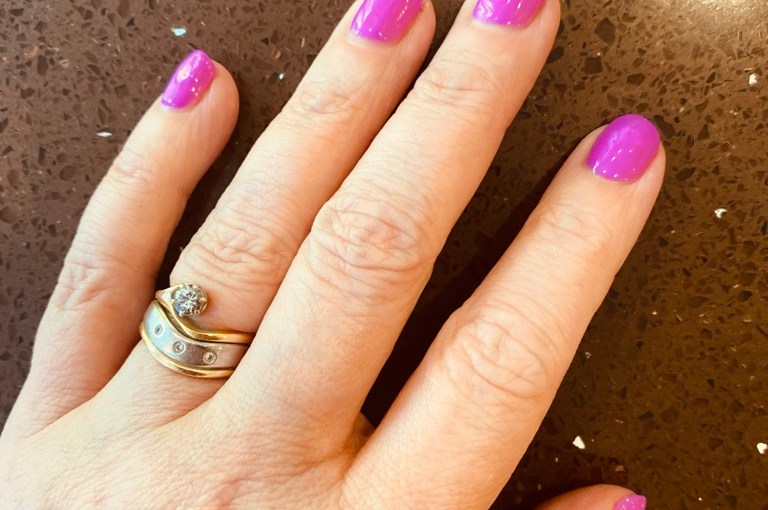
Notice that the flowers are PINK. I was surprised I drew this — pink? I don’t really do pink. And yet, I thought again: in the last year, I have purchased a mauve pink top, and just recently, a bright pink cardigan. And a few weeks ago — I went for the bright pink nails heading this post.

There’s another reason femininity — and specifically pink — have made me wary in the past. Because I associate pink with the body. With orifices, with genitals, and with danger.

But NOW! Something in me has been able to reclaim pink. Enjoy it. Revel in it. Pink is lovely. It’s not dangerous. It’s not attention-getting. It’s not about sex.

As for revealing clothing: this too seems to have turned a corner for me recently. I haven’t worn a real bikini except in front of my nuclear family in decades; revealing skin has up til now made me very, very nervous.

But NOW! For the first time I can remember I’ve got up the nerve to purchase a bikini for wearing when we go away in late August. I WANT to be like other women and not worry about it. Not be ashamed. With empowerment and understanding, I’m more settled in all aspects of my body and my femininity than I ever thought possible.

Next up: pink bikini?! Hmmm.

This extract from LEARNING TO SURVIVE captures some of what it’s like to feel disassociated from my body, constantly observed, and fantasised into a ‘relationship’. Which I hated.

***

just looking

The next summer, I end up in Blacksburg. I am keen to spend time with Alice and her new college friends, and have no trouble getting another restaurant job with evening shifts.  I have the days to myself, and stay out of the house as much as I can; Alice and I go to a pool every day to swim, sunbathe, and drink margaritas. On my nights off, I go to the clubs, having several probably quite dangerous sexual encounters with strangers. There is also a woman I work with who appears desperate to sleep with me. I resist. And, as ever and at this point, none of this activity is important to me, despite various one night stands actually ringing my home phone in an effort to see me again. Sex means absolutely nothing to me, yet I seem to attract people, constantly. I wonder, in time, whether this happens to me because they know something about me, sense something, smell something almost. Sleeping with men – going straight to the sex, no enjoyment, seems required of me. I don’t know how to do anything else, or see myself, or them, otherwise. I don’t want to cuddle. I don’t want soft words. In fact: softness and fondness make me feel a bit sick. The sooner it’s over, the better. Let the hormones take care of business. Then leave as soon as you can.

            At the time, I feel I am wise beyond my years, that I know something others my age don’t: this is all there is; get used to it.

That same summer, the household in Blacksburg acquires a set of weights and some gym mats. They are in the basement, in the half of the downstairs sitting room which has never been used for much. After a serious knee dislocation during a modern dance rehearsal at Oberlin, I am in rehab, building my leg muscles, generally getting back into shape, and use the weights every other day, doing core exercises etc as well. When he’s home, my father comes downstairs to watch me. He says he is learning about weights, and smiles, laughs a half-laugh. But I know he’s simply coming down here to look at me. When June comes home, he quickly gets to his feet, goes upstairs.

            Encounters like this are common, I realise now. From age 16, when the abuse stops, right up until the last time I see him, at age 21, every time we are alone he behaves as if I am party to a secret, a secret between us. He behaves, I realise now, as if we are in a secret relationship. As if external forces have ‘broken us up’, but we still long for each other.

            For me of course, nothing could be further from the truth. He repels me, disgusts me. His laugh, his hands rubbing together, fingers clasping. His physical awkwardness. I have a hard time being around him at all. I have no wish ever to see him again. Yet: here I am. Here is the family. Here is Blacksburg. Here is where I grew up.

            What I struggle to accept now is my tolerance of the situation. How do I not storm out and never come back? How do I eat in the same room? How do I smile? How do I breeze in and out every day? Secrecy, I guess, is hard to break the surface of. It holds firm, membranous and tough, despite the liquid chaos underneath.

            And I suppose, if I’m honest, a part of me still hopes. I hope that this will pass, and I know that some part of me is strong enough to last until it does. I continue to hope – for years – that he will change. That he will seek help in the ways that perpetrators I later witness are forced to seek help. I know – deeply and with real regret – that everything about his attitude to his relationship with me is wrong. What takes me so many years to do is give up on him. Give up on the family, give up on [my stepmother]. And it’s this giving up which brings lasting pain, to this day.