One in 6 children is sexually abused, 90% by someone they know and trust, within the family fold. I was one of those children. An author of five books, I now turn myself to raising awareness, breaking the silences, and sharing lived experiences of CSA (Child Sexual Abuse). We must speak and stop this. The time is now.
I have been writing and re-writing this post in my head for months.
What happened? I considered this for weeks.
What I did not want to admit (to myself, or anyone) was how completely shaken I was by the re-election of an abuser to the White House. His re-emergence, followed by lawless action after lawless action, rendered me almost paralysed.
What is the point of working away in my small corner of the fight against Violence Against Women and Girls, when the whole world order has turned justice on its head?
More pointedly: every survivor I know hears an abuser in his voice. An abuser, and a bully. We have all known this since at least 2015. We all recognise it. And for the last 10 years, we have not been heard. And as we all know: when we talk and no one hears, we are silenced, again.
It took me several months to realise that I was simultaneously triggered and silenced by happenings in the US. Again and again I felt that any voice I had ever had was useless. I see now that I have spent the last year being re-traumatised, over and over.
The reality is: the country where I grew up is being dismantled. The values I thought we all shared (more or less) have evaporated. Any ‘noise’ I might be able to make surely disappears into thin air.
I remain pessimistic when it comes to the US managing to take care of its people. This feels a very long way from achievable at the moment.
However. In the last few months, the plight of the Epstein survivors, and the involvement of men and women who occupy the most wealthy and powerful positions in the world in their trafficking — have crashed my worlds together.
Thing is: we are all the same. As survivors, we are all the same. Whatever our backgrounds, whomever our abusers. Whether ‘it’ happens once, or repeatedly over years and years or perpetrator after perpetrator: we must join forces. Our homes (or lack thereof) made us vulnerable to sexual abuse; in this, we are a community.
We must not allow the isolation that inevitably accompanies our abuse to silence us. We must not consider some peoples’ experiences of abuse more harmful or ‘worse’ than others. We must understand that we are in this together, all of us.
Only then will we be able build upon the voices and experiences of survivors toward real cultural and social change: toward accountability, restitution, prevention.
I come to this post today through partially gritted teeth. I’m not sure if any of this will do any ‘good’. But I can’t not try. The last year has shown this to me in technicolour: I have to keep trying. I have to. The one thing I know is that I would do anything to save a child from going through what one in six of us goes through, worldwide. To that end, I have managed to keep going with a couple of projects, quietly, which will soon come to a kind of fruition. But I know I need to use my voice too, publicly. It’s so important that we do this if we can. And I can.
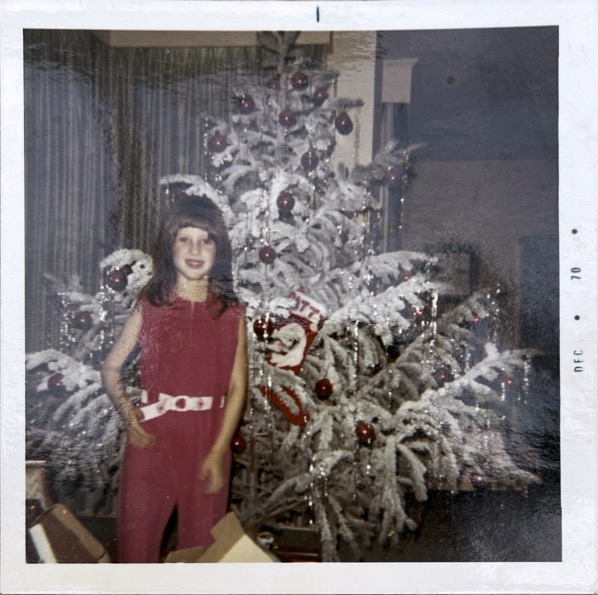
For as long as I can remember, the holiday season has too often brought with it a pervasive melancholy. When I was little — before going to live with my father at age six — Christmas could feel uncomfortable for me: as the only grandchild for a long time, all eyes were on me, wherever I celebrated. There are numerous photos of me in front of my grandparents’ white artificial tree, this last one when I am six years old, back in Texas for Christmas, two months after moving to Virginia.
Thereafter, Christmas becomes outright fraught. With my sister and brother and stepmother and father, the dynamics intensify. I am aware of being ‘the stranger’ in the celebrations, and I remember one particular photo of my stepmother cuddling my brother and sister on the sofa to one side, while I stand in front of the tree, my tightly clasped hands behind my back reflected in the mirror behind me. Just thinking about it breaks my grown-up heart.
I have been reading The Child Safeguarding Review Panel – I wanted them all to notice over the last couple of weeks. This UK report came out in November (2024), and focuses exclusively on Child Sexual Abuse within the family. It’s a depressing read in almost every way: what is missed, who isn’t believed and why, the devastating lack of resources for abused children and families, the over-reliance on ‘evidence’ and on the children themselves disclosing. However, a couple of aspects have struck me with force: first, that so often neglect is a hallmark of an abusive environment. If a child is not neglected, if a child is being cared for, watched out for — sexual abuse is much less likely to occur.
I was emotionally neglected throughout much of my childhood, and when I was living with my mother, physically neglected as well. Despite growing up in a firmly middle-class household, it’s clear that some basic needs weren’t met. This in turn contributed to making me vulnerable; I welcomed any attention I could get from my family, specifically my father. I now see that he groomed me by showing me attention, and then manipulated this into sexual abuse.
Pretence is another common denominator in abusive households. In my life, these layers of everything having to appear ‘fine’ and ‘happy’ seemed to triple at Christmas. We often went to family in Alabama, Florida, or Texas for a week over the holidays. The strain of having to appear ‘just fine’ cast a long shadow every year. The sheer irony of opening presents, having to ‘be a child’ amongst other children haunted me from the moment my father started abusing me. I wasn’t like other children — and I knew it. My childhood was irretrievable. I knew this too.
At Christmas, I often felt trapped. The family was forced into close proximity. I had no friends nearby, nowhere to go, nothing (except reading) to distract me. And I absolutely dreaded nighttimes. I was utterly terrified that my father would come into the room I was inevitably sharing with my siblings or with cousins — he’d done so before — and that then they would ‘find out’ what was happening.
The awful thing here is: I really felt it was my responsibility to keep up family appearances. It was my job to be careful, to make sure no one found out, because otherwise…..otherwise what? All these decades later the only answer I have is that if anyone found out they would simply hate me. Hate me for ruining their lives. Blame me for everything going ‘wrong’.
I am lucky now to have my own healthy family, my separate family traditions — which I created alongside my husband and children and extended family. I am lucky that I no longer feel in danger, or have to pretend for days at a time. I cannot and will not pretend about anything anymore.
So. Please remember that at this time of year there are children for whom Christmas is an ordeal. There are children who have to work extra hard to maintain the pretence, or who are afraid in their beds at night — doubly so, because there is nowhere else to go. Some children — like me — are happier at school, or at friends’ houses. For some children being with family is the last place they would choose to be.
Please remember too that as upsetting as it is to grasp: all of us — you, and you, and you — will know people who are perpetrating sexual abuse. At least 10% of the population is sexually abused before the age of 16. The vast majority of this abuse is perpetrated by family men. They do not appear to be ‘monsters’. They do not appear to be ‘sick’ or ‘unusual’. They make sure that they cultivate looking like a ‘normal’ family. Yet they commit abhorrent crimes. These are the facts.
Due to Gisele Pelicot’s courage, over 50 families (who no doubt consider themselves ‘normal’) must come face to face this Christmas with what lies beneath the surface of their ‘ordinary’ lives. It’s the tip of a huge iceberg, the excavation of which is long overdue. These families are not the exceptions — they are in fact now experiencing what is for large portions of society the hidden norm. Although the road ahead is long and distressing, I join with so many in hoping that this uncovering now has some momentum. Children — and victim survivor women and men — deserve a life free from shame and blame. Shame Must Change Sides.
Pretty much everyone in the literary world — and most of the world in other areas I imagine — will now know about how Nobel Prize-winning writer Alice Munro did not protect her daughter Andrea Robin Skinner from the sexual assaults of her abuser husband, Gerald Fremlin, either during or after the events. Andrea’s story broke internationally last weekend, although it had clearly been known about for years and years — and kept quiet — in some circles.
Long and short: Andrea’s stepfather first assaulted her when she was nine years old. She told her stepbrother, who insisted she tell her bio father. The right reaction, but badly received: her father did nothing. Andrea returned to her mother’s house and to abuse for several years as a result. Andrea finally told her mother about the abuse. Munro briefly left her husband, but then returned. She stood by him even when he was accused of exposing himself to a neighbourhood 14 yr old girl. In 2005, Andrea took her stepfather to court — and won. Even then, Munro stayed with Fremlin.
Here is the international Guardian article which appeared earlier this week. All of the major news and journal outlets have covered this story however, in varying degrees of depth and enquiry. I like Megan Nolan’s article in The New Statesman; she asks questions that need asking, and bares realities that need revealing.
There has been a fair amount of shock-horror and hand-wringing around the revelation of these ‘secrets’. But to anyone in the Child Sexual Abuse survivor world, Munro’s reaction, and the reaction of Andrea’s bio father — are the norm, not the exception. It is very, very common for the family to close ranks and eject the victim, whenever the disclosure occurs. It is very, very common for the victim to be implicated and blamed, and treated (in the case of a girl) like ‘the other woman’. Overall, it is very common for sexual abuse to be viewed as an infidelity by the non-abusing parent or partner. This allows the non-abusing parent/guardian to consider herself (as it is most often the wife/female partner) the injured party — thereby relieving her of any accountability when it comes to the abuse. She can say that she had ‘nothing to do with it’. Any family patterns or dysfunctions can be ignored. And often: the energy is then spent ‘repairing’ the marriage.
This is what happened in Andrea Robin Skinner’s/Alice Munro’s family, and happened in mine. It is what happened in a huge proportion of survivor families I know, and continues to happen in them today.
It is tempting to believe that women don’t leave their pedophile husbands because they are financially trapped, or lacking options. While this will no doubt be the case in some instances (even then: the child should be priority?! Some women DO leave their husbands or families when they discover sexual abuse, regardless), we cannot say the same about Alice Munro’s situation, which is why I bring this up: Alice Munro must not have wanted to leave her husband. She did not feel compelled to leave him.
If the non-abusing parent who has financial stability and status still does not leave the partnership or protect the child/victim/survivor, there are other elements at work here. What makes a person stay with a partner who is a proven or convicted pedophile?
All I can say to those who are shocked: welcome to my world, and the world of millions and millions of child victims and adult survivors. Andrea Robin Skinner’s courageous speaking out (alongside her now-supportive siblings) shows us once again that the incidence of Child Sexual Abuse does not discriminate. CSA is perpetrated at ALL levels of society, across ALL ethnicities, regardless of financial stability, education, or social status. These are facts. They are not supposition. They are real. CSA happens everywhere, every single day.
We have got to do better. We have to offer children safe ways out (which, too often unfortunately, are not about disclosing to parents), and we must continue to raise awareness not just of the existence of CSA, but of the lifelong damage done to victim survivors. Perhaps then non-abusing parents/carers will begin to understand the repercussions of their actions or inactions. Perhaps then there’s a hope that non-abusers will not so frequently side with abusers.
The truth I live with every day is this: I would have liked to stay in my family. I would have liked my father to leave. I would have liked to stay close to my siblings. But at root, because of my stepmother’s reactions/lack of action, none of this could happen. I had to save myself. I had to leave, and eventually become estranged. This is the painful reality. And it is the reality for millions of us.
***
Here is an older post which looks in detail at how I have wrestled with my stepmother’s role in my father’s abuse of me and the subsequent disclosure: forgiveness and complicity. All crashingly familiar, again.
Today is Mothering Sunday here in the UK, so I dedicate this post to my mother, another survivor of sexual abuse perpetrated by her father.
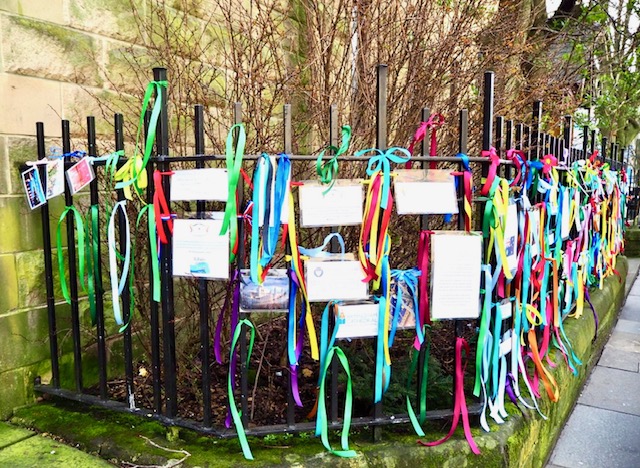
Last week I was in Newcastle (UK), where I helped do a LOUDfence on the railings of St Mary’s Cathedral. As ever, the act of tying ribbons — colourful, fluttering — releases something purposeful in me and I think in others. The tags which are attached by the ribbons recount grief, and loss, and sorrow, and in some — betrayal. They also speak of support, validation, and the determination to make a difference in every walk of life. To say loudly: we hear you, we believe you, we are so sorry. And we want this never to happen again.
A new and powerful symbol in LOUDfence is the introduction of empty shoes: children’s, priests’, religious sisters’, laity’s. They all represent people who aren’t there, who can’t be, and people whose shoes we need to walk in, to be with, and hold close. Abuse is a destructive force. It rips us from those we might love, and from the roads we might have walked.
LOUDfence is making a difference. It’s reaching beyond countries, and beyond regions. Beyond silence and silencing. Victim survivors from every walk of life can see themselves — can feel themselves held. Know that they are seen too, in some cases by the very people who did them harm.
Change comes through a gathering which reaches critical mass, a tipping over into the clear sense that we MUST enact cultural change. On all fronts.
I’m so proud to be part of this movement. Next stop: West Virginia USA in April.
***
Antonia Sobocki (founder of LOUDfence UK) asked me to write a poem for the Newcastle LOUDfence. Here it is. I am not usually one for writing to commission – I tend to freeze up! – but this time I had the gift of a pair of baby shoes I had found in my mother’s belongings after her death. Here are the shoes, and here is the poem.
(apologies for the poor quality reproduction here — the clumsiness of WordPress!)
I thought I would take a minute here to acknowledge the shifting of my memoir title from Learning to Survive to Leaving Locust Avenue. First things first: a big THANK YOU to Caroline Litman, gifted writer and fellow Highly Commended author in the Bridport Memoir Awards. She read my book, and floated this title with me. I immediately knew it was right. So grateful to her for this stroke of insight.
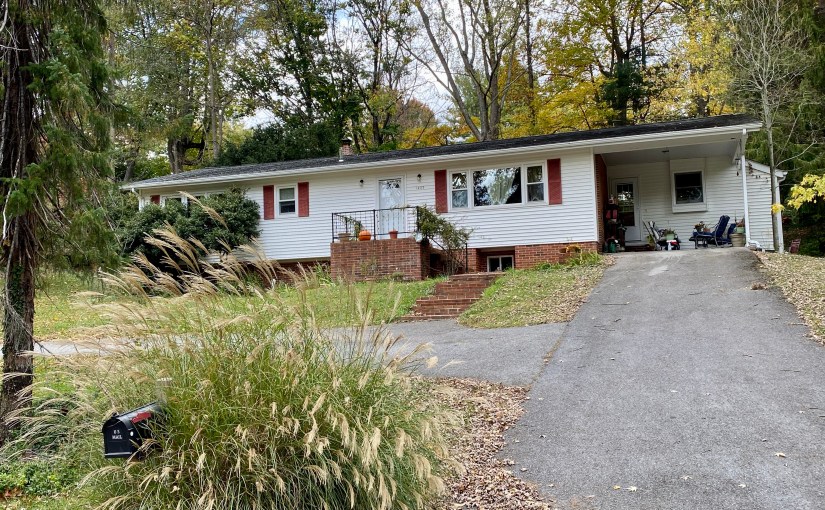
Second: the title makes clear that this house is at the centre of the abuse. On this avenue. In Southwestern Virginia suburbia. It feels right and important to flag here that Child Sexual Abuse occurs everywhere and anywhere. Including within the four walls of my childhood home. My sexual abuse did not happen in some ‘deprived’ area, by parents who were ‘addicts’ or ‘on benefits’ etc etc… I make these points because, believe it or not, over the last couple of years I have had people say exactly these things: ‘oh I knew it happened in some parts of town’, and ‘oh but you are doing so well, how?’ etc. All judgments of not only me now, but the circumstances I and others grew up in. And a ridiculous, shaming attitude toward those who grew up differently. This attitude conveniently keeps CSA at arm’s length — over there, not in my backyard.
Once and for all, here it is: Child Sexual Abuse happens to at least 1 in 6 children across all socioeconomic levels. I am happy to provide the resources I and others, including dozens of charities and organisations, use to arrive at this — but I would also encourage you to look it up yourself if you have questions, as along the way you will find out a great deal about Child Sexual Abuse.
My father was a professor, as were many wage earners living along this particular avenue. And his crimes were completely hidden in this house. How many more houses along this street hid Child Sexual Abuse? Statistically speaking: several. Yes, almost certainly: several.
Third and finally, I come to my leaving Locust Avenue. It was the last thing I wanted to do, in so many ways. But I felt forced out, scapegoated (as I now know is typical in family cases of abuse) — and I had to do something to save myself. As followers of this blog will know, I had to leave behind my [half] brother and [half] sister after 11 years of living with them, and was forbidden from telling them anything. It was a terrible secret to keep. Feeling forced to leave my childhood home destroyed it for me, forever, regardless of any good times there.
So yes. Leaving Locust Avenue is right. It captures so much at the heart of this book.
Here is an excerpt from the memoir which recalls when I first arrived at Locust Avenue.
***
Ommie and Granddaddy take me to Blacksburg the first time [when I am six years old]. Ever the intermediary figures, with them I feel entirely at ease. I remember no feelings of apprehension or even distress saying goodbye to my mother. I don’t remember saying anything to her, or her words to me. I believe we drive up, taking the two days along the Natchez Trace, through Alabama and a corner of Mississippi, then up through Tennessee, South Carolina and North Carolina, arriving at last in deep Southwestern Virginia, in the Blue Ridge Mountains. The only clue I have to the nature of the experience is that later my grandfather tells me he catches me sleep-walking on the journey. He wakes up in the middle of the night in the Best Western, and I am standing there, with my hand on the door handle of the room, about to open it. We are two floors up, and outside there is a metal railing around the rectangle of the pool in the middle. Needless to say, he leads me back to bed.
The house on Locust Avenue, in Blacksburg Virginia, where I mostly live for the next 11 years, is medium sized. Set in a hilly suburban area, it is a single storey olive green clapboard with a steep drive up to the carport. With three bedrooms, a living room, a lounge, dining room/kitchen and two small children, until I arrive it must seem relatively spacious. There is a large flat space out back, the only flat place in the neighbourhood in fact; in later years we brave my father’s warning of killing the grass every evening in order to play kickball, softball, and ‘ghost’. It is a real neighbourhood, with at least a dozen kids of all ages in the streets, especially in summer.
Of course, I know nothing about anything at first. I am impressed by the swings under the big tree, and remember swinging in them with a kind of aimlessness, while Ommie and Granddaddy stand close by watching.
I am impressed too by my half-brother and half-sister, six months old and two and a half, respectively. Already I have missed having siblings, and this ready-made family thrills me. I remember picking [my sister] up, and half-carrying, half-dragging her down the hallway to her room, delighted I can do it. I remember [my stepmother’s] anxiety about this action, afraid I will drop her.
[My sister] is a beautiful child, with enormous blue eyes like Granddaddy’s, and long ash blonde hair. The photograph from close to this time shows her sitting serenely with her legs tucked out to one side, in a blue velvet dress with her hands folded neatly in front of her. Her hair is pulled back just at the crown, her widow’s peak emphasising her high forehead and her gentle, serious face. In the picture she looks vulnerable, like life has caught her unawares, and it is true that from the instant I walk into that house I feel protective of her.
I am ashamed to admit that in all of our years together I never really consider the effect my entrance must have on her. It is only with my own two children, with the exact same age difference, that I can see how I – this vocal, eager to please, attention seeking child – might have overrun and quieted an already naturally introverted little girl. Suddenly [my sister] is the middle one, and despite the several visits to Texas I take in the first years, she remains so until I just as suddenly leave the house eleven years later.
Both [my sister] and I, in a sense, and differently, become stranded. It is due to her quiet determination to keep in touch that we manage to communicate at all in the years after I leave the house, given what will happen.
I imagine that for [my brother], being so young, my entrance is more seamless. My earliest memory of him is noticing his bottle propped up on the cushion of the sofa while [my stepmother] prepares dinner. I remember going over to it and holding it for him; I want someone to feed him. Is it my imagination, or does he look me in the eye then? I wonder now if my deep affection for babies begins with him, with the desire to connect.
Physically, [my brother] too has the long face, the blue eyes of our family. He is always [my stepmother’s] baby though, and I have clear memories of him sitting on her lap, her going through his hair, looking in his ears, grooming him like a chimp grooms her little one. For many years, until recently, he and I fall entirely out of contact, which I regret. As with so much else, I feel I failed him. It was not my job to catch him when so many things seemed to fall apart, first for me, then for him; nevertheless, I wish I had been able to.
And what of my father and stepmother? They inspire in me no emotions, and I suppose at first I look at them as just the next set of grown-ups to take care of me. I am used to living elsewhere, so at first my father’s house is just another in a long line. I remember that he has black glasses and dark hair. I remember [my stepmother’s] long hair and long legs, her quiet, slow-moving ways. Her distance. My father teaches mathematical physics at Virginia Tech, and is at work most of the time. I remember a few arguments, raised voices, and going into school afraid that they will get divorced. But in the main, I remember no display of emotions either from my side or theirs, only the unspoken sense that I have to be good – I have to behave – in order to stay. And that staying is imperative. Underneath it all, beneath the daily smooth running of life, things are desperate somewhere, and I know it. And as is the way with children, I end up feeling like everything, all the ways in which this will or won’t work — everything ultimately depends on me.

My dear friend came to visit recently. After many years of knowing each other and being close as writers — we discovered only a few years ago that we are both CSA (Child Sexual Abuse) survivors. This was a shock to us both: keeping secrets, keeping abuse ‘over there’ is hard-wired in both of us. But we have come to know that much connects us, and that in a way this is cause for celebration. Despite our pasts, we have compassion, we have empathy. We have humour, and love.
This time we ended up alighting upon something I didn’t know she had as well: a violent reaction to feeling enclosed.
I’m curious: do most or all survivors experience this? I cannot bear the sensation of feeling enclosed, or struggling to swallow, or reaching for air. This means that last year when I had tonsillitis I was in a terrible, panicked state. Max sat with me, holding my hand, distracting me by watching sitcoms. I was barely with it. Tears of desperation squeezed out of my eyes with every breath.
Every time a duvet climbs above my shoulders I am panicky and shove it away. I almost always sleep with my arms out of the covers. I also find elevators (lifts) very difficult, especially small ones. I struggle with spiral staircases, and have had more than one serious panic attack while climbing them. I am physically disoriented very easily, and launch into a full blown panic attack when this happens. Whether in IKEA, or once in an observatory when the ceiling rotated — when I don’t know or remember how to ‘escape’ from someplace, I melt down.
My friend is the same. Almost exactly the same. We figured there must be something about being overpowered. About a large person hovering and smothering. About not being able to fight.
One of the first realisations I had in my early therapy was the fact that I wanted to push my father away. My arms ached with that realisation. But I never did. I was frozen, frightened, dissociated.
These triggers — phobias, fears, whatever you call them — are all collateral damage. Ripples from abuse. All of the above responses are valid, as are many more. They are normal trauma responses. Yet both of us have at times been made to feel deficient: buck up, be brave, there’s nothing wrong!
There’s a lot wrong when you are in fear for your life. When you think the breath will be squeezed out of you. When things are forced into your mouth and you can’t breathe. When you are a child and can’t bear the weight, the intrusion. These are the facts. They never go away.
We must respect trauma responses. We need to be trauma-informed. It is often NOT possible to ‘overcome’ these responses, and it’s a myth to believe everyone can. We all have to work with what we carry around the best we can. For survivors, these tangled and deeply embedded responses are unavoidable at times.
For me this means I almost always avoid lifts. For me this means I ask the dentist to raise the head of the chair closer to sitting, and have to ‘go someplace else’ when x-ray plates are in my mouth. For me this means I am always verging on panic when in a crowd.
My family know these things and accept them. They know where these responses come from. With time and recognition of these triggers, I am less compromised by them than I used to be. For me, speaking my ‘truth’ — admitting that I’m frightened, admitting that I’m disoriented and having to control my breathing — eases my panic, and often prevents it from escalating to the point where I can’t be reached. These issues don’t go away — but they have less sway over me.
This won’t work for everyone, clearly. Sometimes we are surrounded by people who refuse to understand, or whom we don’t trust, or with whom we don’t feel safe enough to show we are feeling vulnerable. I know I am very lucky. Without even realising it consciously, I landed on my feet when it comes to close family and friends.
Regardless of how memories manifest with you or with your loved ones, acceptance goes a long way. Lack of judgment goes a long way. Saying ‘it’s alright’ to feel this way, to react, goes a long way. Because next time the panic might not be quite as overwhelming. Regardless of the trigger: being seen and believed and supported can help dismantle these suffocating walls.
It has been SO LONG since I’ve been here. As with everything, then the guilt of NOT doing something accumulates, and then there’s so much water under the bridge that… the task becomes impossible. Or feels it.
However. It is not like me to stop something or give up. There are lots of reasons — some of which I’ll post about here — why I keep repeating this to myself. Never give up.
First: the really fab news that I hinted about last time. Way back in March of this year, 30,000 words from my memoir about Child Sexual Abuse (Learning to Survive) won Highly Commended in the Bridport Memoir Awards. Soon after, I discovered that there were about 1,000 entries. Top 5 out of 1,000 entries. It has been such a joy, a real lift, to have my work validated and valued in such a competition. One of the HUGE blocks to getting stories of CSA out is the resistance of the ‘mainstream’ (whatever form that takes — whether media, arts, medicine) to hearing about these stories. Those of you who circulate in this world of survivors know all too well: the ‘mainstream’ is hugely more likely to draw back than to bear witness, or listen, or support. The ‘mainstream’, generally, turns away.
My prize in the Bridport felt like the beginning of something — at last! I have been struggling for two years to get a bit of purchase for Learning to Survive. My frustration has always been: I have published five books, one of them prize winning, and my work has been collected in various high profile national anthologies, published in newspapers etc. So WHY — why?! — is this book, a book I know is worthwhile and sound and well-written — staggering through almost universal rejection from literally dozens of potential outlets? The Bridport win gave me hope that the book may now be championed — despite the lack of precedent in the publishing world for stories such as mine (as OURS) — hope that someone may be willing now to take a risk.
Second, and alas, it’s clear now that the Bridport accolade has made little difference to the book’s future, at least in the UK. As a result of the Bridport however I have met some wonderful people, people cheering me on, people who — alongside me — are shocked that I’ve not been able to place the book. I’ve also been in touch with some of the judges/readers of the Bridport for advice from within ‘the industry’: from each, the writing is lauded (more than my writing has ever been lauded before, just for comparison), the subject acknowledged as important and vital, my handling of it ‘just right’…. but these effusive compliments are mitigated with ‘the subject is too dark to sell’, ‘maybe child sexual abuse has been done to death’ — etc. In other words: great writing, but the material itself is unpalatable. It’s scary. It’s ‘too much’ for readers. Not worth the risk for publishers. I want to scream what about memoirs about the Holocaust? What about memoirs about domestic violence? Murder? Grief? They exist, and they are ‘dark subjects’; they are horrifying and difficult. Yet somewhere along the line, someone has considered them important enough to be in circulation. Important enough to learn about, to witness. Not so Child Sexual Abuse, clearly.
I have indulged in a couple of threads on Twitter around these responses. Here, in short:
1)CSA affects at least 15% of the population, of ALL adults and children. THERE’S your readership publishers, not to speak of the millions of people who love, support, and care for survivors. It’s a huge audience, ready-made, an audience in dire need of stories which speak to their experiences. Which break the awful silence and shame, which raise social awareness. Which comfort and support, which tell them they are not alone, that there is a future for them and all of us.
2)Child Sexual Abuse has absolutely NOT been ‘done to death’. What we do hear a lot about are ‘serial’ pedophiles such as Savile, Maxwell, Epstein. What we do hear about are ‘monster narratives’ about ‘evil people’. We read about abuse that happens ‘over there’, that is NOT in our lives. We do not read about intra-familial CSA, or CSA perpetrated by someone the child knows. Which makes up 90% of all CSA. We do not read about abusive fathers, uncles, grandfathers, brothers, babysitters, boyfriends, carers. We do not read about the most common form of CSA, that which happens in our lives, right under our noses.
3)There is a clear moral imperative to publicise these stories. Given that there are millions of survivors in the UK alone, and thousands of millions of survivors around the world. Given that these victims and survivors are — wholesale, forcibly — drowning in silence. Given that most survivors of ‘everyday’ CSA believe that they are pretty much the only victims of this in the world. That they are alone in their trauma and loss and shame. Given all this, survivors surely deserve better. There is only one literary memoir published in the UK about CSA (by Clare Best), and only a very few in Europe and Australia. We deserve more. We deserve to be seen. We deserve to be included in the long list of wrongs which need righting in our world.
4) Finally: it’s insulting to label anyone’s suffering as ‘too dark’ for general consumption. Particularly if that suffering is widespread, or ultimately turned toward doing good. My book and writings, and the work of so many other survivors, exist with the explicit aims of relieving suffering and of prevention. Of reaching out, empowering, and bringing strength and hope. All of the abuse in my book is finished by 30,000 words in. The rest of the book — 35,000 words — is about survival, hope, and living.
***
I could go on. Fortunately, as you can see, my anger has returned. Anger turned inward is sadness and depression, and I admit that I have been battling these consequences over the last couple of months. I am silenced AGAIN. We are silenced AGAIN. It’s painful, re-traumatising, and heartbreaking.
I am holding on to the belief that things may be shifting. Slowly, granted, but shifting. There are hundreds of us doing work around CSA in the UK alone, and much of it makes forays into the mainstream. Recently, Channel 4 aired a documentary which told Emily’s story: her father was her abuser. Recently too, Nicole Caroli featured in the Metro newspaper — telling her story and raising awareness. (Nicole also runs an excellent blog, here.) Sophie Olson’s (The Flying Child’s) ‘Last Taboo’ Radio 4 programme, aired nearly two years ago, continues to break down barriers, as does her work with schools, midwives, social workers, etc (Sophie’s blog is here). The glorious and indefatigable Viv Gordon continues her moving performances and showcasing of fellow survivors, championing the necessity of their work. Elizabeth Shane publishes poetry and devotes her time to supporting and speaking up for survivors. Jane Chevous at Survivors Voices and Antonia Sobocki of LOUDfence (also at Survivors Voices) are frankly astonishing in their breadth and dedication to raising awareness and holding others to account in the world of CSA.
There are many more. We are forces to be reckoned with, and there are lots of us.
Many activist/survivors are old hands at this. They know the battles and are not giving up. I’m very new here. And the stark nature of these battles has hit hard. The reality that CSA is drenched in stigma and silence, at every turn, regardless of external validation and the accompanying shocking statistics around CSA — still, in the 21st century! — has hit hard. The fact that my book seems not to stand a chance in this country due to social attitudes toward something that has nothing to do with me — that was not my fault, that I did not choose, that I wish more than anything had never happened — has hit hard. Once again, I’ve had to face that none of this is my fault. Yet I still suffer the consequences.
Saying all this: I cannot give up. I won’t give up. I am able to speak when so many cannot. It really is that simple. I’m back on the horse, with my sights now turned to the US market. I welcome any tips, advice, leads. Something has to give.
Over and over in these days, I replay the scene in which I did something similar: I went to go stay with my father — my abuser — for one night when I was 20 years old. He was living alone in an apartment in Washington DC. The excerpt from LEARNING TO SURVIVE, below, recounts what happened.
That night marked the last time I saw my father. But it didn’t mark the end of me trying to ‘solve’ the family dynamics, of me trying to make him accountable, accept responsibility. Of trying to get an apology. These useless hopes, this belief that maybe just maybe I could ‘fix’ something — went on for another 10 years or so, through letters, therapy, and a few more conversations. To no avail: I do not believe he ever accepted that his actions, his arrogance, his delusions and pathology, were at the root of every single messed up relationship not in only his life, but in the lives of every member of his family. Delusion is indeed the word.
And so I return to why I — and Sophie of The Flying Child, and others, I’m sure — thought seeing our abusers again would be anything other than excruciating, or at worst, dangerous. For me, I can see now, I desperately wanted everything to be over, to be passed. I wanted him to be a father — as in fatherly, parental — and thought, somehow — because the warped world view of abuse also affected my self-perception — that I could lead him to that change of role simply by inhabiting a daughter role fully, and pretend nothing had happened. It’s important to note here that Child Sexual Abuse also skews how the victim views themselves: in my case, because my father seemed unable to ‘control himself’ in my presence, for years, I thought I had some influence over him. And I wanted to ‘use’ this ‘influence’ for good. Somehow. Looking back, knowing what I know now about abuse, I can see that this odd inflated ‘power’ dogged me for years. My perception of all relationships alternated between me having ‘no power’ and me having ‘all the power’. Just like how I registered the abuse.
So when I went to see my father, deep down I wonder if I figured that this was a time when I had all the power. That he would be able to see I needed to be free of him, and that the only way I wanted him in my life was as a father.
I was crushingly wrong about all of it. And yet only ten years later did I truly give up hope — and this giving up involved me cutting ties, me set adrift all on my own. As victims, we are forced into isolation, loneliness and confusion in exchange for escaping unresolved abuse and its attendant distortions. As a result our pain and despair can appear self-inflicted. Yet another way in which the abuser screws us. We strike the world and our families as self-destructive and stubborn. When all we are trying to do is save ourselves.
From Learning to Survive:
***
The summer between my junior and senior years of university, I see my father for what turns out to be the last time. I have worked all summer in a yet another restaurant in Roanoke, a country and western one this time. My father is doing some work in Washington DC, also looking for a permanent job there, never having made the progress he wanted in academia. He is living on his own in an apartment at the weekends. I am not certain what takes me to DC – perhaps I am seeing my friend Daniel, who lives close by, or perhaps I still have the particular blindness that comes with abuse, the compartmentalising that leads me to think that everything is manageable. In any case I am there on my father’s floor in a sleeping bag.
It is an uncomfortable night. I become afraid that he will come in, that he will touch me. Eventually he does come in, but ‘only to talk’; he wants to ‘see how [I am]’. I am lying on the floor; he is crouched next to me. He wants to talk about the abuse somehow, to discuss ‘it’ – but I cannot imagine how this will happen. Ever, really, at this point, and never with him.
I survive the conversation, virtually mute. He touches my hair. I am afraid I am going to throw up, although I have never thrown up in his presence before. Paralysis sets in. I know now that I want to hit him, to push him away, and that this is why my arms ache. For the first time then though, I know, I really, truly know it’s not safe: that I’m not safe. That I must go away for good, and not come back until things have changed, if ever. I leave after that night, and never see him again.
Once the compartmentalising breaks down, it is impossible to put the cat, as it were, back in the bag. I know now that because I am by senior year mostly happy, settled, and with direction, I am for the first time grounded enough to open Pandora’s box. Apparently my body and mind now believe I can withstand whatever emerges, although I do not know this at the time, and although at many points over the next two and a half years, I do not feel I will ever make it through.
So. My post shame (part 1) tackled (somewhat) the pervasive and wholesale shame that Child Sexual Abuse survivors often battle. The kind of shame that constantly threatens to undermine you (me): I should have stopped it; I’m dirty and will always be dirty; everything I attempt will fail; I will never be happy because I’m not worth it.
There is, however, another kind of shame. A very specific kind, which is very, very hard to talk about. I want to tackle this aspect now, because I feel like we don’t address this often enough — and for me, it was a huge thing both during the abuse and afterward. Off and on, I still struggle with it.
The shame I’m talking about is the shame that comes with having a body which can react physically, no matter how hard you try NOT to react, to preserve your shell.
Those of us who have been abused in childhood learn too fast and too early that the mind and body are at once connected and disconnected. It’s important here to remember that in the case of being groomed (like I was, and many if not most CSA survivors were), there is little violence. Instead, there is coercion, manipulation, softness, (false) declarations of love, etc. Therefore often — not always, but often — the body responds in the way that bodies respond naturally to touching without violence. The way that adults understand their bodies to be preparing for a sexual encounter, whatever that may entail.
When this happens — when a girl ‘gets wet’, or a boy has an erection etc — the shame is so overwhelming, so horrifying, that, for me anyway, I hated myself. Because as children we don’t want this to happen — but we have no control over our bodies, no control at all. And yet this is happening anyway.
I tried — desperately — to get some control over my body. When that didn’t work, I opted for secondary control: I became determined not to move, or speak, or respond in ANY way that I could control. I deliberately became stone, separate from my body.
I suspect this reaction is common. It preserves something, it makes us feel like we still have a little bit of ourselves.
However. Imagine carrying this ‘I must stay separate from my body’ message into adulthood, into relationships with people you care about, with people you want to be responsive and sexual with. The profound shame around sexual intimacy — for me anyway — springs from a hard-wired message I sent to myself during the abuse: this is disgusting; I hate my body; I hate myself.
Most survivors swing wildly between being terrified of sex on one hand and not valuing sex on the other, once they reach teenage years and beyond. I was at first terrified, and then — sex didn’t matter. At all. The root of this behaviour was shame, which easily morphed into self-disgust and self destruction.
All survivors I know have had to work hard at one time or another to figure out how to be intimate and have sex at the same time. How to hang on to everything about it, and not ‘check out’, dissociate, from the situation. That’s the easier option, and most survivors can do it instantly and with very little effort: boom, I’m not here. Do what you want. I’ll come back later.
I don’t know exactly how I’ve reconciled the physical responses of a child with the physical responses of an adult. It’s taken a long, long time not to back away, and to feel that this is right, not shameful. Not embarrassing. And that I’m not oversexed or weird for reacting at all.
I’m assuming that TRUST is the lynchpin. I’ve been with the same man, very happily, for nearly 37 years. But there were things I (and he) had to learn and accept along the way: I had to learn to say No sometimes, and we both had to learn that this did not mean the end of our relationship. I had to learn to acknowledge fear and embarrassment in the moment, and then we had to find a way through together.
None of it has been easy. And there were times when I wish I could just ‘go away’ in my head, like I used to. Because dealing with shame, and deep damage to the self and relationships — all this is painful. And not my fault. The blame lies elsewhere — with my father, though he never accepted it — yet my body and mind, they carry ALL the shame. And it is hell to defuse. So infuriating. Another thing we have to ‘fix’, though we had NOTHING to do with the breaking.
An excerpt from LEARNING TO SURVIVE, directly about this.
***
In my memory, he touches me every night, and some mornings. All the time. But this cannot be true. Can it?
The episodes – the days, places, ages – blur into each other. Forgetting the actions forgets time, chronology. Only fragments can be dragged to the surface.
At first, there are no words. Before the room in the basement is built, there can’t be, because I am sharing with [my half brother]. For similar reasons – I’m guessing – these times don’t seem to last long either.
I always lie on my stomach at first, because he reaches the very least of me that way. I try to be as small as possible, as asleep. As silent, as still. As like stone.
I am eleven years old.
Even in this upstairs room he slides his hand into my pyjamas. I have stopped wearing nightgowns, deliberately, and try to wear underwear when I can. He slides his hand under both and slowly creeps it down, rubbing my back the whole time. He feels there, rubbing. He keeps rubbing. And it becomes wet. He sighs. He rubs more.
I am angry. I am so angry at myself. Later, in the downstairs room, he will ask if it feels good. How about this, and this?
There are fleeting moments now and forever when I am in control, when I find something within my power to withhold. This is one of them: I am always like stone.
I’ve been thinking a lot about what holds survivors of Child Sexual Abuse back — from telling someone, from seeking help — and pushes them toward desperation and too often, self destruction. What directs us at all costs away from feeling like victims.
Because a victim must be helpless. And powerlessness feels like weakness, close even to complicity.
Victims of Child Sexual Abuse are NOT weak. No way. They are, indeed, some of the most resilient and tenacious people you will ever know in your life. They — we — have to be. We had to find ways to survive. To preserve, somehow, parts of ourselves.
One of the ways we protect parts of ourselves is to excise — to extract, remove, rip out — or ignore, brush over, push down — toxic feelings which the abuse forces upon us, the most pervasive of which is probably SHAME.
Guilt is a feeling you get when you did something wrong, or perceived you did something wrong.
Shame is a feeling that your whole self is wrong, and it may not be related to a specific behavior or event
SHAME is the feeling that the whole self is wrong. Yes. I cannot emphasise this enough: and if the whole self is wrong, then anything the self does is… wrong. Life, and living, can become One Big Wrong Thing. Shame can become something that feels impossible to row back from, to know where even to start.
And because it’s so comprehensive, so all encompassing, most of us disconnect at some point. Something in us insists on being preserved, remember. Our instincts are always first for survival. We are hanging onto every last bit we have — which usually doesn’t feel like, or isn’t, much.
In order to do this, we don’t tell, we often don’t admit the abuse even to ourselves. We bury the fact of the abuse, we mummify it. When I first faced the terror of having been abused, the damage and shame, I used to think of my life as being on parallel train tracks. And I thought I had ‘jumped tracks’, I hoped permanently. That train track over there is the ‘bad’ part of me. I’m NOT on that track. I’m on this track here, a long way from shame.
However. The train tracks of shame run parallel to our lived reality whether we like it or not, whether we know it or not, no matter how hard we try. And sometimes, often, the tracks converge at an unexpected junction. Sometimes there’s a wreck. Sometimes the choking feeling of shame just emerges, triggered. And then if we’re lucky, the trains part ways and we are okay for a while.
This all-consuming shame is not a coping mechanism. It is the opposite. It is engendered by our abusers. It is planted there, inside us, and grows, completely out of our control. In fact, drowning in shame prevents us from coping; it cripples us.
Shame feels dirty. We feel dirty. We don’t want anyone to know that we must be dirty. We do everything we can to stay off those tracks. But sometimes we get stuck on those tracks, those shame tracks, for a long long time.
We need to keep reminding ourselves that the shame we feel is NOT ours; like the abuse itself, it was FORCED and/or MANIPULATED onto/into us. This shame is not an authentic part of us. This shame tells us we have done something — EVERYTHING indeed — wrong, and that it is all our fault.
But NOTHING — ABSOLUTELY NOTHING — ABOUT THE SEXUAL ABUSE WE ENDURED AS CHILDREN IS OUR FAULT.
Despite us ending up carrying the shame, and despite so few convictions for CSA, so little awareness, and so much surrounding disgust and horror:
NONE OF THIS IS OUR FAULT.
So what do we do about this shame? What do I do about it? Well, I run from it for years. I keep it so firmly on those other tracks that I can’t even name it. I’m not a victim, I tell myself, I am not brimming with self-disgust, emptied of all else.
Yet the energy required to run on two tracks (at least) at the same time eventually defeats me. For me, and only for a short while, the tracks converge and crash, never to be separated again. I have to figure out what to do about this ‘other Patricia’ — the one for whom everything is wrong, everything is dirty, everything is impossible. The shamed one. The one ashamed of simply beingalive. Yet alive she is, and hurting.
As I have said so many times: I was lucky. I am lucky. I had help. I had love. I had a few people to catch me when I was falling so, so fast.
It’s horrible to feel so worthless. So useless. So used. So left on the tracks to die.
I don’t know how to dispel pervasive shame. I do know that words alone don’t do it. Words alone don’t do much, when it comes to emotions beyond and before words, and emotions that flourish in a place where there are no words.
In my own life, DOING has helped me overcome shame (most of the time). I have walked the walk until somehow I am really walking it, with my whole heart. I speak out. I don’t hide. I vent. I rail. I don’t Give. A. Shit. I put that shame over there, scream at it, beat it with my fists — and show it that once and for all, I have survived.
I raise my children to know these stories exist, my story exists. I don’t speak to my father before he dies (after 35 years’ estrangement), nor my stepmother, still counting. This is me DOING. This is me BEING how I want to be, how I imagine my best self to be: passionate, strong, thoughtful, committed, loving. I take care of the Patricia he hurt; I look after her. I understand that he never knew the ‘real’ me. Never. And that he never will.
I do this until I believe in and am able to enact these things. Which is moment to moment, and always pretty much now.
***
An excerpt from LEARNING TO SURVIVE, when I realised I ‘just’ need to hang in there, that I have another ‘self’. That I will certainly escape.
***
Most years we drive further south at Christmas – to see either [my stepmother’s] parents in Florida, or Ommie and Granddaddy back in Texas. It takes about three days.
To save money we all stay in the same room in the motels along the way. For me, it is another welcome splash of rare freedom: he won’t dare, for sure.
One such night he is changing. [My siblings} and I are all piled into the other double bed. My father misjudges, and his penis flaps between his legs, which he then catches as he slams his legs back together. [My siblings] of course think this is completely hysterically funny, and it’s contagious, because then I’m laughing too. My father instantly loses his temper, and after dressing, comes over and throws back the covers, slapping me and one of them – whoever is in reach – hard on the bottom.
That shuts us up quick. It is the only time I ever remember being physically punished my whole childhood. Even then, as now, I am struck by the ludicrous hypocrisy of it all: does he really think it needs hiding? He has tried to get me to do things to it, with my mouth and hands.
In my last journey south with the family, I am nearly 17. The abuse has stopped. We are still all in the same motel room.
I have been involved with Suzanne for nearly a year.
In this final motel room, my father is irritated. He is irritated and unreasonable about everything. I know he is somehow angry at me – Suzanne, I reckon – and I don’t care. He can’t and won’t corner me tonight.
I leave the hotel room, taking T S Eliot’s Selected into the bleak and fluorescent lit corridor. Being in a secret love – which he cannot reach – I cherish my solitude. I lie down on the sofa bench there, and open the book.
The winter evening settles down
With smell of steaks in passageways.
Six o’clock.
The burnt-out ends of smoky days.
And now a gusty shower wraps
The grimy scraps
Of withered leaves about your feet
And newspapers from vacant lots;
The showers beat
On broken blinds and chimney-pots,
And at the corner of the street
A lonely cab-horse steams and stamps.
And then the lighting of the lamps.
It is a familiar section, and one I know then and now by heart. That night, as I’d done so often before – in a pattern I’d set up since the moon landing – I imagine a home I will make somewhere else. On Eliot’s streets, even. I invent the fronts of the houses, the shapes of the rooms, the soft blankets, hot chocolate, smell of wood on a cold night. In my head, this house is always very tiny, and I am almost like a doll, hiding there. But alive, living, and alone.
Suddenly – and it’s like a flash, like a fact blooming in me – I know that I will make a home somewhere else. That this is not a dream. It is real. And that the home will be for real people, not dolls: that I really can leave. That I really am leaving. In 20 months I will be leaving for university, leaving my father and his petty disgusting ways. And there is absolutely nothing he can do about it. I can leave! I really can. And will.