anger

Safe to say it’s been a grim few days, on top of already grim days, on top of a hard year.

I was raised never to be angry. Never to disrupt. Never to raise a fuss. For abuse victim survivors of any sort, anger can bring with it a variety of outcomes, all bad: more abuse perhaps, to ‘put you in your place’; more attention, which may draw eyes to the abuse, which in turn will definitely destabilise your life — and make everything worse. This repression of anger is familial, environmentally necessary. It kept my father from flying off the handle, from making everyone suffer.

But it’s also often cultural: be reasonable. Somehow this has become the reigning metric of so many of our lives. And it has its roots in the primacy of logic. We are encouraged to stand back, to be ‘objective’.

Of course this whole ‘reasonable’ approach has the effect of removing us from our emotional selves. It downplays our emotions, our views, and ultimately is a form of gaslighting: you don’t really feel this, how could you think/feel this, and finally, you’ve got it all wrong.

Case in point: the last time I spoke to my father, in 1987, it was on the phone. I was shaking with fear and anger, struggling to hold the earpiece to my ear. I said that I wanted him to accept responsibility for what he had done to me, that it was sexual abuse. His response was to laugh, and say I’d been reading too many magazines. I then said that unless he did as I asked, he would never see any future children I might have. He laughed again.

***

In fact: he never did see my children. In that moment, that last conversation with him, I somehow managed to hold onto the importance of what I felt, of right and wrong. I somehow, and possibly for the first time, managed to speak to him, however terrifyingly hard it was — and it was — with my whole self.

This won’t be the only post I do about our whole selves, and what this means to me.

For now though I’ll say that I’ve got better at anger. I’ve got better at not always having logical reasons, at not having to explain every last thing — at just feeling something. Feeling something is not in itself threatening, not in itself dangerous.

So what do we do now with these equal measures of anger and despair? When it sometimes seems that any full-throated reaction is ‘too emotional’, ‘too political’, ‘too extreme’?

Sunday January 25th, the day after Alex Pretti’s death, I felt, like a lot of people, incandescent with rage. And grief. All day. And I couldn’t see how I was going to get out of it. Would I just have to get used to this hopelessness — would we all?

At the end of the day I had a text conversation with family. All of us are distressed. We all have loved ones in the US; we all care.

I said that I was so angry, didn’t know what to do with myself. Our younger son M wrote:

you can have a day of being furious

…but the goal is not to trick yourself into thinking

you’re fighting BY getting angry.

In other words: anger is the justified by-product. Of grief, of horror, of despair.

But it’s not, in itself, The Fight. In itself, anger does not do any useful battle.

How do we ‘fight’ then? How do we make sure we are heard? How do we make a difference?

We are heard by being whatever loud means to us — through the written or spoken word, through image, through music — in our houses, on the streets, on the phone. By breaking barriers, pushing through the societal and familial boundaries we have been hesitant to question before now.

It is very much time to ask questions and demand answers, and to keep doing it, to press and press at it all. I think we know this. It’s time to stand together. To break all the silences which form the hierarchies which control our lives — the ‘families’ if you will, which declare how we should act and what we should say.

Nope. No more. It’s time.

I’m so grateful to son M for giving me some clarity through my overwhelming feelings. And yeah: I’m extremely proud to have played a part in raising him.

are we finally at #metooCSA?

So. I spent the first nine months of 2025 feeling pretty freaked out: everything seemed worse, and likely to keep getting worse. Pillars of what most people in the world have taken to be truths and even basic human rights crumbled and continued to crumble. I for one felt that the ground I had stood on my whole life was shifting, inexorably. And I know I wasn’t the only one. I know so many felt this and continue to feel it. Unfortunately, this hasn’t changed yet in any real way.

As I mentioned in my last post, the overriding feeling for me through this became the one I dread possibly the most: we were being silenced. At every turn.

Then came the US government shutdown and the Epstein files saga. And I started to notice: wait, survivors are standing up together. With allies. At least some people are starting to build some momentum.

And then, Virginia Giuffre’s powerful memoir, Nobody’s Girl. It was being read — albeit with a kind of horror still — but it was being read. Not everyone was turning away. It was not ‘niche’ reading. It was not in a bubble. It was mainstream.

Guiffre’s experiences in her childhood home and beyond have the exact shape and tone — down to what is said, the manipulation, the physical responses of her abusers — of not only my own experiences as a victim survivor, but the experiences of every survivor I have spoken to about it.

But she then goes on. She places the abuses in the context of our cultures and our societies. She makes clear that she was not the exception. That child sexual abuse is endemic. And that it’s all about power. Many — across mainstream media, and certainly across socials — sat up and took notice in ways I’ve not seen before.

If you haven’t read the book — read it. It may be triggering for some of you, so take care. And some of you will find it very upsetting. What I would say to that is: welcome to our world. Survivors carry aspects of her story — as she did — every day, day in, day out. We don’t have the luxury of ‘not engaging’ with abuse. We have lived it, and it will never go away.

I’m just stating facts.

***

It’s tempting to turn away from activism — whether quiet or loud — because more often than not it meets with disbelief, horror, embarrassment, or dismissal.

And yet, somehow this latest series of events hasn’t skidded to a stop at a dead end. Somehow a ball is still rolling.

In 2017, the #metoo movement went viral. Begun by a survivor of child sexual abuse, Tarana Burke several years before, it gathered sexual violence as a whole under its umbrella. Various offshoots developed, including #metooinceste, which started in France.

However. From my and other CSA survivors’ I know points of view — we never really felt heard with #metoo. Like so many, I have been sexually assaulted as an adult, and I felt #metoo supported these disclosures. But despite the origins of the phrase, I never felt that it could hold Child Sexual Abuse, or CSA. The viral wave swept it elsewhere. Soon, any hint of #metoo in relation to CSA simply disappeared.

Something is happening now though. Does anyone else feel it? NOT just around Epstein and his cronies (including we know who). But around the whole space of CSA. In the last six weeks or so, my Threads and Bluesky and even Instagram feeds have been flooded with disclosures, with CSA survivors who have never before gone public about the abuse they suffered — now feeling safe to disclose, or that it’s necessary to disclose, or that they know it’s time to disclose, to connect some dots, to be here in solidarity. And the vast majority of these disclosures identify family and family friends as perpetrators. Unsurprisingly.

One way or another I’ve been working in this space for about six years. And almost the whole time, I have felt that my words, my experiences, my desire to connect and amplify — to make a change, somehow — have had almost no impact beyond the (beautiful!) survivor activism community. My greatest frustration — the thing which has done me in time and time again over the years — has been the sense that we are not being heard. That no one is really — really — listening.

I feel a shift now, though. A lasting shift, I hope. A solidarity across ‘types’ of sexual abuse is coming to the fore, a space for all survivor stories and testimonies. As are vocal allies, who are saying over and over, in public and on socials: ‘listen to survivors’, ‘believe the survivors’. I am sensing that there is a gathering together of activists, survivors, and allies into what we have long been working for: a survivor-led #metooCSA movement. We are gaining critical mass — for our voices, and for change.

Thank you always Tarana Burke, for your courage, and your words.

A Year Later: starting 2026

[image from Juneau Empire]

I have been writing and re-writing this post in my head for months.

What happened? I considered this for weeks.

What I did not want to admit (to myself, or anyone) was how completely shaken I was by the re-election of an abuser to the White House. His re-emergence, followed by lawless action after lawless action, rendered me almost paralysed.

What is the point of working away in my small corner of the fight against Violence Against Women and Girls, when the whole world order has turned justice on its head?

More pointedly: every survivor I know hears an abuser in his voice. An abuser, and a bully. We have all known this since at least 2015. We all recognise it. And for the last 10 years, we have not been heard. And as we all know: when we talk and no one hears, we are silenced, again.

It took me several months to realise that I was simultaneously triggered and silenced by happenings in the US. Again and again I felt that any voice I had ever had was useless. I see now that I have spent the last year being re-traumatised, over and over.

The reality is: the country where I grew up is being dismantled. The values I thought we all shared (more or less) have evaporated. Any ‘noise’ I might be able to make surely disappears into thin air.

I remain pessimistic when it comes to the US managing to take care of its people. This feels a very long way from achievable at the moment.

However. In the last few months, the plight of the Epstein survivors, and the involvement of men and women who occupy the most wealthy and powerful positions in the world in their trafficking — have crashed my worlds together.

Thing is: we are all the same. As survivors, we are all the same. Whatever our backgrounds, whomever our abusers. Whether ‘it’ happens once, or repeatedly over years and years or perpetrator after perpetrator: we must join forces. Our homes (or lack thereof) made us vulnerable to sexual abuse; in this, we are a community.

We must not allow the isolation that inevitably accompanies our abuse to silence us. We must not consider some peoples’ experiences of abuse more harmful or ‘worse’ than others. We must understand that we are in this together, all of us.

Only then will we be able build upon the voices and experiences of survivors toward real cultural and social change: toward accountability, restitution, prevention.

I come to this post today through partially gritted teeth. I’m not sure if any of this will do any ‘good’. But I can’t not try. The last year has shown this to me in technicolour: I have to keep trying. I have to. The one thing I know is that I would do anything to save a child from going through what one in six of us goes through, worldwide. To that end, I have managed to keep going with a couple of projects, quietly, which will soon come to a kind of fruition. But I know I need to use my voice too, publicly. It’s so important that we do this if we can. And I can.

So here I am. More soon.

this time of year

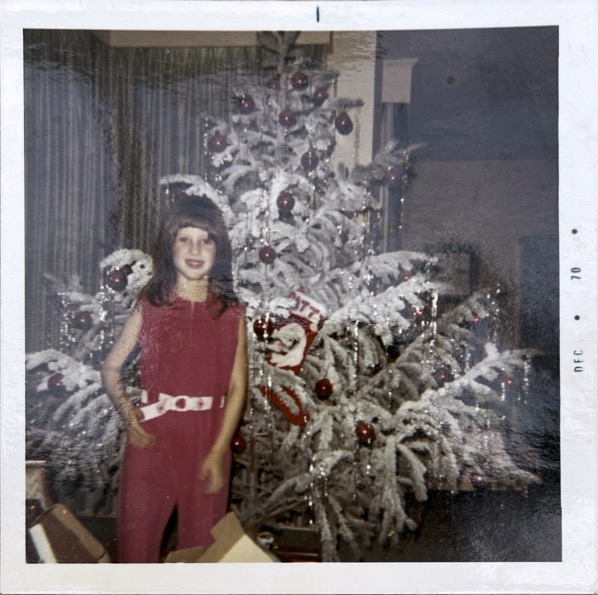
For as long as I can remember, the holiday season has too often brought with it a pervasive melancholy. When I was little — before going to live with my father at age six — Christmas could feel uncomfortable for me: as the only grandchild for a long time, all eyes were on me, wherever I celebrated. There are numerous photos of me in front of my grandparents’ white artificial tree, this last one when I am six years old, back in Texas for Christmas, two months after moving to Virginia.

Thereafter, Christmas becomes outright fraught. With my sister and brother and stepmother and father, the dynamics intensify. I am aware of being ‘the stranger’ in the celebrations, and I remember one particular photo of my stepmother cuddling my brother and sister on the sofa to one side, while I stand in front of the tree, my tightly clasped hands behind my back reflected in the mirror behind me. Just thinking about it breaks my grown-up heart.

I have been reading The Child Safeguarding Review Panel – I wanted them all to notice over the last couple of weeks. This UK report came out in November (2024), and focuses exclusively on Child Sexual Abuse within the family. It’s a depressing read in almost every way: what is missed, who isn’t believed and why, the devastating lack of resources for abused children and families, the over-reliance on ‘evidence’ and on the children themselves disclosing. However, a couple of aspects have struck me with force: first, that so often neglect is a hallmark of an abusive environment. If a child is not neglected, if a child is being cared for, watched out for — sexual abuse is much less likely to occur.

I was emotionally neglected throughout much of my childhood, and when I was living with my mother, physically neglected as well. Despite growing up in a firmly middle-class household, it’s clear that some basic needs weren’t met. This in turn contributed to making me vulnerable; I welcomed any attention I could get from my family, specifically my father. I now see that he groomed me by showing me attention, and then manipulated this into sexual abuse.

Pretence is another common denominator in abusive households. In my life, these layers of everything having to appear ‘fine’ and ‘happy’ seemed to triple at Christmas. We often went to family in Alabama, Florida, or Texas for a week over the holidays. The strain of having to appear ‘just fine’ cast a long shadow every year. The sheer irony of opening presents, having to ‘be a child’ amongst other children haunted me from the moment my father started abusing me. I wasn’t like other children — and I knew it. My childhood was irretrievable. I knew this too.

At Christmas, I often felt trapped. The family was forced into close proximity. I had no friends nearby, nowhere to go, nothing (except reading) to distract me. And I absolutely dreaded nighttimes. I was utterly terrified that my father would come into the room I was inevitably sharing with my siblings or with cousins — he’d done so before — and that then they would ‘find out’ what was happening.

The awful thing here is: I really felt it was my responsibility to keep up family appearances. It was my job to be careful, to make sure no one found out, because otherwise…..otherwise what? All these decades later the only answer I have is that if anyone found out they would simply hate me. Hate me for ruining their lives. Blame me for everything going ‘wrong’.

I am lucky now to have my own healthy family, my separate family traditions — which I created alongside my husband and children and extended family. I am lucky that I no longer feel in danger, or have to pretend for days at a time. I cannot and will not pretend about anything anymore.

So. Please remember that at this time of year there are children for whom Christmas is an ordeal. There are children who have to work extra hard to maintain the pretence, or who are afraid in their beds at night — doubly so, because there is nowhere else to go. Some children — like me — are happier at school, or at friends’ houses. For some children being with family is the last place they would choose to be.

Please remember too that as upsetting as it is to grasp: all of us — you, and you, and you — will know people who are perpetrating sexual abuse. At least 10% of the population is sexually abused before the age of 16. The vast majority of this abuse is perpetrated by family men. They do not appear to be ‘monsters’. They do not appear to be ‘sick’ or ‘unusual’. They make sure that they cultivate looking like a ‘normal’ family. Yet they commit abhorrent crimes. These are the facts.

Due to Gisele Pelicot’s courage, over 50 families (who no doubt consider themselves ‘normal’) must come face to face this Christmas with what lies beneath the surface of their ‘ordinary’ lives. It’s the tip of a huge iceberg, the excavation of which is long overdue. These families are not the exceptions — they are in fact now experiencing what is for large portions of society the hidden norm. Although the road ahead is long and distressing, I join with so many in hoping that this uncovering now has some momentum. Children — and victim survivor women and men — deserve a life free from shame and blame. Shame Must Change Sides.

our ribbons, our shoes

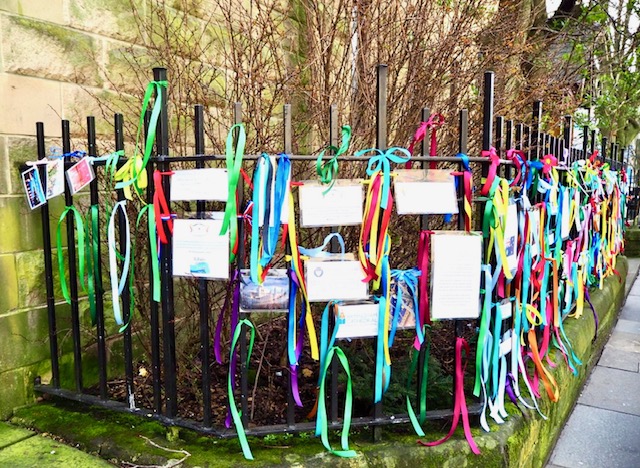
Last week I was in Newcastle (UK), where I helped do a LOUDfence on the railings of St Mary’s Cathedral. As ever, the act of tying ribbons — colourful, fluttering — releases something purposeful in me and I think in others. The tags which are attached by the ribbons recount grief, and loss, and sorrow, and in some — betrayal. They also speak of support, validation, and the determination to make a difference in every walk of life. To say loudly: we hear you, we believe you, we are so sorry. And we want this never to happen again.

A new and powerful symbol in LOUDfence is the introduction of empty shoes: children’s, priests’, religious sisters’, laity’s. They all represent people who aren’t there, who can’t be, and people whose shoes we need to walk in, to be with, and hold close. Abuse is a destructive force. It rips us from those we might love, and from the roads we might have walked.

LOUDfence is making a difference. It’s reaching beyond countries, and beyond regions. Beyond silence and silencing. Victim survivors from every walk of life can see themselves — can feel themselves held. Know that they are seen too, in some cases by the very people who did them harm.

Change comes through a gathering which reaches critical mass, a tipping over into the clear sense that we MUST enact cultural change. On all fronts.

I’m so proud to be part of this movement. Next stop: West Virginia USA in April.

***

Antonia Sobocki (founder of LOUDfence UK) asked me to write a poem for the Newcastle LOUDfence. Here it is. I am not usually one for writing to commission – I tend to freeze up! – but this time I had the gift of a pair of baby shoes I had found in my mother’s belongings after her death. Here are the shoes, and here is the poem.

(apologies for the poor quality reproduction here — the clumsiness of WordPress!)

blindsided

I have been feeling silenced.

It’s taken me 10 weeks to come here and say this. That’s how silenced I have felt.

What silences sexual abuse victim/survivors? What silences ME?

To somewhat answer this, I’d like to highlight this article. Absolutely none of it will be news to survivors who struggle with their families, particularly if the sexual abuse they suffered was perpetrated by a member of the family.

https://www.brainzmagazine.com/post/understanding-family-scapegoating-and-its-interplay-with-survivors-of-childhood-sexual-abuse

None of this is news, but none of this can be solved either.

I cannot say much more. I have written and erased this post several times. This is how silenced I feel, and how much I am checking myself, worrying about my words.

For weeks my husband, children, other family, and close friends have been my scaffolding. Alongside me and checking in every day. Thanks to them, and to the years of excellent therapy, the ‘top up’ therapy I’m doing now — I know I’m okay, and always will be.

I love my life. I won’t be dragged back into tangles of secrets and blame. There’s no reconciliation in that. In the words of glorious Fleetwood Mac: never going back again.

This is one of the recurring dreams I had during the abuse, and afterward during my initial therapy. I have felt very much like this over the last few weeks. Nothing to stand on, falling, exposed.

But I’m back on my feet now. For good.

from my memoir, Leaving Locust Avenue: